Today's Word Nerd Wednesday tackles a topic that has lit up the Internet in the last week or so: the so-called "news" that the word literally has a new definition, meaning figuratively, which is technically the opposite of what the term means.
Note that I put "news" in scare quotes. That's because it's not really news. Dictionaries have been adding that second definition for years. Literally. (Hah!) People noticed this time, because it was a new change to Google's dictionary.
I got my copy of the OED about ten years ago, and the alternate definition of literally is there. Granted, that definition is the last of five, meaning that it's the least common and least accepted one. Plus, it has a note that it's "improper" to use literally in a figurative sense.
HOWEVER . . . (You knew that was coming, right?) as with every word in the OED, this definition includes quotations from the earliest usages of literally with each definition. And guess what: the quotations for using literally meaning figuratively go way back to Dryden (hardly a hack) in 1687. You'll find quotations from the 1700s, 1800s, and 1900s, as well.
In other words, people have been using literally as figuratively for a very long time.
So now what? Should we all adopt that definition because it's in just about every dictionary? Not so fast.
First let's talk about what dictionaries actually do. Dictionaries don't record what is correct. Dictionaries report what is said and written. They're the non-judgmental messenger.
In other words, a word or a definition showing up in a dictionary doesn't give that word/definition any kind of stamp of approval. It may still be considered incorrect according to Standard English.
Plenty of words and definitions that aren't Standard English (or at least, not yet) appear in dictionaries, including ain't, which isn't in the ballpark of Standard English.
The bottom line is that language changes over time; that's a simple fact. Try reading Beowulf or The Canterbury Tales in their original text, and you'll see just how much English has changed over the centuries. (Hint: the text doesn't even look like English.)
For that matter, if we're stuck on what a word "really" means, let's look at the OED's first two definitions of literally: 1) By the letters 2) In literature.
So if we're going by the definition from the late 1500s, my English degree made me literally smart, where literally refers to literature. No one's crying foul that the meaning of the word has drastically changed since then. And that's fine.
For that matter, in the OED's entry for literally, today's most common definition ("in a literal sense") isn't listed until number four.
If this sort of thing interests you, here are two other posts that relate, where I've ranted about how English evolves and also how we need to know Standard English to be taken seriously in most educated situations.
I used Grammarly to grammar check this post, so I can spend the time I saved eating brownies, because seriously, they won't eat themselves.
Showing posts with label OED. Show all posts
Showing posts with label OED. Show all posts
Wednesday, August 21, 2013


Wednesday, October 03, 2012
WNW: The Influence of a Madman
If you've frequented my blog for any significant period, you know that I adore and rely on the Oxford English Dictionary (known as the OED). An entire blog label is devoted to my references to the beloved OED (including this post!). I turned to my most beloved dictionary a lot when writing my historical novels. (Was "cookie" used in the 1880s?) Many friends ask me to check the OED for similar reasons. (Among them, J. Scott Savage, author of The Fourth Nephite books, to be sure he's got the 1830s lingo right.)
And, of course, right here, Word Nerd Wednesday mentions the OED with relative frequency.
This post will have two parts:
(1) What is the OED anyway? (What makes it different from any other English dictionary out there?) (I've covered this briefly in past posts, but it's been a long while.) (Yes, I know that multiple sets of parentheses is atypical.)
and
(2) What does a madman have to do with the OED?
What Is the OED, Anyway?
In 1857, Professor James Murray began one of the most ambitious linguistic projects of all time. His goal: to create a dictionary that went beyond definitions to recording the first instance of each word used in print. His dictionary would show the change and evolution of the language.
Understandably, the project took years and years. An entry in the OED lists quotations from multiple sources, so you can see when a word was used, fell out of use, and came back. How the meaning has changed over time, and so on.
During my university days at Brigham Young University, I often walked past a copy in the library. It sat atop a waist-high bookcase, which the blue volumes covered in two full rows with somewhere around 30 volumes. (In that edition. It's longer now.) The OED is constantly being updated, as new words constantly enter the language (today more than ever).
My dad owns the shrunken-down version of the OED. It's only two volumes long, but each page has four complete, miniaturized pages. And no kidding, the set comes with a magnifying glass because even someone with 20/20 vision would go cross-eyed trying to read that puppy.
I own a CD version of the OED from about 10 years ago. I got it for my birthday one year and use it regularly.
What does a madman have to do with the OED?
While working on his dictionary, Professor Murray sent out calls for help in looking for early printed instances of specific words. This wasn't a one-man task. Even with help, completing the dictionary would take decades. And this was way more than a century before computers. Many people sent in slips of paper with quotes and sources.
But one man came to Murray's aid more than any other, somehow managing to find the time search for words hours on end, constantly, eventually submitting over ten thousand quotes, including many obscure words Murray wrote to him about, specifically assigning him to look for.
What Murray didn't know was why this man, Dr. W. C. Minor, had so much time on his hands: He was an inmate at an asylum for the criminally insane. A murderer.
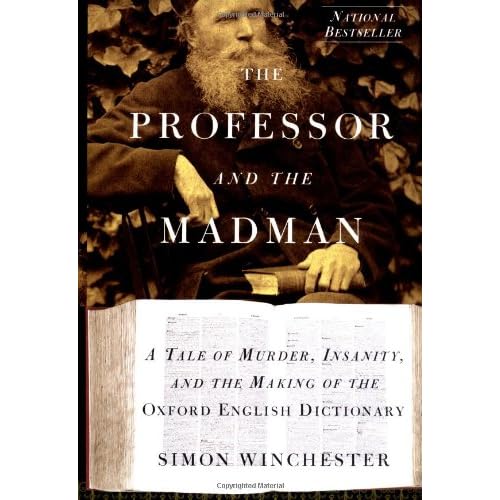
You can read the true story, which reads like a novel, in a book I love: The Professor and the Madman: A Tale of Murder, Insanity, and the Making of the Oxford English Dictionary, by Simon Winchester.
I read it years ago, marked it up, and still count it as one of the most fascinating non-fiction works I've ever read.
Oh, and if you're on Twitter, be sure to follow @OEDonline for fun word nerdiness throughout your day!
And, of course, right here, Word Nerd Wednesday mentions the OED with relative frequency.
This post will have two parts:
(1) What is the OED anyway? (What makes it different from any other English dictionary out there?) (I've covered this briefly in past posts, but it's been a long while.) (Yes, I know that multiple sets of parentheses is atypical.)
and
(2) What does a madman have to do with the OED?
What Is the OED, Anyway?
In 1857, Professor James Murray began one of the most ambitious linguistic projects of all time. His goal: to create a dictionary that went beyond definitions to recording the first instance of each word used in print. His dictionary would show the change and evolution of the language.
Understandably, the project took years and years. An entry in the OED lists quotations from multiple sources, so you can see when a word was used, fell out of use, and came back. How the meaning has changed over time, and so on.
During my university days at Brigham Young University, I often walked past a copy in the library. It sat atop a waist-high bookcase, which the blue volumes covered in two full rows with somewhere around 30 volumes. (In that edition. It's longer now.) The OED is constantly being updated, as new words constantly enter the language (today more than ever).
My dad owns the shrunken-down version of the OED. It's only two volumes long, but each page has four complete, miniaturized pages. And no kidding, the set comes with a magnifying glass because even someone with 20/20 vision would go cross-eyed trying to read that puppy.
I own a CD version of the OED from about 10 years ago. I got it for my birthday one year and use it regularly.
What does a madman have to do with the OED?
While working on his dictionary, Professor Murray sent out calls for help in looking for early printed instances of specific words. This wasn't a one-man task. Even with help, completing the dictionary would take decades. And this was way more than a century before computers. Many people sent in slips of paper with quotes and sources.
But one man came to Murray's aid more than any other, somehow managing to find the time search for words hours on end, constantly, eventually submitting over ten thousand quotes, including many obscure words Murray wrote to him about, specifically assigning him to look for.
What Murray didn't know was why this man, Dr. W. C. Minor, had so much time on his hands: He was an inmate at an asylum for the criminally insane. A murderer.
You can read the true story, which reads like a novel, in a book I love: The Professor and the Madman: A Tale of Murder, Insanity, and the Making of the Oxford English Dictionary, by Simon Winchester.
I read it years ago, marked it up, and still count it as one of the most fascinating non-fiction works I've ever read.
Oh, and if you're on Twitter, be sure to follow @OEDonline for fun word nerdiness throughout your day!
Wednesday, May 19, 2010
WNW: When Dictionaries Get It Wrong
My good friend Meggen sent me a link to an article, knowing it was right up my nerdy alley.
You can go read it, but the gist is this: a physics professor from Australia noted that every English dictionary he could find (including . . . GASP!!! . . . the OED) had the wrong definition of the word siphon.
We all know the general idea of siphoning: a liquid moves from one place to another, such as siphoning gas from a car.
Here's the problem: English dictionaries (which are not edited by scientists) all state that the force that creates a siphon is "atmospheric pressure."
The professor knew that was wrong. The force that creates a siphon is gravity.
I quickly checked my own OED, and sure enough, there it was: "atmospheric pressure," the definition dating back to 1911, and, unluckily for all the rest of us non-scientific folks, that's the definition every English dictionary has used for over a century. (Siphon is defined incorrectly at Merriam-Webster onlineand Dictionary.com even now.)
The professor, Stephen Hughes, contacted the OED folks, who are in the process of doing a revision and update. They had reached the R section, so Hughes was just in time: they could fix siphon when they hit S.
I remember a similar moment in college when a professor of mine found a minor error in the OED. He beamed and talked about it as if he'd discovered uranium. You don't just find mistakes in the OED. They're pretty darn rare.
The nerd in me loves how this particular error has been perpetuated, undebated, for such a long period and in so many dictionaries.
Speaking of the OED, my random word of the day popped up as jeniver, an obscure synonym to juniper. Sure you wanted to know that.
(I'm such a nerd.)
Subscribe to:
Posts (Atom)
BOOKLOVER DEALS FOR PRIME DAY!
Amazon's famous Prime Day events are huge for so many reasons, and for bookworms, it's even better: books aren't high-ticket ite...

-
 The Original Scrapbox has a brand new piece of organizing furniture and you have a chance to win it! Introducing the Office Box... And we...
 -
 Yay! From today, November 17, through Sunday, November 27th, I'm part of the Gratitude Giveaway Hop! It's a chance for me to say th...
 -
As part of the celebration for the release of my book Tower of Strength, I'm doing a giveaway that will last through Saturday, with win...
