Showing posts with label Word Nerd Wednesday. Show all posts

Wednesday, July 30, 2014

WNW: Pioneer Day Edition

Hooray for Word Nerd Wednesday! It’s back this week, and as I debated what topic to cover, I remembered that last week, Utahns celebrated a somewhat Mormon holiday: Pioneer Day.

It’s marks the day when the first Mormon pioneers first entered the Salt Lake Valley back in 1847. 

Except that we tend to gloss over the fact that the first pioneers actually arrived two days earlier, and that the 24th is when Brigham Young first showed up. By then, men were already plowing fields and building shelters.

The 24th was the day that Brigham, who was very ill, was driven in a wagon. It was backed up to the valley so he could raise himself up on his elbow. He’d seen the valley in a vision, so when he looked out, he confirmed, “This is the right place. Drive on.”

The real story is a bit contrary to the image we tend to have of him standing there, pounding his walking stick into the ground and declaring (as the park is named), “This is the place.” 

(Adding the word right sort of messes with the rhythm of the phrase anyway, right?) 

(And the fact that dozens of people were already there, making it their home, sort of showed that they knew they’d arrived in the right place, but still…)

Hey, he was their leader, so he got to pick the date for the holiday.

On Pioneer Day, Salt Lake City puts on a huge parade, but few people get off work (my husband is one of the lucky ones). In honor of the day (I’m not quite a week late; give me a break), I thought I’d list some words and phrases for WNW that tend to be Mormon-isms and, to a lesser extent, Utah-isms.

My fellow Utah and/or Mormon readers (and friends of Utahns and Mormons) are welcome to add more to the comments!

Deseret
You’ll find this word all over Utah, particularly in names of businesses, and you’ll find it in the history books. Where you won’t find it is in the dictionary. (I checked my favorite, the Oxford English Dictionary, as well as Dictionary.com and Merriam Webster.) The word comes from The Book of Mormon and refers to honeybees. Utah was also original called Deseret, and the term is sometimes found in poems and hymns to refer to the Church as a group. More on that below.

Beehive
Another word you’ll find all over Utah, which is fitting, as Utah is known as The Beehive State. The Beehive emblem is found on all state highway signs and elsewhere. Early pioneers viewed the honeybee as an industrious, never-lazy worker laboring for the benefit of the hive. In pioneer terms, that meant a person working tirelessly for the community. The Mormon pioneers viewed the honeybee as an example of what they should strive to be like. You start to see why Utah was first named after the honeybee.

But there’s more. Youth programs in the Church are split by gender, and the boys and girls are further split into three groups by age. The youngest group for girls, ages twelve and thirteen, are called (yep) Beehives. I think meaning of the name (and hence the message to strive to work hard for the common good) is a bit lost on today’s generation. But then, the types of goals 21st century girls are expected to reach are totally different from the girls who lived in the late 1800s: they no longer have milk cows or plow fields to earn their medallion.

Mia Maid
This term doesn’t even make sense outside the Church. The closest thing you can find in a dictionary is the acronym for Missing in Action, which is not what this means. It’s the name for the fourteen- and fifteen-year-old young women class.

If I understand correctly, the first part of term, used to be in all caps: MIA Maid. This is because it was an acronym. MIA stood for Mutual Improvement Association, what the youth programs were called collectively. When young men and young women had activities and cultural events together, which was at least weekly, they said they were going to MIA or simply to mutual.

Today, some people still refer to the weekday youth activities as mutual, but I’m betting most of today’s youth have no idea why.

Laurel
Moving up to the oldest group of young women, ages sixteen and seventeen. (At eighteen, or a bit later, typically after high school graduation, young women start attending Relief Society, the women’s organization.)

Of course, the laurel plant was commonly used long ago to create a crown or wreath with which to honor a victor of a competition. (Think the little guy on the Little Caesar’s box.) I think the idea here is for young women to strive to be the best they can be, to earn that laurel wreath. And again, of course, modern girls don’t always know what the term means, and they have very different goals that mark what it means to be an accomplished young woman.

Today, a young woman heading off to college on scholarship may be considered to be accomplished, when that term might have once meant someone who can darn a mean sock.

Dixie
This one is specific to Utah. Outside the state, Dixie refers to the southern states of the U.S., the ones involved in the U.S. Civil War. And that’s actually where the name came from.

After being driven out of their homes, with family members killed, and otherwise being persecuted, the Mormons in Utah wanted to separate themselves from other groups and be as self-sufficient as possible. When the Civil War broke out, they needed an alternate source of cotton. Brigham Young sent scouts south to see if growing cotton might be viable down there. It was. (The area was also a miserable place to live. Some early settlers quipped that the devil himself would be quite comfortable there.) And thus the hot, sunny area was named Utah’s Dixie. There’s even a Dixie State College in the area.


I could go on and on, but I’ll end with a phrase that has become so common in prayer that it rolls right off the tongue and therefore has become a bit of a joke: the request when saying grace at a meal to bless the food to “nourish and strengthen our bodies.” Some people then add, “and do us the good that we need.”

This prayer is often uttered right before teens at mutual snarf down cookies or donuts.

Therefore, I’ve enjoyed the twist The Cultural Hall podcast (er, show—right, Richie?) has put on it, something you’ll hear at the end of many episodes: “Please bless the sugar out of this crap.”


If this kind of thing interests you, check out THIS WORD NERD WEDNESDAY POST as well as THIS ONE, in which we look more deeply at Mormon words and phrases.

And be sure to check out the WNW post about how Utahns (and, frankly, a lot of people) pronounce mountain, and this other one about another Utah quirk: pronouncing a short E sound (as in well) when the vowel is technically a long A followed by the letter L (as in whale, which often sounds like well in Utah).

And for even more word nerdiness, be sure to subscribe to the GUMshoes podcast on iTunes. I co-host with Luisa Perkins, where we delve into what we call GUM issues: ones involving GRAMMAR, USAGE, and MECHANICS.

Live today: An episode all about how Seinfeld has influenced the vernacular! This episode is SO MUCH FUN, people!


Wednesday, February 26, 2014

WNW: Grammar Girl's Quick & Dirty Tips Book Review

As long-time readers know, this isn't a review blog. The only reviews I post are about books I have handpicked, and they're usually nonfiction titles I want to pass along to fellow readers and writers. I think the last book I reviewed was Mignon Fogarty's 101 Words Every High School Graduate Needs to Know.

Truth be told, shortly after that post, I meant to post a second review of another book by Fogarty (also known as Grammar Girl, from the podcast of the same name), but after reading the other book, I promptly misplaced it in one of those cases of "I'll keep it in a very safe place so I won't lose it" and, of course, I promptly forgot the safe place.

I didn't want to post a review without having the book beside me because, as I do with so many reference books, I wrote in the margins and wanted to be able to refer to my notes.

For this week's Word Nerd Wednesday, the first bit of good news is that the book is found and at my side! Hooray! Now we can discuss Grammar Girls' Quick and Dirty Tips for Better Writing.


The second piece of news is that I had a great time rereading my notes and then going over the passages they refer to, and I found the book as delightful as I did when I first read it a few years ago. I found stars, underlined passages, and smiley faces all over the place.

Best of all, the author and I share many of the same stylistic peeves, which made me like her even more. Seriously, I couldn't stop grinning over to try and versus to try to on page 45, something I rant talk about on page 90 of my own grammar book. Beside her discussion of another of my peeves, the weak there is/are way of beginning a sentence, on page 81, I'd written, "Yay!"

Grammar Girl is known for her conversational, accessible style, and this book is no exception. It's laid out in an easy-to-read format, with clear headers and fun examples, as well as text boxes with background and other additional information, often fun trivia related to language. (Yes, fun and language can exist in the same sentence.)

The book goes over many common problems in writing, from grammar to punctuation to style issues. She even discusses why the rule of two spaces after a period has changed in the computer era (page 85). (See this post for my explanation, which agrees entirely with her.)

The final chapter is short, and while it won't be one you turn to regularly to remember a rule, it's helpful for writers of all kinds. It talks about breaking through blocks, finding writing groups, revising, proofreading, and more.

At the end of the book, you'll find appendices with lists of commonly confused words and other great references.

I can't cover all of the great parts of a book with more than 200 pages, but here are a few highlights I particularly enjoyed:
  • Squinty modifiers. (Page 65.) Great name for an easy error to make with modifiers, with a clear explanation and a great example.
  • The semicolon splicer image to help remember how to use the mark (page 75).
  • Properly punctuating indirect questions. (Page 89.) I've seen this issue a lot in my editing work, and agree with Fogarty so entirely that in that margin, I wrote "For the love!" because people need to learn this!
  • How to properly use a colon. (Pages 92 to 96.) A much-needed explanation.
  • The Oxford comma. (She favors it! Woohoo!) 
  • The title of chapter six: "Prozac for Pronouns: Getting the Stuntmen of Language Under Control." (Page 139.) LOVE IT.
And this gem on page 96: "Using a hyphen in place of a dash can cause your copy editor to have a mild fit."

Amen and amen.

The book is a quick read, and it's one you'll want to keep on hand as a reference for a long time. 

My only complaint is tiny: A few things have changed since the book's publication in 2008, such as how long Facebook status updates can be. Like I said, very small things. Considering how fast technology changes, I'm impressed how on top of technology she is, and that I noted only a couple of spots where things are different in 2014. 

Get a copy for yourself and another for the writer in your life. (Hint: That's everyone in today's society. We all need to know how to write clearly.) Here's the link again to make it really easy for you. And if you haven't gotten my book, here's that link too.


SOME BIG NEWS IS COMING SOON!
Stay tuned for the announcement of two projects I'm working on with Luisa Perkins. We'll roll out the first one in a few weeks, and the second one a few weeks after that. 

You won't want to miss out on them! 


UPDATE
Coincidentally, right now, Mignon Fogarty (Grammar Girl) is raising money to fund an awesome card game called Peeve Wars. I've chipped in; I hope you will too. The campaign has just 10 days left to reach its goal. Learn more about Peeve Wars and donation rewards HERE. If you have personal grammar and usage peeves (and you know you do), you'll want this game.

Wednesday, November 27, 2013

WNW—Sandy Hook and the "They" Conspiracy

Today's Word Nerd Wednesday has a more somber topic than I usually take here, but I think it's a relevant one in light of how news is covered in the US and how we interpret evidence presented to us by various sources.

This post has been on my mind for almost a year, when I first heard conspiracy theories after the Sandy Hook shooting in December 2012. With the report of the shooting released this week, concluding that Adam Lanza acted alone, and with almost a full year passing since the tragic events of that day, I'm taking a stab at the issue the conspiracy theorists brought up in hope of shedding some light on the situation and, I hope, on not jumping to conclusions in relation to the language used in news reports and other situations.


Shortly after the shooting, I listened to several tapes online where people discussed how, in their strong opinions, there had to have been multiple gunmen in Sandy Hook, and that the federal government was hiding that fact.

One video went so far as to insist that President Obama himself had ordered the shootings so he could have a leg up in passing new gun control laws. My jaw dropped at that accusation. Obama isn't perfect, and he's made mistakes as President, but would he seriously order the murder of children for a crap-shoot chance for passing a new law? Is he really evil, a mass murderer? Not a chance.

Over and over, I came across one piece of so-called "evidence" that these theorists used to "prove" that there was more than one gunman. I won't link to the videos; I don't want to give those people extra attention. The point of this post is to show how relying on language used by victims in the heat of a crisis cannot be psycho-analyzed as a reliable way to justify a personal agenda.

The "Evidence"
In more than one spot on a tape (I believe it was a 9-1-1 call), the person on the phone, an eye witness in the school, used phrases such as these (not quotes, but they give the general idea):
They're coming down the hall!
They're shooting!
They've got more than one gun!
Conspiracy theorists based their conclusions, in large part, on the fact that the witness had used the word they while relating ongoing events during the shooting, that a single pronoun somehow proved that more than one person was carrying out the attack.

Let's back up the trolley a bit.

Almost three years ago, I blogged about how their is gradually becoming a singular pronoun. In English, we simply don't have a gender-neutral third-person, singular pronoun. We have he and we have she, and I suppose we also have it, but we don't use it when referring to people.

Often, when we don't know the gender of the person, or when the gender is irrelevant, we have to get creative, and that often means falling to the easiest way to explain with the fewest words.

In publications, we often see constructions such as he or she, or sentences rewritten so they have a plural verb and can justify the plural pronoun their. That happens mostly in scholarly publications in academia, student's college papers, and, probably, in any resume you submit.

In everyday, casual speech, we often use their as a single pronoun. 

Why? For several reasons. For one, using he or she gets cumbersome and often sounds hoity-toity. In addition, we tend to go the simplest route when speaking; why use three words when one will do? The English-language culture has shifted. Today, their is largely accepted in conversation as just fine when it's acting as a single pronoun; you won't generally find it in most published works, although that's changing in fiction, especially in dialog, which tends to mirror actual conversation.

The reality is, when someone is under duress, and isn't an English professor who is so used to using he or she that the phrase rolls off the tongue without a thought, even in a moment of crisis, a witness will almost certainly use they when referring to an unknown perpetrator.

Heightened emotion does that to people: while under stress; we slip into the registers of speaking we're most comfortable in. We're far less likely to adhere to grammatical standards, especially ones we aren't 100% familiar with. Even if you know the difference between the verbs to lay and to lie and which forms to use when, but you have to think about which form to use even for a split second, chances are, if your life is on the line, you won't give the verb that split second of thought, and a word will pop out, which may well be technically incorrect.

In other words, even if witnesses could tell that the shooter was male, we can predict, even without hearing any 9-1-1 tape, that witnesses would describe the shooter's action in terms of they, and not as he.

Granted, I doubt the new report will sway die-hard conspiracy theorists, even though they are just as likely to unconsciously throw in they when speaking, even when technically he or she would be correct.

I hope that the report of a lone gunman helps give a little bit of closure to the families affected by the horrific events of that day.

For the rest of us, I hope that by talking about these things, we gain some clarity. Like how people use casual and "incorrect" words in conversation and especially in life-or-death situations. Like how they're liable to use incorrect grammar or slip into more colloquial usage in tense moments. How we cannot use such speech as a basis for making broad accusations or assumptions, especially when such theories cannot hold water in light of how the language is used in the real world.

As much as I hope we never have another shooting or other similar tragedy in this country, I'm not naive enough to think we've seen the end. But I do hope that whenever we hear a tragic news story and people coming up with theories about them, we can take a step back and look at the fact objectively, not over-analyzing a single word and assuming what the person speaking meant by it. Especially, as in this case, when that single word was interpreted so wildly off base.

I'm all for unraveling stories to reveal the truth, and language does have the power to do amazing things along those lines. This isn't one of those times. Saying that the use of their automatically means there had have been multiple people committing this crime only causes grief, quite literally, to so many people involved, including the law-enforcement officers who, I believe, really did do their best to find out what happened.

Wednesday, October 16, 2013

WNW: Abbreviations, Acronyms, Initialisms, & Monograms

Weeks (months?) ago, I pasted a note from Twitter to remind myself to do this post. I'm pretty sure the suggestion came from TJ Bronley, and here I am, finally getting around to answering his request.

For this week's Word Nerd Wednesday: What is the difference between acronyms, monograms, and abbreviations?

(I'm adding initialisms to the list; you'll see why.)

First off, let's look at what an abbreviation is.

An abbreviation is simply a shortening of a word or phrase using components of that word or phrase. Some abbreviations use a period at the end, but not all require one.

Examples of abbreviations:
  • Quart = qt
  • Minute = min
  • Doctor = Dr.
  • Mister = Mr.
  • Et cetera = etc.
  • International Police = Interpol*
  • AM, PM
  • BC, AD

The last two on that list are so common that we've almost forgotten what they stand for (ante meridiem/post meridiem, meaning before and after noon, and Before Christ/Anno Domini, meaning in the year of our Lord).


Here are some modern abbreviations that developed from e-mail and texting. (This list could go on forever, but I'll keep it short.)
  • FWIW (For what it's worth)
  • IMO (In my opinion)
  • LOL (Laughing out loud) 
We use abbreviations for all kinds of things, including the United States (the US) and the group of countries that comprise the United Kingdom (the UK). 

Acronyms are a type of abbreviation. They typically use the initial letters of a phrase or name and (here's the important part) acronyms can be pronounced as a word. Some acronyms are spelled out as all caps. Others use periods between the letters, and some are entirely lowercase. Check your style guide to know how to write one out. Examples of acronyms:
  • NASA (National Aeronautics and Space Administration)
  • laser (light amplification by stimulated emission of radiation)
  • AIDS (autoimmune-deficiency syndrome)
  • scuba (self-contained underwater breathing apparatus)
  • CD-ROM (compact disc read-only memory)
That last one mixes things up a bit, as only the second part (ROM) is pronounced as a word. We still say the letters separately on CD, of course.

Initialisms are similar to acronyms. They're also a type of abbreviation. Like acronyms, they use the first letters, but the big difference is that initialisms aren't pronounced as words. 

Many initialisms are abbreviations for organizations, such as television stations, government entities, or universities. Examples of initialisms:
  • FBI
  • CIA
  • NBC
  • FCC
  • BYU 
Tip: If you don't say it like a word, it's just a regular abbreviation or an initialism, not an acronym.


RAS Syndrome
This is a silly name for something that crops up a lot because of how often we use abbreviations. RAS is an abbreviation of Redundant Acronym Syndrome. Say the full name (with syndrome at the end), and we've got a repetitive phrase with RAS Syndrome in action: Redundant Acronym Syndrome Syndrome.

Silly, yes, but this kind of thing really does show up all the time. I bet you've heard people talk about a PIN Number, when the N in PIN already means number, so they're saying, Personal Identification Number Number. 

Or what about a screen's LCD display? We don't need that last word, because then we're saying liquid crystal display display.

Monograms are another animal altogether. Unlike the other terms we've talked about, they aren't a type of abbreviation. Instead, monograms are symbols or logos with one or more letters made into a single image. Monograms were often used as symbols of a monarch. Today we see them a lot in corporate and school logos. They aren't words at all, just images that tell the viewer instantly who or what it stands for.

An example: For many years during her talk-show period, Oprah used a big O with a specific font to symbolize her name and brand. We still see it prominently on her magazine today.

There you have it! If you have suggestions for future Word Nerd Wednesdays, drop me a line on Twitter. You can find me here: @AnnetteLyon.


*I believe InterPol technically has a longer name, but I'm not doing the research on that one today. 

Wednesday, August 21, 2013

WNW: The Outrage over "Literally"

Today's Word Nerd Wednesday tackles a topic that has lit up the Internet in the last week or so: the so-called "news" that the word literally has a new definition, meaning figuratively, which is technically the opposite of what the term means.

Note that I put "news" in scare quotes. That's because it's not really news. Dictionaries have been adding that second definition for years. Literally. (Hah!) People noticed this time, because it was a new change to Google's dictionary.

I got my copy of the OED about ten years ago, and the alternate definition of literally is there. Granted, that definition is the last of five, meaning that it's the least common and least accepted one. Plus, it has a note that it's "improper" to use literally in a figurative sense.

HOWEVER . . . (You knew that was coming, right?) as with every word in the OED, this definition includes quotations from the earliest usages of literally with each definition. And guess what: the quotations for using literally meaning  figuratively go way back to Dryden (hardly a hack) in 1687. You'll find quotations from the 1700s, 1800s, and 1900s, as well.

In other words, people have been using literally as figuratively for a very long time.

So now what? Should we all adopt that definition because it's in just about every dictionary? Not so fast.

First let's talk about what dictionaries actually do. Dictionaries don't record what is correct. Dictionaries report what is said and written. They're the non-judgmental messenger.

In other words, a word or a definition showing up in a dictionary doesn't give that word/definition any kind of stamp of approval. It may still be considered incorrect according to Standard English.

Plenty of words and definitions that aren't Standard English (or at least, not yet) appear in dictionaries, including ain't, which isn't in the ballpark of Standard English.

The bottom line is that language changes over time; that's a simple fact. Try reading Beowulf or The Canterbury Tales in their original text, and you'll see just how much English has changed over the centuries. (Hint: the text doesn't even look like English.)

For that matter, if we're stuck on what a word "really" means, let's look at the OED's first two definitions of literally: 1) By the letters 2) In literature.

So if we're going by the definition from the late 1500s, my English degree made me literally smart, where literally refers to literature. No one's crying foul that the meaning of the word has drastically changed since then. And that's fine.

For that matter, in the OED's entry for literally, today's most common definition ("in a literal sense") isn't listed until number four.

If this sort of thing interests you, here are two other posts that relate, where I've ranted about how English evolves and also how we need to know Standard English to be taken seriously in most educated situations.


I used Grammarly to grammar check this post, so I can spend the time I saved eating brownies, because seriously, they won't eat themselves. 

Wednesday, June 12, 2013

WNW: Please Trash?

Last winter, our family took a trip to the Happiest Place on Earth. Because I'm a nerd and can't entirely shut off my editor brain even on vacation, I couldn't help but notice a recurring grammatical problem on the trash cans in Disneyland and California Adventure.

While I took plenty of pictures of the kids, I found myself snapping pictures of trash cans and other things that made me laugh. Soon my husband was in on it too. (My sickness appears to be contagious.)

Let's take a look.

The folks designing the cans for recyclables did an okay job. Note this can, with the polite request to recycle:


We could argue that they could have added a comma between the two words, making it RECYCLE, PLEASE, but at least the request makes sense.

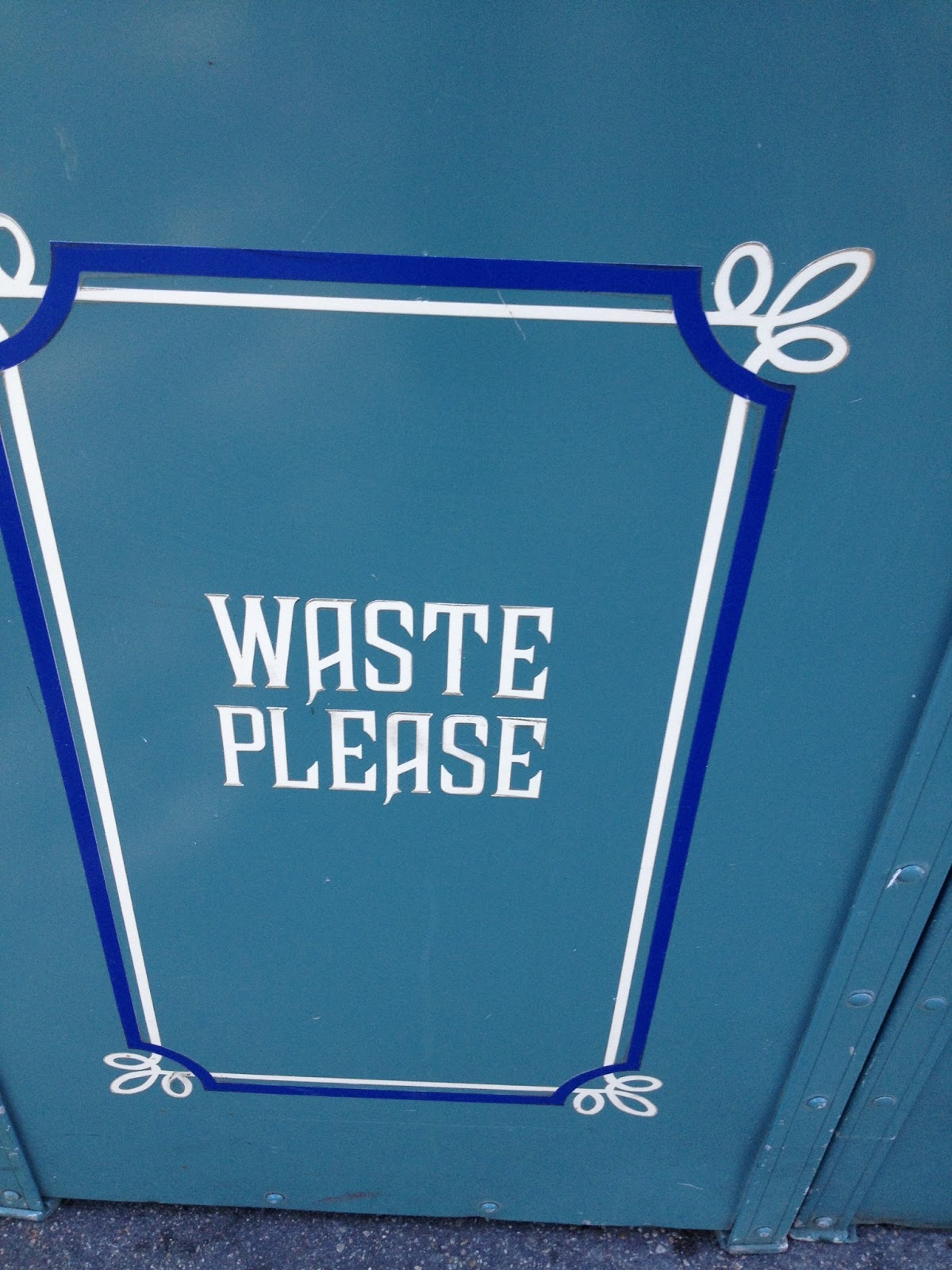
The receptacle standing right next to this one, however, uses the same type of phrase, including please, but they ended up with an unintentional humorous meaning:


Now obviously they don't want park goers to throw things around and otherwise waste stuff. No, what they're asking is for people to put their waste in the can. But that's not necessarily what the can says. Because waste can be both a verb (don't waste your money) and a noun (garbage = waste), the two-word phrase could mean either, "Please put your waste here," or, "Please do waste the park." 

The problem was compounded by the fact that its twin, the RECYCLE PLEASE can, used a verb first, making it all too easy to assume that the other can also has a verb in its almost-matching phrase. Look at the cans side by side, and you'll see what I mean.


Jiminy Cricket wasn't the only one with the problem. We found the very same issue in Frontier Land.


It became a chronic problem everywhere we went day . . .


and night. 

Interestingly, at least one time, Jiminy and company found a way to make the request in a full sentence (minus the period). They totally should have done this elsewhere:


Monsters, Inc. added only into the mix, but that didn't help; the resulting phrase could have meant "Do nothing but waste," as well as "Put nothing but waste here."


Here's a case where they changed up the phrase on one can. They kept the request structure, but here (hooray!), the actual request is clear: KEEP IT CLEAN.


After seeing so many problems on trash cans, I thought that maybe the problem was solely in the rubbish division. But then I spotted this door at the Muppet theater, and I shook my head, sure someone had messed up again. Didn't they know that if something or someone is alarmed, it can mean more than one thing?


But I should have trusted that the Muppets knew what they were doing. I walked closer and noted the smaller text in the the brown rectangle:


Oh, yes! Woohoo! The person who made this sign is smart, knows their grammar, and has a killer sense of humor.

After a great trip, we flew home. But as we rode the airport shuttle to the parking lot, it happened again; I laughed at another sign. This one seemed to be an attempt to sound official, but it sounded rather silly.

In English, we often create objects by adding ee to the end of a word. For example, I've heard a tutor call the person they teach a tutee. Not a real word, but we know what it means: the recipient of the tutoring.

So what in the heck is a standee?


As is often the case in public typos, this is probably a case of over thinking it. The sign-maker people could have used the exact same number of letters by simply stating: NO STANDING.

And for the fun of it, as proof that we did Disney, here's a family photo of Splash Mountain, wherein we're inwardly freaking out but purposely looking bored.


Wednesday, April 10, 2013

WNW: An Excellent Issue. Single & Double Plurals.


I was first introduced to Mignon Fogerty (Grammar Girl) because of this grammar issue. She appeared on  Oprah to settle a viewer's complaint. (If you don't listen to the Grammar Girl podcast, subscribe already!)

Oprah and her best friend, Gayle, had gone on a road trip across the United States, and camera crews followed them. The result was several episodes of something they called "Oprah and Gayle's Road Trip."

A viewer wrote in saying that the title was incorrect; Oprah's name also needed a possessive, like so: "Oprah's and Gayle's Road Trip." She ended her note by saying she was an English teacher and therefore knew this stuff.

The viewer was brought on to tell her side, and then Oprah brought on Mignon to reveal the truth. Did the show get it right or wrong?

The show, not surprisingly, got it right. I doubt Oprah would have embarrassed her staff by bringing on a grammar expert to publicly point out a mistake.

But why was the title correct? Is there a time where making both names possessive would be correct?

First, yes, there are times when making both names possessive is correct. And there are times when it's not. It all depends on whether the ownership is joint or separate.

Let's set Oprah and Gayle aside and look at another example. Either of these sentences could be correct:
Jane and Sally’s bikes are in the garage.
Jane’s and Sally’s bikes are in the garage.

Which you choose depends on context. We need more information about the bikes before we can make the call.

If Jane and Sally have a sporting goods store they own together, and in it, they have several bikes, then we have joint possession, and we need only one apostrophe. In that case, the first example is correct, because Jane and Sally are acting as a group of ownership. Together, they own the bikes. So:
Jane and Sally’s bikes are in the garage.

But if Jane and Sally simply own different bikes (Jane’s is purple, and Sally’s is blue), we’re dealing with separate possession, so each girl needs her own apostrophe to show her ownership of her bike.
Jane’s and Sally’s bikes are in the garage.

Another example: Let’s take Tom and Joey, who are brothers. Let's talk about their parents. Because the parents belong jointly to both boys, we don’t need to make both of their names possessive. We use a single possessive to show joint ownership:
Tom and Joey’s parents go on dates every weekend.

But what if Tom and Joey are buddies rather than brothers? What if both sets of their parents happen to be friends who hang out in a larger group together on weekends? Then the whole situation changes. Now we’re talking about Tom’s parents, and we’re also talking about Joey’s parents: four different people, not two. Now we need to make both boys' names possessive.
Tom’s and Joey’s parents go to the movies every weekend.

One way to remember this is by substituting the noun (bikes, parents) for an opinion. If two people share the same opinion, then group their names together as a joint possessive:
        Tom and Joey’s political views sparked controversy.


If Tom and Joey don’t agree on politics—let’s say Tom is a Democrat and Joey is a Republican—then both names need an apostrophe, because we have separate views:
        Tom’s and Joey’s political arguments sparked controversy at school.

Or you can always remember the Oprah viewer who was wrong. Oprah and Gayle took their trip together. It was their joint trip. Therefore, the title of those episodes needed only one apostrophe. If they’d gone on separate trips, we’d need two.


If you're from my generation, you can just think of a favorite movie to get this one right. Bill and Ted had a shared adventure. Therefore, their movie is Bill and Ted's Excellent Adventure.


This topic and many more are new to the second edition of my grammar book. It's got more than double the word count of the original, with tons of new entries and many expanded ones to address more commonly asked questions I get. We're putting the final touches on it now.

Watch for it in May!

Wednesday, March 06, 2013

WNW: Hypercorrection

On our last Word Nerd Wednesday, we talked about how Utahns say mountain and how some people over overboard in trying to be "right" (note the sneer quotes) by pronouncing the T. When my friend Jordan McCollum, who is as big a word nerd as I am (only more qualified, because she's got a degree in linguistics), commented in that post about hypercorrection, I knew I wanted her to elaborate on the topic and share it with my readers.

Don't know what hypercorrection is? Don't think you're guilty of it? Maybe, maybe not. It's worth knowing about. Read on!


Hypercorrection: If talking like this is wrong, I don't want to be right 
Guest post by Jordan McCollum 

Have you ever drifted out of your lane while driving? I know I have. The natural tendency is to quickly correct your course by pulling the wheel back the opposite way. But sometimes, a drifting driver jerks the wheel back in the right direction too much. The over-correction succeeds, but the vehicle shoots into the wrong lane or the car rolls.

The same thing happens in language. (Okay, with fewer fatalities.) Most people want to speak "correctly." But did you know there might be such a thing as "too right"? I'm sure we've all had an English teacher or other "friend" who corrects casual speech with prescriptivist usage and pronunciation.

Fortunately, sometimes, those friends are so right, they're wrong. (But not dead. Whew!)

Hypercorrection

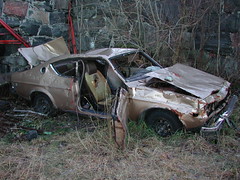
Hypercorrection is the linguistic term for being "too right." Usually, hypercorrection comes about because the speaker knows the "rules" of the language, in pronunciation, usage, or grammar, but applies them in more situations than they should (hence clip at right).

Hypercorrection is a very common phenomenon. In fact, it's part of learning a language, too. If you've ever heard a small child suddenly start saying "goed" instead of "went," it's a form of hypercorrection. They're learning that you form the past tense by adding the -ed sound, and applying it in situations where you actually don't follow that rule.

Hypercorrection in pronunciation

A couple weeks ago, Annette blogged about how people pronounce "mountain." People see the T and believe that they pronounce it like you'd say a T in isolation, or at the beginning of a word. However, the American pronunciation of "mountain" uses a glottal stop instead of a "tuh" (and those are just two of the six ways T is pronounced in English words!).

Mountain isn't the only word that uses a glottal stop for a T. Most speakers of American English, in natural speech, will pronounce the first T in important as a glottal stop. (It shows up all over the place in lots of other varieties of English too, so no knocking on Americans.)

However, some American English speakers see the "T" and think the "correct" pronunciation must feature a hard "tuh" sound like you'd hear from a T at the beginning of a word (or in British English). But T is virtually never pronounced as "tuh" in the middle of a word in American English—we rely on four of the other "allophones" of T in the middle of words, and the glottal stop is just as valid a rendition of T as the "tuh."  So when you stick a "tuh" in the middle of "important," you start to sound a little . . . well, self-importuhant.

Phonologically speaking, this pronunciation is unnatural in all varieties of English (because in British English there's no 'r' there).

Another great example of hypercorrection is found in this clip from My Fair Lady, where Professor Higgins is trying to teach Eliza Doolittle to stop her dropping her H's at the beginning of words:


The "hever" is exactly the same principle—applying a correct rule (add an 'h' to the beginning of words that you pronounce as starting with a vowel) to an incorrect situation (a word that really does start with a vowel). Funnily enough, this same principle has changed the pronunciation of the name of the letter "h" in some varieties of English to "haitch." This is also influenced by the perception of h-dropping accents like Cockney as lower in prestige.

Another place I see this is when actors who speak a variety of British English get an American role. In many accents of British English, an R at the end of the syllable isn't pronounced, but in most varieties of American English, it is. So sometimes an actorrr tries a little too harrrd to stick those R's in therrre, verging on another popular dialect, Pirate English. Yarrr. (But yay for trying!)


Hypercorrection in grammar

The same principle applies to grammar (maybe even more so). For example, most speakers of English are taught from a young age that you shouldn't say "me" in subject position: Never "me and you went to the store." (Don't you just cringe?!) Always "You and I gave her the gift." But when we move the "me" into another position in a sentence, things get a little trickier: "She gave the gift back to you and I."

If you're not cringing again, here's a hint: it's "me" there. She gave the gift back to me / She gave the gift back to you and me. (Or if you're really having trouble, "She gave the gift back to us"!)

Eventually, some people try so hard to speak "correctly" that they end up talking like this:
For our one year anniversary, my girlfriend caused myself to go to a Yankees game, with whomever amongst our friends can go. But, the Weather Channel just changed their forecast and the skies are grey, so we might go with the girl that lives next door to see the movie, "Iron Man 2".
I—just—I—oh, where to begin?

We all want to talk correctly. But keep in mind that hypercorrection isn't "extra right." It's actually wrong.

What do you think? What are your favorite examples of hypercorrection? How do you see good grammar principles go bad?

Photo credits: wrecked car—Niels Heidenreich; pirate—Kate Haskell


An award-winning author, Jordan McCollum blogs about writing craft and the writing life at JordanMcCollum.com. She holds a degree in American Studies and Linguistics from Brigham Young University and now makes her home in Utah with her husband and three children. Catch up with her writing links, word nerdiness and crazy life on Twitter, @JordanMcCollum.


Wednesday, February 06, 2013

WNW: Utahns and "Mountain"

Today we have another edition of Word Nerd Wednesday inspired by where I live: Utah.

That, and the idea of judging people based on their accents. But we'll get to that part in a minute.

Many people love poking fun at the Utah accent, as if it's somehow inferior and unique to their own speech. I did a post some time ago about how, in words with a long A followed by an L, the A is often changed into a short E, so sale sounds like sell, and whale sounds like well.

I had a lot of readers telling me that this was a only Utah thing. (Actually, it's not. It happens in a lot of places. But I digress.)

As I've mentioned here before, everyone has an accent (yes, you, too). Standard English pronunciation doesn't exist in nature. Actors often work at developing what we think is "correct" American English. And they work hard at it.

Another interesting tidbit is that national news stations, for some reason I don't know, have a lot of big-name anchors who hail from the Midwest, so many Americans hear that accent and view it as the standard. This is why people from Ohio and thereabouts often swear that they have no accent! (But oh, they do. They do!)

I recently found this report on a study done at Brigham Young University, not surprisingly, addressing a common pronunciation seen here in Utah: the mysterious dropping of the T in words like mountain and the city name Layton.

It's become such a joke that I regularly see newscasters going overboard in pronouncing the T. "As you can see, the inversion has made it hard to see the . . . moun-Tains."

They almost pause before the T and then accentuate it so the word comes out totally unnatural sounding. But I'm sure they do that because hoity-toity viewers have written in, saying that come on, please don't fall for the  lower-class Utah accent! Speak correctly! Use the T!

But the study found that most Americans drop the T.

I know; you're thinking that Utahns say mountain differently than you do! Maybe. The key is that Utahns drop the T in a different way than the the rest of the country.

Here comes the mini lesson. I promise it'll be brief and easy.

When we speak, air vibrates our vocal chords. When the air is cut off, the sounds stops. Simple, yes? Sometimes as we speak, we purposely block the air for a split second.

For example, think of casual conversation when you use a sound to say no: "Nu-uh."

Say it aloud. Do you hear how your voice stops between the vowel sounds? It's more like Nu. Uh. When we stop the air (and hence, the sound) during speech, it's called a glottal stop.

When Utahns drop the T in mountain, there's a glottal stop in place of the T, followed by the air (and sound) continuing through the mouth.

What do other Americans do? They drop the very same T. Here's the difference: After the glottal stop that cuts the very same T, they release the air through their noses, creating a softer sound than releasing it through the mouth.

So contrary to the belief of some people, the ones who love snickering over the Utah accent, the majority of Americans don't actually use the full T sound in words like mountain. It's not just Utahns who drop that T.

Instead, Utahns release the same glottal stop through their mouths instead of their noses.

Listen to the difference yourself:
Through the mouth (Utahn)
Through the nose (other areas)

Please note that neither way of saying mountain is more or less correct, and that both drop the T, just in different ways.

It's amazing to me how such a small thing can stir up such scorn and debate, especially when every single area of the country has these kinds of quirks.

My purpose for bringing up issues like this is in the hope that we'll be more understanding and less critical of one another, less judgmental over something as simple as the way another person uses a single word.

I personally know a woman who has an accent in English because it is her second language, although she knows it better than most native speakers. When she first came to the States, some people on first meeting her thought she had to be dumb because she had a strong accent.

The reality: She had an advanced education that included something like half a dozen languages. By the time she was eighteen, her education was the equivalent of an associates degree.

In later years, as her accent softened (and, I believe, as the country softened in its attitudes), people started to see her intelligence, and some people assumed she must have a Ph.D. or two in her pocket. They were finally listening to her words, not her accent.

It's safe to say that the idea of judging someone based solely on their speech hits close to home, because that woman is my mother. And I can guarantee that no matter what her accent is like, she's smarter than many of us!

(Love you, Mom!)

Wednesday, November 21, 2012

WNW: A Twitchy Mistake: "Let Alone"

Some time ago, two friends (Sarah M. Eden and TJ Bronley), brought up a grammatical pet peeve they shared: the misuse of "let alone."

It was one of those things that I hadn't noticed too much . . . until someone pointed it out. Turns out that yep, people do use this one wrong, and with somewhat alarming frequency.

Here's how you use "let alone": 
"Let alone" ups the stakes. Generally, the speaker/writer is referring to two things, one much bigger/worse/awful/awesome than the other.

Rules of thumb: 
(1) The smaller "less wow" item is first.
(2) The item with the biggest "wow" factor is mentioned second, after "let alone."

And that is where people make the mistake: by putting "let alone" next to the lesser item.


Example #1 (courtesy TJ)
Incorrect: 
Five-year-old Timmy asked for a pet, but we aren't getting a pony, let a lone a dog.

Here, the sentence implies that a pony is a common pet, while a dog (a DOG!) is something totally out of the realm of possibility, a ridiculous idea.

Correct: 
Five-year-old Timmy asked for a pet, but we aren't getting a dog [lesser pet!], let a lone a pony [the WOW pet!].


Example #2 (courtesy Sarah)
Incorrect: 
I've never been to London, let alone  Salt Lake City.

For most of my readers (likely Utahns) and even those throughout the U.S. and the world, Salt Lake City is by far the lesser "wow" of the two cities. For starters, SLC, as an actual settled city (not counting Native Americans who may have lived in the area) doesn't even have 200 years of history yet, while London has hundreds and hundreds of years' worth.

Correct:
I've never been to Salt Lake City [the lesser city, assuming you're big about history, art, literature, etc.], let alone London [the holy grail for writers and English major nerds like me, ergo the WOW city to visit].

***

As with many of my Word Nerd Wednesday posts, this issue probably a lot of readers wondering how anyone could get that wrong. Good!

For those few people who didn't know the correct way of using "let alone," now you can go forth and use it properly over Thanksgiving dinner, knowing that the word nerd at your table won't choke on a turkey bone.


Wednesday, October 03, 2012

WNW: The Influence of a Madman

If you've frequented my blog for any significant period, you know that I adore and rely on the Oxford English Dictionary (known as the OED). An entire blog label is devoted to my references to the beloved OED (including this post!). I turned to my most beloved dictionary a lot when writing my historical novels. (Was "cookie" used in the 1880s?) Many friends ask me to check the OED for similar reasons. (Among them, J. Scott Savage, author of The Fourth Nephite books, to be sure he's got the 1830s lingo right.)

And, of course, right here, Word Nerd Wednesday mentions the OED with relative frequency.

This post will have two parts:
(1) What is the OED anyway? (What makes it different from any other English dictionary out there?) (I've covered this briefly in past posts, but it's been a long while.) (Yes, I know that multiple sets of parentheses is atypical.)

and

(2) What does a madman have to do with the OED?


What Is the OED, Anyway?
In 1857, Professor James Murray began one of the most ambitious linguistic projects of all time. His goal: to create a dictionary that went beyond definitions to recording the first instance of each word used in print. His dictionary would show the change and evolution of the language.

Understandably, the project took years and years. An entry in the OED lists quotations from multiple sources, so you can see when a word was used, fell out of use, and came back. How the meaning has changed over time, and so on.

During my university days at Brigham Young University, I often walked past a copy in the library. It sat atop a waist-high bookcase, which the blue volumes covered in two full rows with somewhere around 30 volumes. (In that edition. It's longer now.) The OED is constantly being updated, as new words constantly enter the language (today more than ever).

My dad owns the shrunken-down version of the OED. It's only two volumes long, but each page has four complete, miniaturized pages. And no kidding, the set comes with a magnifying glass because even someone with 20/20 vision would go cross-eyed trying to read that puppy.

I own a CD version of the OED from about 10 years ago. I got it for my birthday one year and use it regularly.


What does a madman have to do with the OED?
While working on his dictionary, Professor Murray sent out calls for help in looking for early printed instances of specific words. This wasn't a one-man task. Even with help, completing the dictionary would take decades. And this was way more than a century before computers. Many people sent in slips of paper with quotes and sources.

But one man came to Murray's aid more than any other, somehow managing to find the time search for words hours on end, constantly, eventually submitting over ten thousand quotes, including many obscure words Murray wrote to him about, specifically assigning him to look for.

What Murray didn't know was why this man, Dr. W. C. Minor, had so much time on his hands: He was an inmate at an asylum for the criminally insane. A murderer.

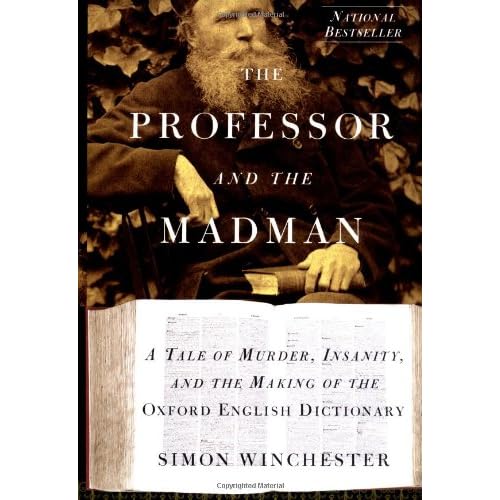
You can read the true story, which reads like a novel, in a book I love: The Professor and the Madman: A Tale of Murder, Insanity, and the Making of the Oxford English Dictionary, by Simon Winchester.

I read it years ago, marked it up, and still count it as one of the most fascinating non-fiction works I've ever read.


Oh, and if you're on Twitter, be sure to follow @OEDonline for fun word nerdiness throughout your day!

Wednesday, April 18, 2012

WNW: Celebration

Before today's Word Nerd Wednesday, a couple of housekeeping items:

1) I haven't posted as much as usual lately, because I'm under the gun on several deadlines. (Among them: the edits for Paige, my book in the Newport Ladies Book Club! Yeehaw!) (Oh, and be sure to LIKE the Book Club Facebook page!)

2) When those deadlines are over, I'll have a busy week with the conference I attend and typically speak at every year. I'm teaching a table at the Publishing Primer workshop plus two classes. Which means busy, busy, busy.

These two items mean that I'll return to my regular posting schedule after that.


TODAY we look at words for happiness and celebration, because I got some great news this afternoon. (See below.)


Gala
As in, the awesome place where I totally celebrated last May when I received a certain award.

Fete
A lavish, often outdoor party. Sign me up!

Carnival
This one's more for the kids. As long as there aren't huge crowds, I'm happy to show up.

Fest
One of my favorite words. I use it when describing all kinds of fun activities. Writing fest. Chocolate fest. Reading fest. You get the idea.

Jubilee
This sounds awfully fancy, like I need an evening gown.

Fiesta
Pinata, anyone?


Two fun related words that apply:

Merrymaking
Here's one that totally fits today's situation. I'm excited and will celebrate through merrymaking, which may or may not include a goofy dance. I hope it doesn't look as goofy as Elaine.

and (not kidding):

Jollification
This goes back to the early 1800s, and it's an Old West, mountain man term. I love it! I think I'll incorporate it into my vocabulary.


So WHY am I'm excited today? What's with the merrymaking and jollification?

The sequel to Band of Sisters has been accepted for publication!!!

It'll be called Band of Sisters: Coming Home, and it's slated for release pretty soon: in January!

This means I'll have two books out soon: Paige and then Band of Sisters: Coming Home.

(Can I hear a booyah?)


The writer's journey is fraught with bumps and bruises and well as the awesome vistas. To reach a summit (or increasingly more difficult-to-reach summits, as the case is), you have to climb long mountain paths.

The last couple of years have been tough; it's felt like I've been climbing and falling down cliffs, making little progress.

And now this. I'm feeling great about what's lined up and the projects I'm currently working on.

Serendipitously (I'm claiming that's a word), we're going out for Thai food with my parents tonight. Sounds like the perfect way to celebrate to me.


Oh, and a final celebration-related word:

Hooray!


Wednesday, March 28, 2012

WNW: Why Punctuation Matters

People joke that I'm the Grammar Nazi.
My critique group says that I know exactly how to use commas (and then they go comatose, and tweet about it, if I try to explain why a semicolon is correct on page 5).
For that matter, rumor has it that when they speak about our group and mention members' strengths, they bring up punctuation as my strength.
While I do know my fair share of punctuation rules, I do like to hope that in the 12 years I've been there I've been worth more than fixing comma splices. :)
But yes, I do care about punctuation more than the average reader or writer. Why? Because it adds nuance and meaning that nothing else can. The same words can have a totally different meaning with a few different punctuation marks.
This is true with big issues like pacing, tone, and mood.
But to make my point, I'll go a bit over the top for today's Word Nerd Wednesday.
First off, read Lynne Truss's Eats, Shoots, and Leaves (the title of which is a punctuation joke). If you think punctuation is stale and boring, read that book. I read it on the treadmill and nearly fell off, I was laughing so hard.
Truss has several other titles, including picture books. I own one of them, and my kids love it. My third grader took it to school for show-and-tell. (And probably had to explain it to the class . . .)

To make my point about how punctuation can change meaning, here are three fun examples:
1) I've seen this one go around Facebook under the guise of, "Punctuation saves lives!"
Let’s eat Grandpa.
(I doubt he's very tasty)
versus:
Let’s eat, Grandpa.
(Yo, Grandpa, dinner's ready! I'll race ya to the table!)

2) I saw this one in college during my nerd training (read: English major studies). The professor, a woman, wrote the following sentence on the board:
Woman, without her man, is nothing.
I was rather incensed. Until she changed the punctuation.
Woman: without her, man is nothing.

And then I laughed.
3) One of Lynne Truss's books, Twenty-odd Ducks, includes a punctuation joke right on the cover with the title. With the hyphen, the title means, "roughly twenty ducks." If you take the hyphen out, it means, "twenty weird ducks." So the cover has twenty funky ducks: some that are striped, one ready to go snorkeling, and so on.
Even the subtitle has a play on punctuation: Why, Punctuation Matters
On each page spread, the book has the same sentence but with different punctuation (and therefore different meanings), plus illustrations to match.
You need to get your hands on a copy. Really. As proof, I present my kids' favorite 2-page spread from the book. It's gruesome, which may be why they love it.
The first page shows a king strolling near a group of girls bowing and throwing flowers at him as he says, "Ah, life is grand." The caption reads as follows:
The king walked and talked. Half an hour after, his head was cut off.
The second page makes the whole thing read as one sentence, which changes the meaning drastically:
The king walked and talked half an hour after his head was cut off.
Above the caption: three illustrations showing the king decapitated and his head talking ("Why can't I feel my lips?") as his body walks around.
Hysterical, if you ask me. At the end of the book, Truss manages (quite brilliantly) to write an entire letter to a school teacher on one page and then changes the meaning entirely using nothing but punctuation on the other.
Convinced that punctuation matters? I hope so. At the very least, remember point number one: punctuation saves lives.

BOOKLOVER DEALS FOR PRIME DAY!

Amazon's famous Prime Day events are huge for so many reasons, and for bookworms, it's even better: books aren't high-ticket ite...