Showing posts with label grammar. Show all posts

Wednesday, February 26, 2014

WNW: Grammar Girl's Quick & Dirty Tips Book Review

As long-time readers know, this isn't a review blog. The only reviews I post are about books I have handpicked, and they're usually nonfiction titles I want to pass along to fellow readers and writers. I think the last book I reviewed was Mignon Fogarty's 101 Words Every High School Graduate Needs to Know.

Truth be told, shortly after that post, I meant to post a second review of another book by Fogarty (also known as Grammar Girl, from the podcast of the same name), but after reading the other book, I promptly misplaced it in one of those cases of "I'll keep it in a very safe place so I won't lose it" and, of course, I promptly forgot the safe place.

I didn't want to post a review without having the book beside me because, as I do with so many reference books, I wrote in the margins and wanted to be able to refer to my notes.

For this week's Word Nerd Wednesday, the first bit of good news is that the book is found and at my side! Hooray! Now we can discuss Grammar Girls' Quick and Dirty Tips for Better Writing.


The second piece of news is that I had a great time rereading my notes and then going over the passages they refer to, and I found the book as delightful as I did when I first read it a few years ago. I found stars, underlined passages, and smiley faces all over the place.

Best of all, the author and I share many of the same stylistic peeves, which made me like her even more. Seriously, I couldn't stop grinning over to try and versus to try to on page 45, something I rant talk about on page 90 of my own grammar book. Beside her discussion of another of my peeves, the weak there is/are way of beginning a sentence, on page 81, I'd written, "Yay!"

Grammar Girl is known for her conversational, accessible style, and this book is no exception. It's laid out in an easy-to-read format, with clear headers and fun examples, as well as text boxes with background and other additional information, often fun trivia related to language. (Yes, fun and language can exist in the same sentence.)

The book goes over many common problems in writing, from grammar to punctuation to style issues. She even discusses why the rule of two spaces after a period has changed in the computer era (page 85). (See this post for my explanation, which agrees entirely with her.)

The final chapter is short, and while it won't be one you turn to regularly to remember a rule, it's helpful for writers of all kinds. It talks about breaking through blocks, finding writing groups, revising, proofreading, and more.

At the end of the book, you'll find appendices with lists of commonly confused words and other great references.

I can't cover all of the great parts of a book with more than 200 pages, but here are a few highlights I particularly enjoyed:
  • Squinty modifiers. (Page 65.) Great name for an easy error to make with modifiers, with a clear explanation and a great example.
  • The semicolon splicer image to help remember how to use the mark (page 75).
  • Properly punctuating indirect questions. (Page 89.) I've seen this issue a lot in my editing work, and agree with Fogarty so entirely that in that margin, I wrote "For the love!" because people need to learn this!
  • How to properly use a colon. (Pages 92 to 96.) A much-needed explanation.
  • The Oxford comma. (She favors it! Woohoo!) 
  • The title of chapter six: "Prozac for Pronouns: Getting the Stuntmen of Language Under Control." (Page 139.) LOVE IT.
And this gem on page 96: "Using a hyphen in place of a dash can cause your copy editor to have a mild fit."

Amen and amen.

The book is a quick read, and it's one you'll want to keep on hand as a reference for a long time. 

My only complaint is tiny: A few things have changed since the book's publication in 2008, such as how long Facebook status updates can be. Like I said, very small things. Considering how fast technology changes, I'm impressed how on top of technology she is, and that I noted only a couple of spots where things are different in 2014. 

Get a copy for yourself and another for the writer in your life. (Hint: That's everyone in today's society. We all need to know how to write clearly.) Here's the link again to make it really easy for you. And if you haven't gotten my book, here's that link too.


SOME BIG NEWS IS COMING SOON!
Stay tuned for the announcement of two projects I'm working on with Luisa Perkins. We'll roll out the first one in a few weeks, and the second one a few weeks after that. 

You won't want to miss out on them! 


UPDATE
Coincidentally, right now, Mignon Fogarty (Grammar Girl) is raising money to fund an awesome card game called Peeve Wars. I've chipped in; I hope you will too. The campaign has just 10 days left to reach its goal. Learn more about Peeve Wars and donation rewards HERE. If you have personal grammar and usage peeves (and you know you do), you'll want this game.

Wednesday, November 27, 2013

WNW—Sandy Hook and the "They" Conspiracy

Today's Word Nerd Wednesday has a more somber topic than I usually take here, but I think it's a relevant one in light of how news is covered in the US and how we interpret evidence presented to us by various sources.

This post has been on my mind for almost a year, when I first heard conspiracy theories after the Sandy Hook shooting in December 2012. With the report of the shooting released this week, concluding that Adam Lanza acted alone, and with almost a full year passing since the tragic events of that day, I'm taking a stab at the issue the conspiracy theorists brought up in hope of shedding some light on the situation and, I hope, on not jumping to conclusions in relation to the language used in news reports and other situations.


Shortly after the shooting, I listened to several tapes online where people discussed how, in their strong opinions, there had to have been multiple gunmen in Sandy Hook, and that the federal government was hiding that fact.

One video went so far as to insist that President Obama himself had ordered the shootings so he could have a leg up in passing new gun control laws. My jaw dropped at that accusation. Obama isn't perfect, and he's made mistakes as President, but would he seriously order the murder of children for a crap-shoot chance for passing a new law? Is he really evil, a mass murderer? Not a chance.

Over and over, I came across one piece of so-called "evidence" that these theorists used to "prove" that there was more than one gunman. I won't link to the videos; I don't want to give those people extra attention. The point of this post is to show how relying on language used by victims in the heat of a crisis cannot be psycho-analyzed as a reliable way to justify a personal agenda.

The "Evidence"
In more than one spot on a tape (I believe it was a 9-1-1 call), the person on the phone, an eye witness in the school, used phrases such as these (not quotes, but they give the general idea):
They're coming down the hall!
They're shooting!
They've got more than one gun!
Conspiracy theorists based their conclusions, in large part, on the fact that the witness had used the word they while relating ongoing events during the shooting, that a single pronoun somehow proved that more than one person was carrying out the attack.

Let's back up the trolley a bit.

Almost three years ago, I blogged about how their is gradually becoming a singular pronoun. In English, we simply don't have a gender-neutral third-person, singular pronoun. We have he and we have she, and I suppose we also have it, but we don't use it when referring to people.

Often, when we don't know the gender of the person, or when the gender is irrelevant, we have to get creative, and that often means falling to the easiest way to explain with the fewest words.

In publications, we often see constructions such as he or she, or sentences rewritten so they have a plural verb and can justify the plural pronoun their. That happens mostly in scholarly publications in academia, student's college papers, and, probably, in any resume you submit.

In everyday, casual speech, we often use their as a single pronoun. 

Why? For several reasons. For one, using he or she gets cumbersome and often sounds hoity-toity. In addition, we tend to go the simplest route when speaking; why use three words when one will do? The English-language culture has shifted. Today, their is largely accepted in conversation as just fine when it's acting as a single pronoun; you won't generally find it in most published works, although that's changing in fiction, especially in dialog, which tends to mirror actual conversation.

The reality is, when someone is under duress, and isn't an English professor who is so used to using he or she that the phrase rolls off the tongue without a thought, even in a moment of crisis, a witness will almost certainly use they when referring to an unknown perpetrator.

Heightened emotion does that to people: while under stress; we slip into the registers of speaking we're most comfortable in. We're far less likely to adhere to grammatical standards, especially ones we aren't 100% familiar with. Even if you know the difference between the verbs to lay and to lie and which forms to use when, but you have to think about which form to use even for a split second, chances are, if your life is on the line, you won't give the verb that split second of thought, and a word will pop out, which may well be technically incorrect.

In other words, even if witnesses could tell that the shooter was male, we can predict, even without hearing any 9-1-1 tape, that witnesses would describe the shooter's action in terms of they, and not as he.

Granted, I doubt the new report will sway die-hard conspiracy theorists, even though they are just as likely to unconsciously throw in they when speaking, even when technically he or she would be correct.

I hope that the report of a lone gunman helps give a little bit of closure to the families affected by the horrific events of that day.

For the rest of us, I hope that by talking about these things, we gain some clarity. Like how people use casual and "incorrect" words in conversation and especially in life-or-death situations. Like how they're liable to use incorrect grammar or slip into more colloquial usage in tense moments. How we cannot use such speech as a basis for making broad accusations or assumptions, especially when such theories cannot hold water in light of how the language is used in the real world.

As much as I hope we never have another shooting or other similar tragedy in this country, I'm not naive enough to think we've seen the end. But I do hope that whenever we hear a tragic news story and people coming up with theories about them, we can take a step back and look at the fact objectively, not over-analyzing a single word and assuming what the person speaking meant by it. Especially, as in this case, when that single word was interpreted so wildly off base.

I'm all for unraveling stories to reveal the truth, and language does have the power to do amazing things along those lines. This isn't one of those times. Saying that the use of their automatically means there had have been multiple people committing this crime only causes grief, quite literally, to so many people involved, including the law-enforcement officers who, I believe, really did do their best to find out what happened.

Wednesday, June 12, 2013

WNW: Please Trash?

Last winter, our family took a trip to the Happiest Place on Earth. Because I'm a nerd and can't entirely shut off my editor brain even on vacation, I couldn't help but notice a recurring grammatical problem on the trash cans in Disneyland and California Adventure.

While I took plenty of pictures of the kids, I found myself snapping pictures of trash cans and other things that made me laugh. Soon my husband was in on it too. (My sickness appears to be contagious.)

Let's take a look.

The folks designing the cans for recyclables did an okay job. Note this can, with the polite request to recycle:


We could argue that they could have added a comma between the two words, making it RECYCLE, PLEASE, but at least the request makes sense.

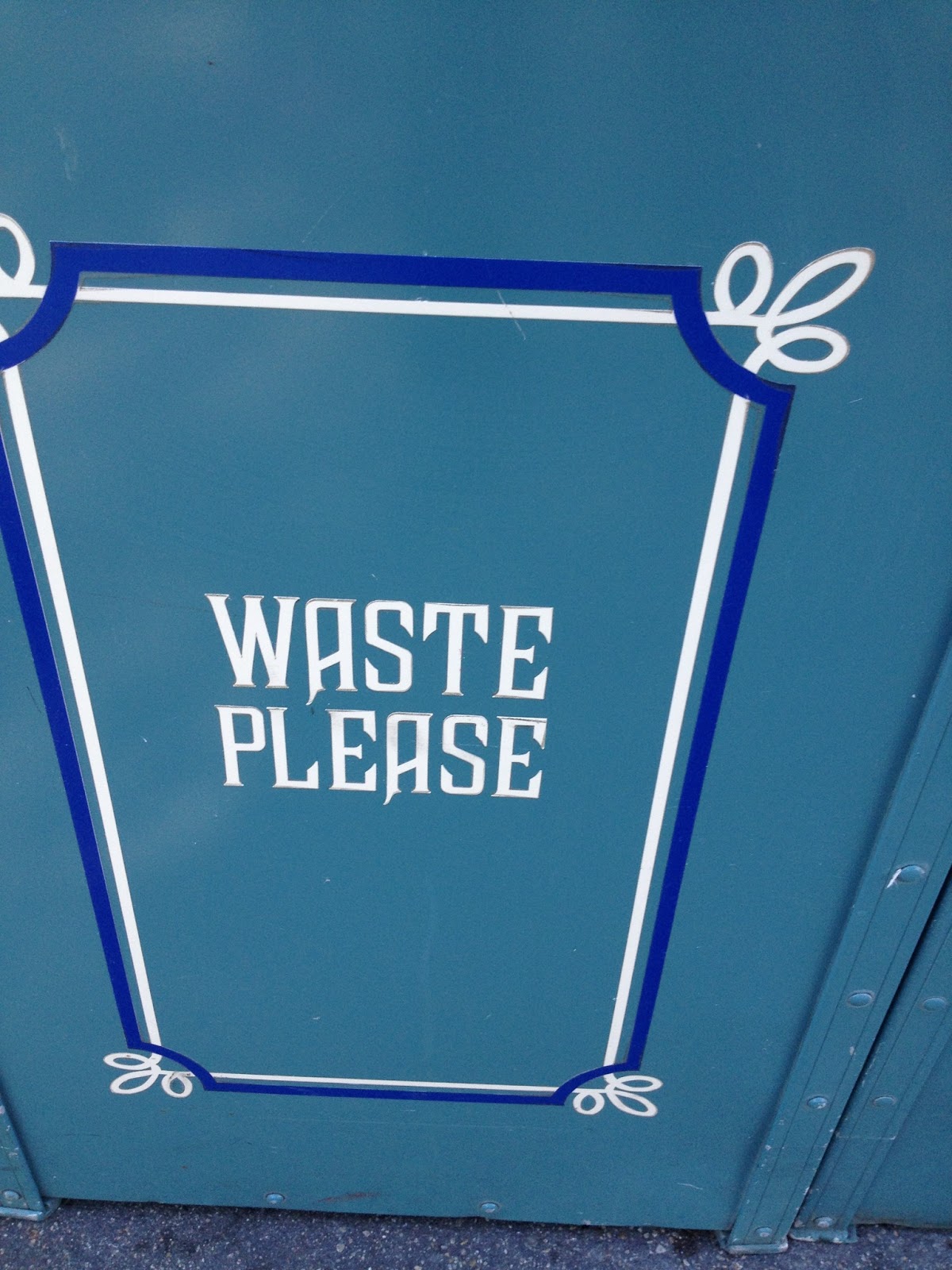
The receptacle standing right next to this one, however, uses the same type of phrase, including please, but they ended up with an unintentional humorous meaning:


Now obviously they don't want park goers to throw things around and otherwise waste stuff. No, what they're asking is for people to put their waste in the can. But that's not necessarily what the can says. Because waste can be both a verb (don't waste your money) and a noun (garbage = waste), the two-word phrase could mean either, "Please put your waste here," or, "Please do waste the park." 

The problem was compounded by the fact that its twin, the RECYCLE PLEASE can, used a verb first, making it all too easy to assume that the other can also has a verb in its almost-matching phrase. Look at the cans side by side, and you'll see what I mean.


Jiminy Cricket wasn't the only one with the problem. We found the very same issue in Frontier Land.


It became a chronic problem everywhere we went day . . .


and night. 

Interestingly, at least one time, Jiminy and company found a way to make the request in a full sentence (minus the period). They totally should have done this elsewhere:


Monsters, Inc. added only into the mix, but that didn't help; the resulting phrase could have meant "Do nothing but waste," as well as "Put nothing but waste here."


Here's a case where they changed up the phrase on one can. They kept the request structure, but here (hooray!), the actual request is clear: KEEP IT CLEAN.


After seeing so many problems on trash cans, I thought that maybe the problem was solely in the rubbish division. But then I spotted this door at the Muppet theater, and I shook my head, sure someone had messed up again. Didn't they know that if something or someone is alarmed, it can mean more than one thing?


But I should have trusted that the Muppets knew what they were doing. I walked closer and noted the smaller text in the the brown rectangle:


Oh, yes! Woohoo! The person who made this sign is smart, knows their grammar, and has a killer sense of humor.

After a great trip, we flew home. But as we rode the airport shuttle to the parking lot, it happened again; I laughed at another sign. This one seemed to be an attempt to sound official, but it sounded rather silly.

In English, we often create objects by adding ee to the end of a word. For example, I've heard a tutor call the person they teach a tutee. Not a real word, but we know what it means: the recipient of the tutoring.

So what in the heck is a standee?


As is often the case in public typos, this is probably a case of over thinking it. The sign-maker people could have used the exact same number of letters by simply stating: NO STANDING.

And for the fun of it, as proof that we did Disney, here's a family photo of Splash Mountain, wherein we're inwardly freaking out but purposely looking bored.


Wednesday, April 10, 2013

WNW: An Excellent Issue. Single & Double Plurals.


I was first introduced to Mignon Fogerty (Grammar Girl) because of this grammar issue. She appeared on  Oprah to settle a viewer's complaint. (If you don't listen to the Grammar Girl podcast, subscribe already!)

Oprah and her best friend, Gayle, had gone on a road trip across the United States, and camera crews followed them. The result was several episodes of something they called "Oprah and Gayle's Road Trip."

A viewer wrote in saying that the title was incorrect; Oprah's name also needed a possessive, like so: "Oprah's and Gayle's Road Trip." She ended her note by saying she was an English teacher and therefore knew this stuff.

The viewer was brought on to tell her side, and then Oprah brought on Mignon to reveal the truth. Did the show get it right or wrong?

The show, not surprisingly, got it right. I doubt Oprah would have embarrassed her staff by bringing on a grammar expert to publicly point out a mistake.

But why was the title correct? Is there a time where making both names possessive would be correct?

First, yes, there are times when making both names possessive is correct. And there are times when it's not. It all depends on whether the ownership is joint or separate.

Let's set Oprah and Gayle aside and look at another example. Either of these sentences could be correct:
Jane and Sally’s bikes are in the garage.
Jane’s and Sally’s bikes are in the garage.

Which you choose depends on context. We need more information about the bikes before we can make the call.

If Jane and Sally have a sporting goods store they own together, and in it, they have several bikes, then we have joint possession, and we need only one apostrophe. In that case, the first example is correct, because Jane and Sally are acting as a group of ownership. Together, they own the bikes. So:
Jane and Sally’s bikes are in the garage.

But if Jane and Sally simply own different bikes (Jane’s is purple, and Sally’s is blue), we’re dealing with separate possession, so each girl needs her own apostrophe to show her ownership of her bike.
Jane’s and Sally’s bikes are in the garage.

Another example: Let’s take Tom and Joey, who are brothers. Let's talk about their parents. Because the parents belong jointly to both boys, we don’t need to make both of their names possessive. We use a single possessive to show joint ownership:
Tom and Joey’s parents go on dates every weekend.

But what if Tom and Joey are buddies rather than brothers? What if both sets of their parents happen to be friends who hang out in a larger group together on weekends? Then the whole situation changes. Now we’re talking about Tom’s parents, and we’re also talking about Joey’s parents: four different people, not two. Now we need to make both boys' names possessive.
Tom’s and Joey’s parents go to the movies every weekend.

One way to remember this is by substituting the noun (bikes, parents) for an opinion. If two people share the same opinion, then group their names together as a joint possessive:
        Tom and Joey’s political views sparked controversy.


If Tom and Joey don’t agree on politics—let’s say Tom is a Democrat and Joey is a Republican—then both names need an apostrophe, because we have separate views:
        Tom’s and Joey’s political arguments sparked controversy at school.

Or you can always remember the Oprah viewer who was wrong. Oprah and Gayle took their trip together. It was their joint trip. Therefore, the title of those episodes needed only one apostrophe. If they’d gone on separate trips, we’d need two.


If you're from my generation, you can just think of a favorite movie to get this one right. Bill and Ted had a shared adventure. Therefore, their movie is Bill and Ted's Excellent Adventure.


This topic and many more are new to the second edition of my grammar book. It's got more than double the word count of the original, with tons of new entries and many expanded ones to address more commonly asked questions I get. We're putting the final touches on it now.

Watch for it in May!

Wednesday, March 06, 2013

WNW: Hypercorrection

On our last Word Nerd Wednesday, we talked about how Utahns say mountain and how some people over overboard in trying to be "right" (note the sneer quotes) by pronouncing the T. When my friend Jordan McCollum, who is as big a word nerd as I am (only more qualified, because she's got a degree in linguistics), commented in that post about hypercorrection, I knew I wanted her to elaborate on the topic and share it with my readers.

Don't know what hypercorrection is? Don't think you're guilty of it? Maybe, maybe not. It's worth knowing about. Read on!


Hypercorrection: If talking like this is wrong, I don't want to be right 
Guest post by Jordan McCollum 

Have you ever drifted out of your lane while driving? I know I have. The natural tendency is to quickly correct your course by pulling the wheel back the opposite way. But sometimes, a drifting driver jerks the wheel back in the right direction too much. The over-correction succeeds, but the vehicle shoots into the wrong lane or the car rolls.

The same thing happens in language. (Okay, with fewer fatalities.) Most people want to speak "correctly." But did you know there might be such a thing as "too right"? I'm sure we've all had an English teacher or other "friend" who corrects casual speech with prescriptivist usage and pronunciation.

Fortunately, sometimes, those friends are so right, they're wrong. (But not dead. Whew!)

Hypercorrection

Hypercorrection is the linguistic term for being "too right." Usually, hypercorrection comes about because the speaker knows the "rules" of the language, in pronunciation, usage, or grammar, but applies them in more situations than they should (hence clip at right).

Hypercorrection is a very common phenomenon. In fact, it's part of learning a language, too. If you've ever heard a small child suddenly start saying "goed" instead of "went," it's a form of hypercorrection. They're learning that you form the past tense by adding the -ed sound, and applying it in situations where you actually don't follow that rule.

Hypercorrection in pronunciation

A couple weeks ago, Annette blogged about how people pronounce "mountain." People see the T and believe that they pronounce it like you'd say a T in isolation, or at the beginning of a word. However, the American pronunciation of "mountain" uses a glottal stop instead of a "tuh" (and those are just two of the six ways T is pronounced in English words!).

Mountain isn't the only word that uses a glottal stop for a T. Most speakers of American English, in natural speech, will pronounce the first T in important as a glottal stop. (It shows up all over the place in lots of other varieties of English too, so no knocking on Americans.)

However, some American English speakers see the "T" and think the "correct" pronunciation must feature a hard "tuh" sound like you'd hear from a T at the beginning of a word (or in British English). But T is virtually never pronounced as "tuh" in the middle of a word in American English—we rely on four of the other "allophones" of T in the middle of words, and the glottal stop is just as valid a rendition of T as the "tuh."  So when you stick a "tuh" in the middle of "important," you start to sound a little . . . well, self-importuhant.

Phonologically speaking, this pronunciation is unnatural in all varieties of English (because in British English there's no 'r' there).

Another great example of hypercorrection is found in this clip from My Fair Lady, where Professor Higgins is trying to teach Eliza Doolittle to stop her dropping her H's at the beginning of words:


The "hever" is exactly the same principle—applying a correct rule (add an 'h' to the beginning of words that you pronounce as starting with a vowel) to an incorrect situation (a word that really does start with a vowel). Funnily enough, this same principle has changed the pronunciation of the name of the letter "h" in some varieties of English to "haitch." This is also influenced by the perception of h-dropping accents like Cockney as lower in prestige.

Another place I see this is when actors who speak a variety of British English get an American role. In many accents of British English, an R at the end of the syllable isn't pronounced, but in most varieties of American English, it is. So sometimes an actorrr tries a little too harrrd to stick those R's in therrre, verging on another popular dialect, Pirate English. Yarrr. (But yay for trying!)


Hypercorrection in grammar

The same principle applies to grammar (maybe even more so). For example, most speakers of English are taught from a young age that you shouldn't say "me" in subject position: Never "me and you went to the store." (Don't you just cringe?!) Always "You and I gave her the gift." But when we move the "me" into another position in a sentence, things get a little trickier: "She gave the gift back to you and I."

If you're not cringing again, here's a hint: it's "me" there. She gave the gift back to me / She gave the gift back to you and me. (Or if you're really having trouble, "She gave the gift back to us"!)

Eventually, some people try so hard to speak "correctly" that they end up talking like this:
For our one year anniversary, my girlfriend caused myself to go to a Yankees game, with whomever amongst our friends can go. But, the Weather Channel just changed their forecast and the skies are grey, so we might go with the girl that lives next door to see the movie, "Iron Man 2".
I—just—I—oh, where to begin?

We all want to talk correctly. But keep in mind that hypercorrection isn't "extra right." It's actually wrong.

What do you think? What are your favorite examples of hypercorrection? How do you see good grammar principles go bad?

Photo credits: wrecked car—Niels Heidenreich; pirate—Kate Haskell


An award-winning author, Jordan McCollum blogs about writing craft and the writing life at JordanMcCollum.com. She holds a degree in American Studies and Linguistics from Brigham Young University and now makes her home in Utah with her husband and three children. Catch up with her writing links, word nerdiness and crazy life on Twitter, @JordanMcCollum.


Wednesday, September 14, 2011

WNW: Needs Washed. Twitch.

Recently, Mignon Fogarty (known as Grammar Girl, the author of the book I talked about in last week's Word Nerd Wednesday) asked her readers on Facebook to help her pinpoint a geographical trend in speech.

It's a quirk and (yes, I'll say it) an error that puzzles me, but I hear it often enough.

I don't know where it hails from. I get the idea that it's particularly common the Midwest, but I've seen people use it who are from all over the place, from California to Florida and in between.

As we usually do here on WNW, the grammatical "back story" first:

A direct object is something a verb modifies, or refers to.
Amy drank milk.
Brandon eats candy.
Here, milk and candy are the direct objects. They're what the verbs (drank, eats) refer to.

Direct objects are nouns.

A refresher: What's a noun? A person, place or thing.

A noun is NOT an adjective or a state of being.

For the goofiness of it (because it'll show the quirk later), let's turn one of the direct objects above into an adjective. Let's see how well that works:
Adjective: Amy drank red.
Okay, that doesn't work at all. You could add something to it so it makes sense, like, oh A NOUN after RED (which we needed all along, right?):
Amy drank red punch.
Let's try it with a state of being:
Brandon eats washed.
Granted, that's beyond silly. But it shows that a state of being, or in this case, a past-tense verb, simply can't work here. It doesn't make sense. You couldn't come up with another set of verb + direct object where a state of being works. Those just don't go together.

How about this state of being:
The turkey is cooked.
See, now that works. Why? We aren't using a verb that requires a direct object.

The sentence is constructed to explain the state of being the turkey is in, using the key word IS. So we don't need a direct object that the verb refers to. The turkey just IS.

You can ask, "The turkey is what?" and the answer is clear: "The turkey is cooked."

But what if the turkey isn't cooked yet, and you need to tell someone to put the turkey into the oven? You could start out with stating the situation of the turkey:
"The turkey isn't cooked."
Or just say what needs to happen. NEED is a verb that requires a direct object. Refresher: a direct object is a NOUN, right?

So: Ready for the quiz?
The turkey needs . . . WHAT?
Well, it's raw. We aren't saying the turkey needs a hat or a box. But we do need a noun, and it needs to be an action, although a verb won't do. (Because verbs aren't nouns!)

BUT you can "noun-ify" verbs in two ways:

1) Add -ING to the end. The turkey needs cooking.

2) ADD "TO BE" before it. The turkey needs to be cooked.

Here's where I get all a-twitching. I see people say things like this all the time:

The car needs washed.

Who needs tickled?

**Direct objects are NOUNS. Past-tense verbs aren't nouns.**

So these are correct:
The car needs TO BE washed.
The car needs WASHING.

Who needs TO BE tickled?
Who needs TICKLING?

The turkey needs TO BE cooked.
The turkey needs COOKING.


I let some things slide with my kids, rules that are gradually going away and may seem antiquated (who/whom, can/may), but stuff like this is absolutely crazy-making to my ear.

Wednesday, June 29, 2011

WNW: Anaphora

Anaphora is a funky term that essentially refers to a stylistic effect with repetition at the beginning of sentences or phrases.

Before your brain starts spinning with "what the huh?" let's look at some examples you're probably already familiar with. Note the bolded sections:

One of the most famous examples in modern times is from Martin Luther King, Jr:
I still have a dream. It is a dream deeply rooted in the American dream. I have a dream that one day this nation will rise up and live out the true meaning of its creed: "We hold these truths to be self-evident: that all men are created equal." I have a dream that one day on the red hills of Georgia the sons of former slaves and the sons of former slave owners will be able to sit down together at a table of brotherhood. I have a dream that one day even the state of Mississippi a state, sweltering with the heat of injustice, sweltering with the heat of oppression, will be transformed into an oasis of freedom and justice. I have a dream that my four little children will one day live in a nation where they will not be judged by the color of their skin but by the content of their character. I have a dream today.


Then there's one of the most famous openings to a novel, where Charles Dickens used anaphora in A Tale of Two Cities:
It was the best of times, it was the worst of times, it was the age of wisdom, it was the age of foolishness, it was the epoch of belief, it was the epoch of incredulity, it was the season of Light, it was the season of Darkness, it was the spring of hope, it was the winter of despair . . .

Or how about Abraham Lincoln in his second inaugural address:
With malice toward none; with charity for all; with firmness in the right . . .

A general writing rule is to avoid repetition. But as with any rule, there are exceptions, and this is one.

My critique group is great at catching weak repetition (so, not anaphora), whether it's when one of us gets redundant with concepts ("beating a dead horse; you already showed that . . . a lot") or words ("on these two pages, your characters looked twelve times").

When I find that kind of repetition, I cut it out and revise, and I suggest the same to editing clients. A great way to find repetition is to read you work aloud. Your ear will catch things your eyes don't.

But anaphora is a different animal; it's repetition with a purpose. It's used for a specific emphasis in meaning or to create a desired impact on the reader or listener.

In thinking about anaphora, I realized I used one in Lost Without You, my first published novel (*cough*now on Kindle for cheap*cough*cough*).

It's a minor moment, when Brooke falls into a lake. Greg and Russell worry at first that she's hurt herself, but
Brooke was only wet. Very wet.
I remember circling "Very wet" during revisions, wondering whether I should take it out. In the end, I kept it in for emphasis, even though I didn't realize that what I was doing had a name. In that case, I think it worked.

Once you 're aware of it, anaphora shows up a lot. Without resorting to Dr. Google, can you think of other examples of anaphora? Any favorites?

*Edited to add: In hindsight, the example from LWY technically isn't anaphora, but epistrophe, which is repetition at the end of a line.

Wednesday, May 25, 2011

WNW: When Spell Check Won't Help

My sister (and fellow word nerd) sent me the following photos, all taken within a 48-hour period.

I knew right away we had a Word Nerd Wednesday on our hands. Laugh with me!

(Captions hers.)


An unfortunate error . . .
this is what happens when a parent does the typing
then tells the kid to cut out & paste all his own tags
for his report on horses in Mexico.


Maybe it's just a really small selection . . .


Apparently, both the ginger beer and root beer are for BINGERS.


The historical exhibit stands alongside three or four
other plaques that discuss (quite clearly) the ApostaSy.

These kinds of things are the reason that some days I wish I had the guts to carry a Sharpie everywhere I go . . . and correct signs that make their creators look well, not quite intelligent.

Wednesday, April 06, 2011

WNW: I Want This Book

If you're a true word nerd and already know grammar and punctuation rules, you'll get a huge kick out this book (which I'm dying to buy):


This "Absolutely Phony Guide" is by the folks behind one of my favorite Twitter streams: FakeAPStylebook. If you're on Twitter, follow them. Now. They're brilliantly funny.

The book is filled with fake "rules" and suggestions. One example: “Weapons and the Military: Shoot first, then ask questions about shooting.”

Not so sure about the rules? No problem; just go in with the knowledge that chances are, everything you read is bogus (even if you aren't getting the joke).

Note that the misspellings and typos are totally on purpose. This is my kind of humor book!

Read more about it in The New Yorker. And then buy it HERE from Amazon.

Friday, March 04, 2011

National Grammar Day

I'm offline most of the day, but before I unplug, I wanted to point out for my fellow word nerds that today is National Grammar Day. (March fourth/forth. Hahahaaaa!)

As you can imagine, Grammar Girl is celebrating big time.

Visit her site to send a celebratory e-card to your "favorite language lover or language offender."

She's got got ten grammar myths, a writing contest, t-shirts, and much more. Visit her National Grammar Day post for all the fun.

Go to iTunes to buy her new song, "March Forth." You can even get the sheet music for it. Here's the song. Listen closely to the lyrics for full appreciation!


Thursday, February 17, 2011

Word Nerd Linkage

It's a day late for Word Nerd Wednesday, so I thought I'd do something a little different: show you some of my favorite nerdy places to hang out.

Oxford Dictionaries Online and their Word World blog brings me no end of joy. I follow their Twitter stream, and it always points me toward posts that cheer the nerd inside me. (Up today: Five Events that Shaped the History of English)

Check out this fun Michigan Today post about obscure words. (It even mentions mondegreens, which we talked about more than a year ago HERE. In related news, we bought Mad Gab for Christmas.)

Grammar Girl. I'm going to admit here that I first learned about Mignon Fogarty, known better as Grammar Girl, when she appeared on Oprah to clear up some grammar confusion. She has a great podcast and blog (and a book and regular vlogs on YouTube) where she addresses a wealth of grammar and usage issues. (I admit I've learned a few things from her.)

"The Alot" on Hyperbole and a Half. The writer here is hysterically funny and does a few other posts related to language, like the one on the semi colon. (Note that the entire blog isn't about language or punctuation, and some posts are somewhat PG-13, definitely not appropriate for kids.)

Fake Editor and Fake AP Stylebook. Both of these are on Twitter, and their streams keep me in stitches. (November had a Fake NaNo Tips feed. Holy crimeny, I laughed.)

Also on Twitter, and showing that his wit is just as sharp with 140 characters as it is on the silver screen, is Steve Martin. He's a great writer as well as actor, and his tweets show an awesome grasp of not only what Twitter is (and how to poke fun at it) but how to craft a great tweet with the language. (Like how he used "FYI" and went on to explain that it means "for your information" but FYI is shorter . . . all in the same tweet.)

Common Errors in English. This site is a treasure trove of information. Stuck on whether it's wrack your brain or rack your brain? What about the difference between discreet and discrete? The guy behind the site is thorough and easy to understand, and the it's all arranged alphabetically. Just click on the letter of the word you're wondering about. (He has a book version and a calendar. I think I need that.)

Proofreader's Marks, courtesy Merriam-Webster. I do a lot of freelance editing, and while most in digital, every so often I get a hard-copy job. Once or twice, I'll get a brain freeze (which was the right way to insert a hyphen?), so I pull up this bookmarked site and double-check.

National Punctuation Day. Yes, it has its own website. Remember this one when September rolls around.

Funds for Writers has been listed as one of the top 101 best web sites for writers by Writers Digest for over a decade. It's a fantastic resource. (Tooting my horn here: I won the 2009 essay contest. Felt kinda cool.) The owner, C. Hope Clark, has a sister blog, updated regularly in addition to putting out three regular newsletters with oodles of great information for writers.

Not that I'm even a little biased (Hahahaaa!) but I think Precision Editing Group's Writing on the Wall blog is pretty great too.

I could list more word and writing-related sites, but I'll stop there and leave you with one that's for the pure fun of it. It's where we see inside the lives of the people who inhabit those picture-perfect catalogs like Pottery Barn: Catalog Living.

Check it out and laugh.

Wednesday, January 05, 2011

WNW: Their As a Singular Pronoun

A reader recently called me out on using their as a singular generic pronoun. (I forget who right now; feel free to claim the comment as your own!)

The issue: What pronoun do you use in a situation where the gender of the person acting either isn't known or isn't relevant? For example:

When an employee arrives . . .

The rest of the sentence is about the employee, who must sign in. What pronoun do you use?

When an employee arrives, ____ must sign in.

At one time, writers simply used he as the generic pronoun:

When an employee arrives, he must sign in.

But eventually came the complaints of sexism. (What if the employee is female?) That's when we started seeing a lot of he or she, just to be sure we covered our bases:

When an employee arrives, he or she must sign in.

That's seriously clunky and awkward, but it's better than the other weird compromise, s/he.

Others have opted to use she instead of he. That's annoying to me as a reader, because a) it's reverse sexism and b) historically he has a far more neutral feel than she, which jumps out like a flashing red light.

(Good writing should move smoothly, without jolts or flashing red lights.)

To keep the gender thing fair, some writers alternate between he and she throughout a piece. Personally, I think that goes beyond annoying and enters the range of shoot me now.

I've seen magazines that alternate on an article level: this article uses he, and the next one uses she. Not a particularly elegant solution, but at least it doesn't have me wanting to hit something.

So the gender-neutral problem persists: English simply doesn't have a singular, gender-neutral pronoun.

Finnish does have a gender-neutral pronoun, and I have to say, it's really convenient when you see a baby but can't figure out the gender. You can totally compliment the kid without offending the parents. Too bad English doesn't have an equivalent of hän.

(Another side note: Finns often use se instead of hän . . . which means it, even when referring to people. Totally works in Finnish. Not so much in English. Can you imagine referring to your friend and saying you're going to lunch with it?)

Chicago and a lot of other style guides suggest avoiding the problem altogether. Either 1) reword the sentence so you don't need the pronoun, or 2) change the sentence so you can grammatically use the plural:

When employees arrive, they must sign in.

That works fine at times, but it's still not a solution. Sometimes a piece needs the singular, and making it plural or otherwise doing acrobatics to avoid their as singular sounds odd.

This is precisely why their is becoming increasingly accepted as the singular pronoun, at least in conversation and informal writing. I'm in the camp that accepts this usage already (obviously), although some people still foam at the mouth when they see their used this way. (Just as I foam at the mouth at infer used for imply and other losing usage battles.)

That said, if I'm writing for a professional journal or something similar, I avoid using their as a singular. You write to fit the register you want the piece to fit in. If something isn't accepted in that arena, don't use it, and no, their is not accepted as Standard English.

Yet.

I believe it's just a matter of time before their is considered correct and perfectly fine to use this way. People already do, often, sometimes by accident and other times absolutely on purpose (raising my hand here).

The new rule actually reaching style guides? That may take some time, but it'll happen.

Grammar Girl agrees with me and adds that "it takes a bold, confident, and possibly reckless person to use they with a singular antecedent today."

What can I say? I live on the edge.

WNW: Very Unique?

I hate that phrase. Gets my eye all a-twitchin'.

The reason is that unique means the only one or without its like or equal.

Therefore, unique is not something that can be compared by degrees, unlike like how warm, old, or bright something is. Those words can have very added to them and make sense. Something can be more (or less) warm, old, or bright.

Then you have words like unique that are absolute modifiers. That means the word, by definition, is not something that varies by degrees. It either is or it isn't.

It's absolute. (Hence: absolute modifier.)

So you can't be slightly dead. You're either dead or you're alive.
(We aren't going into the technicalities of medicine and life support and all that . . . you know what I mean. And of course there's Miracle Max, but that's a different story.)

You could argue whether some words are absolute modifiers, like Jerry and George do in an episode of Seinfeld with dry. Jerry insists you can't over-dry something, just like you can't over-die. So he says something is either wet or it's dry. (But, you could argue, there's the in-between stage. Where does damp fit in?)

Here's a list of some other absolute modifiers (words you do NOT add very or other comparing words to):
absolute
overwhelmed
straight
opposite
right
eternal
fatal
final
identical
infinite/finite
mortal/immortal
perfect
irrevocable
original

Add "very" to any of those, and you'll see that they don't make sense.

You cannot have a "very fatal" collision. (If you mean several people died, that's something else.)

A final exam must be the last one. (You can't have one exam that's more final than another. The first one wouldn't be final.)

While trying a case in court, a lawyer wouldn't say that the defendant's DNA was very identical to the one at the crime scene.

Those absolute modifiers are a bit more obvious than unique or original. You're less likely to accidentally use one of those.

Now that you know the concept, apply it where it's most easily forgotten: something either is or is not unique.

Don't add very.

Sunday, January 02, 2011

Sample Sunday: There, Their, They're

Sample Sunday is for authors to share a bit of their Kindle-published titles. I'll post a sample of Lost Without You sometime soon, but today I thought I'd put up a piece from my grammar book, There, Their, They're: A No-Tears Guide to Grammar from the Word Nerd, which is now on Kindle for all of 99 cents.

Below is the section that discusses splitting infinitives: what does it mean to split an infinitive, and is it wrong to do so?

(Check out the #SampleSunday hash tag on Twitter to read other samples from Kindle authors.)

Splitting Infinitives

At some point in history, grammarians and teachers decided that Latin, a dead language, should be our guide. Why it made any sense to use another language to prescribe English grammar, I’ll never know, but Latin is the basis for the argument that we shouldn’t split infinitives (and a bunch of other silly grammar “rules”).

Here’s the crux of the old argument: In most languages, the infinitive or base form of a verb is a single word.

Since I know Finnish best, I’ll use it as our example.

Finnish: olla

English: to be

You can’t take the Finnish olla and split it up. It’s one word. The same holds true for the French être and the Spanish ser. The infinitive is one word. Of course you can’t split it up and have it make any sense.

But English has two words for the infinitive: to be. So, heck, let’s throw something between them: to happily be

That’s what is called a split infinitive. Frankly, unless you’re writing a paper for cranky Mrs. Robinson from eighth grade who insists on her students abiding by antiquated rules, split infinitives to your heart’s content. Although you shouldn’t overuse any construction, splitting an infinitive isn’t wrong.

Consider how utterly flat the classic tagline from Star Trek would be if it held to this “rule”:

To go boldly where no man has gone before.

Sorry, Mrs. Robinson. That lacks punch. It’s lame. We really need to split that infinitive:

To boldly go where no man has gone before.

Whether you like Vulcans or avoid them like a bad rash, you have to agree that the original tagline is the superior one.

From Chapter 2: Grammar Grapples, There, Their, They're: A No-Tears Guide to Grammar from the Word Nerd


Wednesday, December 15, 2010

WNW: More on Passive Voice: Hi, Ambiguity!


A couple of weeks ago we discussed what passive voice is plus when it's actually okay to use it, even though writers are told over and over again to avoid it.

That post got some comments (hey, that phrase was passive :-D) about whether some sentence structures were passive, and I promised to clarify.

The example cited was:

She was excited.

IS that passive? It does have the key word was in there.

The answer: No, that sentence is most definitely NOT passive.

Except. English has some great ambiguity built into the underlying context. So all by itself and out of context, no, that sentence is not a passive construction. But it could be. (We'll get to that in a second.)

A similar example, showing why it's NOT passive:

Sarah was sad.

That sentence can't be passive; nothing (or no one) is being acted upon. We're just describing a state of being for the subject (Sarah), not what's happening to her.

You could make that kind of construction passive:

She was excited by putting up the Christmas tree.

Check it out: now it's passive. She's not just in a state of excitement; she's being acted upon (putting up the tree), which makes her excited.

Here comes the funky ambiguous part:
This kind of sentence construction (he/she/it was ____) is ambiguous in English because the sentence could imply that something is being acted upon.

Basically, in some contexts, you could figure out what's making the person excited (versus the fact that she just IS excited).

If you have an entire conversation (or, in writing, a paragraph or whatever) where we know why she's excited, what's causing the excitement, then it's passive. In Sarah's case, we know her excitement is because of the Christmas tree.

So "She was excited," while not grammatically/structurally passive, becomes contextually passive.

Upshot there:

She was excited could be passive . . . or not. Technically it isn't from a grammar standpoint, but the final meaning depends on what the speaker intends.

Again, based purely on the structure, and if we're just explaining her emotional state, then no, it's not passive. Not even close.

Another ambiguous example:

The turkey was cooked.

We could simply be stating a fact about the turkey: We have poultry that is not longer raw.

Say a story explained how they knew when it was time to eat Thanksgiving dinner:

The turkey was cooked.

That's not passive. It describes the state turkey. (It's toasty hot, juicy, falling off the bone, and ready to eat. Yum. Pass the cranberry sauce.)

To make it passive, we need the person who did the cooking to be implied:

The turkey was cooked.
[And we, the reader/listener, know Paula did the cooking. The turkey was cooked by Paula = passive.]

(Is this making any sense?)


Here's my linguist dad's key way of explaining passive voice:

Passive voice is when the grammatical subject is ALSO the logical object.

Wednesday, December 08, 2010

WNW: Things We Say Wrong--Right

Found a fun video showing a lot of incorrect usage and pronunciation in English. It's really funny and worth taking a look/listen.

Two of my favorite bits:
"Text messaging has erased any sense of spelling you may have gleaned"

"I could care less."

But . . . I have a few beefs.

First, watch the video. Then read my rant.


Okay . . .

First off, he says that if you feel bad that's incorrect. He insists that the adverb form is needed: you feel badly.

See, here's the thing: feel bad is just fine.

In fact, it's more correct . . . unless he's discussing the sensing capability of his nerve endings and how they just don't work anymore.

Then he could feel badly, because he'd be NUMB.

Aside from that example, the fact is that you don't always need the -ly adverbial form, which he brings up multiple times, like with talk different vs. talk differently.

It comes down to FLAT ADVERBS, something this dude could use a lesson on.

(For a quick lesson, check out Grammar Girl's explanation. She points out that flat adverbs go back the 1600s. They're more popular now, but hardly new.)

And then there's this complaint:

a whole nother apple

Here's the deal: English has lots of pre-fixes (like UN as in unsolved puzzle), and suffixes (like FUL, as in thankFUL), and many others.

Just about every language also has IN-fixes, where the "fix" is sandwiched in the middle of words. English doesn't support infixes very well, but guess what?

A whole nother is essentially an English INFIX.

They exist, dude. Deal with it.

Also, alternate pronunciations aren't wrong just because they exist. Yes, words are sometimes pronounced incorrectly, but if, over decades, more than one pronunciation is considered acceptable by the educated masses, the others will be added to dictionaries.

This happens with English a lot, since most of the planet speaks it (at least as a second language), and many, many countries have it as a national language and speak it with their own pronunciation and variations.

(I'm not about to tell an Aussie that his way of saying "mate" is wrong. Are you?)

Thing is, LANGUAGE EVOLVES. (Read that post for yet another rant.)

From Chaucer's and Shakespeare's standpoints, our English would be ridiculously "wrong." But no, it's not wrong. English has just CHANGED over the centuries. A lot.

The final kicker of the video would be really funny if he weren't still harping on the adverbial thing.

I wanted to absolutely love the video. I loved parts. But he lost a bit of credibility on some points. Sigh.

Note on last week's WNW: Got a few questions on passive voice, including whether something like "she was excited" falls under that umbrella. Will discuss that soon!

Wednesday, August 25, 2010

WNW: Rules? Who Says?

Several people have asked me recently about the rules of grammar and usage. Who makes them? What determines what a rule is? When and why and can we break them?

To answer that, first, we have to back up a bit.

Language evolves; we all know that. Take a look at the opening line of Chaucer's Canterbury Tales in the original, and your eyes will glaze over. (That is English? What the . . . )

My dad has the first paragraph memorized, and when he recites it, it sounds stinkin' cool . . . but nothing like English.

My History of the English Language class was taught, as I've mentioned before, not by a linguist as it should have been, but by a well-meaning but ignorant literature professor who had no clue what the material meant. (Fortunately, I could go to Dad to figure out what the HECK she was teaching.)

But the workbook was helpful. It gave us exercises to show how the language had gradually changed in very predictable ways (if this vowel came after this consonant, it changed into this one). We'd apply the changes to Old English sentences and get Middle English ones. Then we'd get a new set of rules, apply them and, assuming we'd done the previous set correctly, we'd end up with Modern English.

It was way cool, especially to see how the changes weren't random, but very systematic.

We did similar things with sentences in a current dialect: BEV, or Black English Vernacular. Such "street" talk may sound random and just wrong, but even it is governed by its own rules (whether the speakers know it or not).

That was a lesson in a simple linguistic concept:

No dialect is inherently better or worse than another. They all have quirks and rules and structure. There is nothing in and of a standard dialect that makes it better than another . . .

Except for the fact that those who are educated have picked the standard as the dialect of the educated. They've selected it as the "correct" dialect, for lack of a better term.

Therefore, to be taken seriously in school, jobs, and other settings, a person must know the standard dialect and know its rules.

If you break the rules of the standard dialect in a situation where the standard is called for, you risk losing credibility and looking uneducated.

But break the rules of the standard by speaking your home-town dialect with family and friends, and that's totally fine. That dialect is what's expected of you in that environment.

Most of us have several of these "registers" (sort of like mini dialects) that we use in different situations. For example, I'd tell the same story to a gal pal very differently than I would to a police officer or my parents or one of my children. In each situation, I'd slip into a different register, using different vocabulary, sentences lengths, etc.

Okay, so back to the standard dialect and THE RULES:

The rules change gradually over time. Note the over time part.

A true change can take literally decades before it's accepted as a new standard.

So who accepts it as the new standard? Essentially, if the majority of educated, standard-dialect speakers view the change as an acceptable usage, it's considered a new rule.

Forty or so years ago, parents constantly corrected children asking, "Can I go to the bathroom?" with, "May I go to the bathroom?"

But the word can has since taken on a definition beyond ability. It also implies permission. Today, you'll occasionally run into someone old-school who insists on the old definition, but kids today will grow up with the new one.

Recently we watched an old movie that had a moment using can in the old sense, with an adult correcting the child, and my kids were genuinely confused as to what the problem was. (And these are well-read, smart kids, if I say so myself.) The rule has simply changed. Can I go is perfectly acceptable now.

Another rule that's on its way out but has a few die-hard people holding on is whom (and its cousin, whomever). There's a funny scene on The Office about when to use whomever, and it's a great example of how the general (educated!) public has almost entirely lost the meaning of whom. (Pam, the secretary, knows the rule. Michael, the manager, doesn't. Then again, I wouldn't call Michael educated . . .)

Today, whom is so rarely used that in my own writing, I avoid any sentence structure that would call for it, because it would draw attention to itself. Can you imagine Kim from Band of Sisters asking "To whom does this straw belong?" Um, no.

Other books, including the new Mockingjay, use who in places where the old rule required whom, which again shows how things are changing and how we're getting pretty darn close to having who being acceptable in every situation. (But not in everyone's book, quite yet. I'd give it another ten years.)

All of this is why, in casual conversation and on blog posts, I don't worry about broken rules and the like. Those aren't situations (or registers) that require the rules, such as they are, to be kept.

But in professional situations, such as in articles and novels and the like, I tend to lean on the side of being conservative, to be sure that my colleagues, readers, and reviewers are aware that yes, I am well-versed in the standard dialect and know its rules.

And this is precisely why I freaked out when a copy editor added a lay/lie error to one of my books. I caught it at the last minute (phew!). And yes, I know 99% of readers likely either wouldn't notice or care. But I do. And I know that there are readers who do care.

I also know that the distinction between lay/lie is dying, but, to quote Monty Python, it isn't quite dead yet.

So it's a good idea to learn the rules, including what's gradually changing and how close the changes are to being considered standard. Then use that knowledge in speech and writing when the register is appropriate.

Hanging out with friends, I could well say, "Me and my sister went to the store," but if I'm talking to a prospective employer, I'd rephrase it as, "My sister and I went to the store."

Because I know the rule and the expectations surrounding the standard.

Lots of rules are bent all the time, and you can definitely get on those bandwagons, but if you're hoping to be taken seriously in a professional writing capacity, you do need to know the "real" rules of the standard and know how to apply them.

But then you can have fun breaking them in dialogue, because your characters can speak in whatever register and dialect they want.

BOOKLOVER DEALS FOR PRIME DAY!

Amazon's famous Prime Day events are huge for so many reasons, and for bookworms, it's even better: books aren't high-ticket ite...