Friday, February 13, 2009

Writing Journey: Part VI

Part I
Part II
Part III
Part IV
Part V

When I set off on the adventure of writing a historical novel, I went into it refusing to allow myself to commit a personal pet peeve.

I'd read historical novels with chunks that were thinly disguised history lessons. You probably know what I'm talking about: a real historical event must be shown because, well, it was real and important and happened right then, but it doesn't have much bearing on the actual plot. But it MUST be shown! So characters A and B just happen to be at the real event, and therefore, it's in the book.

Peeve, peeve, peeve.

To me, that isn't good storytelling. That's shoving a history lesson down the reader's throat. In my mind, the history should be the backdrop to the story, the hanger on which the plot drapes. It should impact the story in natural ways. It should never be so far into the forefront that it's what we see at the expense of an actual story.

Think Gone with the Wind. Yes, the Civil War was a huge part of the story. But the point wasn't the war. The point was Scarlett and Rhett. In theory, the story could have been set during another war.

I decided early on that any history I included in this historical novel experiment would be relevant to either characterization or plot (and preferably both). It would NOT be there for the sake of being there.

I sat down with my notes about the Logan Temple and analyzed them. The book I relied on most told about the construction by topic: here's a section on the lime kilns, now one on the wood camp, then the plasterers, and so forth. It wasn't at all chronological.

That's why, during my second read, I made a master chronology. Then I analyzed what happened when, which events were near one another, and which months not much took place. I wouldn't cover the entire construction of the temple, I knew. Seven years is a long time to stretch a story without boring readers to tears. So what period should I focus on?

I decided on some of what I felt were the events I most wanted to talk about, which meant the book would begin right before the cornerstone dedication. At this point, I had a pretty good idea of some of my characters and a good chunk of the plot.

I'd already discovered Abe, who has turned out to be my readers' favorite character to date. He was "born" after I read a paper published in Nearly Everything Imaginable from Brigham Young University Press. The book has research papers all about life after the Utah pioneers' arrival, what daily life was like for the next generation. Which I was writing about. One paper was about Mormons who indentured and adopted Native Americans. Ding! A lightbulb went off in my head. I knew immediately that one of my main characters fit that description.

I also knew exactly when I would place the epilogue, because there was a way cool thing discovered inside one of the temple walls during the late 70s demolition and remodel that is (as far as I know) still unexplained. I wanted to use it, giving a possible explanation for why it was there and what it meant.

I began the first couple of chapters. Then I totally rewrote them. Probably six or seven (or heck, twenty? It felt like that) times. (I have serious first-chapter issues; just ask my critique group.)

When I finally made it into the first real temple construction stuff, I ran into a problem: I really wanted to show the cornerstone dedication, but at that point, I had no plot or character reason for doing so.

Dang.

I had to set the manuscript aside for a week or so before moving on. I couldn't get myself to throw in that real event just for its own sake, no matter how cool it was. (Peeve!)

Eventually I realized where the cornerstone dedication fit: it's where we begin to learn much about Lizzy's faith issues (characterization) and, more importantly, she first lays eyes on Abe (plot!). With those two pieces, I was able to move forward.

This book was an interesting writing experience for me on several levels. Placing characters more than a hundred years in the past was extremely different than setting them running loose in a modern-day setting, of course. But the story itself morphed several times. It started out being a more light-hearted, surface-level story, but my editor made me dig deeper and find the other layers (it's an onion!).

She pushed me and even gave me a 2-week deadline to do some significant rewriting. The final version ended up much longer (by nearly 100 manuscript pages) than the one I turned in. Best of all, some of my favorite scenes are ones she forced me to uncover. (Can you see why I mourned in sackcloth and ashes when she left the company?!)

I submitted the historical while we were still in the rental (well after we were supposed to be OUT of it, but we won't go into the pains of house construction). I didn't hear back for over three months, well past the time I should have.

See, one nice perk to being an in-house writer is that your submissions go through the evaluation process much faster than those of someone submitting cold, which takes much longer. But for me, by book three, I knew that this was longer than I should have to wait. I finally got up the courage to inquire.

Angela's response: "No one told you? It was accepted weeks ago. Sorry about that." I was too happy to be annoyed.

This book's title and cover were easily my favorite yet. House on the Hill just fit. And no more stock photos! Instead, I got actual artwork, details from paintings by Al Rounds (the Logan Temple) and William Whitaker (the girl). I loved the cover. I still do:


I was apparently rather clueless. After writing a historical novel, I didn't realize that this was my forte and what I should keep doing. Either that, or my writing attention span was the size of a gnat's.

Whatever the reason, for my next project, I landed on what I thought was a totally cool idea for murder mystery, a sequel of sorts for Lost without You, set ten years later.

[Angela is now a high school senior. Her cop father is now a detective. Angela's best friend is murdered, and he's on the case. Booyah!]

When I told my husband about the idea (including more detail than what I just told you), he said, "But hasn't Angela been through enough?"

Well, yeah, I guess. But isn't it a cool idea?! (Writers are so sadistic.)

I submitted that mystery next. When I heard back, it wasn't my editor calling. The company's managing editor was on the line. The head honcho. I wasn't sure whether that was a good thing or a bad thing. I gulped, wondering if I was in trouble (with no clue why I would be). I couldn't imagine what she'd be calling about.

What she said wasn't at all what I expected, and it sent my feet on a path I'd follow for years to come.

Wednesday, February 11, 2009

WNW: The Power of a Hyphen

I love punctuation.

I adore how these little marks allow writers to "conduct" the music that is their sentences and paragraphs. If a writer knows how to use punctuation well, the meaning is clear, rhythms flow, and everyone lives happily ever after.

Fine. That's a slight exaggeration. But the basic concept is sound.

One of my favorite punctuation situations involves hyphenated compound adjectives, because leaving off a hyphen with these little buggers is a classic way of inadvertently creating writer bloopers.

What?! Hyphenated compound adjectives sound as interesting at burnt toast?

Try this on for size:

Not long ago, there was an episode of Monk where sportscaster Bob Costas guest-starred. Bob expressed his gratitude for a time earlier when Monk had saved his life from a situation involving a demented cat salesman.

Bob tells the story to Captain Stottlemeyer of the San Fransisco Police. Since Monk is known for catching murderers and solving apparently unsolvable mysteries, the good Captain and the audience are all picturing the demented cat salesman as some shady dude who sells cats on the side then takes on the role of psycho murderer in his down time.

Not so.

Bob clarifies: The cat was demented. It tried to kill Bob, not the salesman.

In which case, he wasn't talking about a demented cat salesman.

He was talking about a demented-cat salesman.

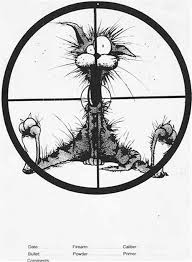
Now the image shifts: Bob was nearly killed by something like this:


Amazing what a little hyphen can do, don't ya think?

Monday, February 09, 2009

Today Is the Day!

Today is the big day many LDS readers and writers have been waiting for: the announcement of the 2008 Whitney Award finalists!

Yay!

Spires of Stone was a Whitney finalist last year, and I couldn't have been more thrilled over that. Whitney committee members aren't eligible for the award, and since I didn't have an '08 release (so wasn't eligible anyway), I offered to serve on the '08 committee. Among other things, it meant I got to be a judge for two of the categories.

It's been a fantastic experience so far. I've had the opportunity to read a lot of books I never would have picked up otherwise, books nominated by readers.

That's how the program works; it's reader-driven. So if you think an '09 release by any LDS writer deserves to be considered, whether they publish in the LDS market or the national one, nominate it!

Some of the books have been stellar. Some . . . haven't been. But every book taught me something.

I believe the existence of the Whitneys (the brainchild of Robison Wells who has put in hundreds and hundreds of hours of work into it) will make writers and publisher up their game, continually improving the quality of their fiction. It'll also help readers looking for quality LDS fiction to find it.

The next step is when the Whitney academy, made up of hundreds of industry professionals (writers, editors, reviewers, bookstore owners, publishers, etc.) read and then vote on the finalists. They'll cast ballots in several genre categories (General, Romance, Speculative, Youth Fiction, Mystery/Suspense, and Historical) as well as for Best Novel of the Year and Best Novel by a New Author. The Whitney Gala will be in April after the LDStorymakers conference.

I can't wait!

Even though it's too late to nominate a book for the 2008 award, be sure to keep the Whitneys in mind as you read throughout '09. You can nominate all year long at the Whitney website.

A big congratulations to all the finalists!

Friday, February 06, 2009

Writing Journey: Part V

Part I
Part II
Part III
Part IV

I'd been writing for years and years (buckling down and getting serious for eight years by this point). That meant I'd written lots of manuscripts. What that didn't mean was that they were all good. It also didn't mean I had several just lying around, ready to be submitted.

In fact, one of them in particular is so awful I don't think I'll ever open the file again. I call it one of my "learning experiences." (What NOT to do . . .)

I had a problem, though: if I didn't submit something else very soon, I'd end up with a two-year gap between my first and second books. I was working on something else (more on that in a minute), but I wasn't anywhere near done with it. At the rate I was going, trying to finish it might take a year or more . . . which could mean three or four years between books.

Not a good way to build a readership.

As things stood, I'd spent nearly 3 months on promotion and about that long again adapting to life with another baby. I hadn't done much by the way of writing during those months. I was burning daylight.

I decided to pull out the manuscript that Covenant had requested I revise and resubmit more than a year before, the one I'd sent in right before LWY. It was the book that sparked my lunch with Valerie, and Covenant had shown interest in it, right? So I sat down and revised the puppy . . . yet again.

This time I made changes based on what Valerie had told me about the market, which meant some hefty revisions. For starters, I aged my protagonist by six years (the average Covenant reader isn't going to go for a high school graduate as a protagonist; that's way too young), so Annela now had a dream of going to the States for graduate school instead of college. I had to redo several opening chapters because a 24-year-old isn't going to be living at home, but I needed to get her there temporarily for the rest of the story to work. Stuff like that.

I submitted it and hoped for the best.

Within a few months, the book was accepted for publication (yay!), but of course, I didn't get lucky by landing another release date only 5 months out. Turns out my books would be nearly two years apart anyway: LWY hit shelves July 2002, and this one would come out February 2004.

Our family ended up moving right in the middle of edits. This caused a couple of problems.

First, I'd just gotten my first royalty check, with which I bought a fancy-schmancy microwave. My hubby got an equal amount from the check to buy a guy toy with. (Wait. You thought writers are rich? Hahahahaaa!) I was not about to leave my hard-earned (and did I mention fancy? I mean, it had a setting for melting chocolate!) microwave behind.

We took it with us even though it wouldn't match my new kitchen. But we were installing a little kitchenette downstairs (for future popcorn popping and whatever when kids have friends over to watch movies), so that's where it is now. It still brings me joy:


The second issue moving caused was losing access to my computer. I remember being in a panic because I couldn't retrieve a file I needed, and I might miss an important deadline. At one point, in an effort to get me an edit, I ended up having Angela e-mail a file to my dad. It was nuts, but it all worked out.

I got the title and cover after we were somewhat settled in the rental we'd be living in while our house was being built. (For me, memories of where things happened are inextricably linked to the events themselves, so I gotta include that. Stupid rental. I hated that place.)

When I first heard the title, At the Water's Edge, I thought it worked pretty well on a couple of levels. Annela is on the verge of baptism at the opening, so symbolically, she was at the edge of the water. And then a lot of significant things take place on a big stone protrusion (nicknamed "The Elephant Rock") at the beach. So again, the water was meaningful.

But the cover? Mmmm . . . Honestly? It's my least favorite:


My biggest reason for not liking the cover is that the book takes place in Finland, a land of lush pine forests. The picture on the cover, on the other hand, looks like it could have been snapped in Saudi Arabia.

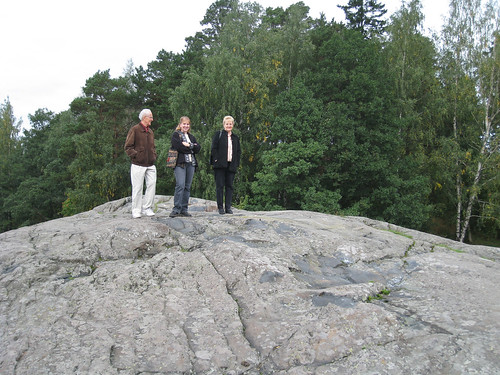
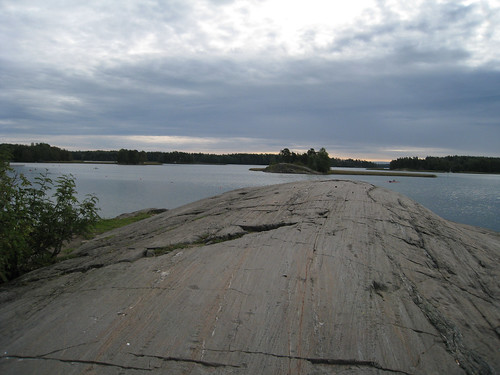
When my husband and I got to visit Finland last fall, I made a point of visiting the real Elephant Rock, where a lot of the book takes place.

Here is a photo of me with my parents on the Elephant Rock (the angle is such that you can't see the elephant head shape, but it'll give you an idea of the setting):

And looking out from the rock to the water:

Let's all laugh now. :)

Even though I didn't feel that the cover matched the book, I didn't make a stink over it. First off, I didn't dare; I was still pretty timid. But I also trusted the marketing people, figuring that if it was eye-catching enough to make readers pick up the book, then the cover did the job even if it wasn't accurate. (In the end, I'm still not all that sure the cover did its job, but I digress.)

In the final proof stage, I came across some funky symbols in the text where Finnish letters belonged: every time there should have been an A or O with dots on the top (like Ä), there was some weird symbol instead. I kinda panicked.

My beloved editor, Angela, assured me they'd all be fixed. In my paranoia, I asked her to fax me the affected pages so I could see for myself that they'd been corrected before the book went to press. (She was always great at accommodating my control issues. I was timid on the cover, but not on the text!) And phew. They were all fixed.

This book was the first and only time I've gotten a radio ad for advertising. The commercial was silly and fun. The term "chick lit" was pretty new, and someone in marketing misunderstood what the term meant, figuring that "chick lit" simply meant books women like (akin to "chick flicks"). So the ad refers to ATWE as "chick lit." Which it totally isn't. I didn't care; I got a radio ad!

(To hear the commercial, click on the link at the bottom of this page of my website.)

Right around this time (following the release of LWY and during the revision/submission stage of ATWE), I finally got the guts to start writing a book that had practically been burning a hole into my psyche for some time. It was the one I had only a few chapters of written after LWY came out, so it hadn't been an option for submitting second.

For years, I'd felt drawn to writing a story about the Logan Temple. The very thought of attempting to write something historical scared me off (let's all laugh again . . . I had no idea what the future held!).

But the story simply wouldn't go away; it nagged at me. I'd already read Nolan P. Olsen's book about the Logan temple. Twice. I was drawn to the book originally because there's family history in Logan, including the fact that my parents were married in the Logan Temple, and I chose to be married there as well. I knew that somewhere in Olsen's book was a story I had to tell.

For a long time, I was just too chicken to do it.

Before our move, I attended a city-level writing workshop where Marilyn Brown, a historical novelist, spoke. Her sheer excitement over her research and writing was contagious, and I left with the courage to finally try my hand at a historical novel.

After submitting At the Water's Edge, I had no excuse to avoid the historical anymore. I buckled down to finish this project that was totally different from anything I'd ever tried before, a fact that was both thrilling and absolutely terrifying at the same time.

**Edited to add: I got the rights back to ATWE a few years ago, got a new cover designed, and put it up as an e-book. Here's the new cover, which looks so much better: a woman who looks Scandinavian, with a blue (watery?) background. Love it.**


Wednesday, February 04, 2009

WNW: A Place for “Ain’t”

I’m all for using correct grammar. (You know that, right? Especially if you’ve read Word Nerd Wednesday for any length of time.)

That said, the word nerd in me has much joy discovering fun and interesting grammar tidbits in odd places.

One such oddity is the word ain’t.

While I won’t advocate the average person using it (particularly if you hope to sound educated), get this:

In English, there is a grammatical place for ain’t. Really.

Check it out:

First off, let's look at the basic “to be” chart with all the regular pronouns.

Singular:
I am
You are
He/She/It is

Plural:
We are
You are
They are

With me so far? Good. Now let’s negate them:

Singular:
I am not
You are not
He/She /It is not

Plural:
We are not
You are not
They are not

Simple so far, yes?

Now, since we generally speak in contractions, let’s make these into contractions, starting with the plural side this time:

Plural:
We aren’t
You aren’t
They aren’t

Now for singular, starting at the bottom:
He/She/It isn’t
You aren’t
I . . . ????

There is no contraction for “am not.”

What could you use? I am’t???

Eureka! I ain’t!

See? English has a grammatical hole—a vacuum. And vacuums tend to be filled. So I ain’t came about because of that hole.

Grammatically speaking, the existence of ain’t makes perfect sense.

But since we’ve be taught that ain’t is wrong, we compensate by making a contraction instead out of “I am” (I’m) instead of “am not,” yielding, I’m not.

According to my trusty OED, ain’t has been around as a contraction of “am not” quite a bit longer (since 1778) than won’t has been around as a contraction for “will not” (since 1857).

Don’t (even older: 1670) and won’t were debated by the educated masses and often derided at first until they were accepted as perfectly fine. So why are these two acceptable but the other one isn’t?

No reason beyond ain't losing the roll of the grammatical dice. The debate could have ended with ain't being standard and won't being "wrong."

Note that none of these contractions are grammatically superior than any of the others. If anything, ain’t makes more grammatical sense than the others. There’s a specific hole it fills, after all.

We’re just used to one of them being “wrong,” and as a result, it’s not part of the standard dialect used by educated speakers.

This is one more example of how dialects (even Black English Vernacular, which frankly sounds totally random and incorrect compared to Standard English) actually make sense when you break them down. They have patterns and rules of their own, even when the users don’t know it.

It also shows that the standard dialect doesn’t necessarily make any more sense than another dialect. It’s not better or superior in any way; it’s just the standard.

Naturally, we still need to know the standard and use it, so you won’t hear me using ain’t, even if it’s technically not grammatically inferior.

Post Script:
And in rather horrifying news, Birmingham, England has decided that apostrophes are no longer necessary. They've been abolished from street signs.

City councillor Mullany said, "Apostrophes denote possessions that are no longer accurate, and are not needed. . . . More importantly, they confuse people."

Um, WHAT?!!!! Read the article here.

Monday, February 02, 2009

One Month! And, I'm Old.

Yesterday, I was informed of the following by my six-year-old:

"Mom, if you were in cat years, you'd be dead."

Um . . . thanks, cutie. I can already feel my joints creaking . . .

Fun stuff: We're only ONE month out from the release of Tower of Strength! Yes!

So even though the release is a little way out, I thought I'd put up a fun doohickey video thing I put together about it.

Keep in mind I'm not a photographer. When hubs and I took these photos, it was on a research-gathering trip to Manti. It wasn't until much later that it occurred to me to use some of them this way.

(Have to say that it was awesome picking out buildings were certain events happen in the book, and a few of them are in the video.)

One of my favorite parts is the music. It's an arrangement of "Come Thou Fount" with some "If You Could Hie to Kolob" thrown in. It's arranged and performed by the talented Sher. (Be sure to check out her music website here.)


Friday, January 30, 2009

Writing Journey: Part IV

Part I
Part II
Part III

After that February phone call, my editor Angela and I began the editing process pretty quickly because I had an unusually early release date. At first they waffled on two different ones: July or January.

With the typical publishing pipeline process, January would have made much more sense. I don't know why they ended up picking July, but I've always guessed they had an unexpected open slot or something. Looking back, I can see how insanely fast it all happened.

July turned out to be very good for me, as I was due with baby #4 mid-September. That gave me two and a half months to promote before baby arrived. Trying to do book signings and the like with a newborn would have been a challenge. (As it was, dragging my huge, swollen self around was tough enough. My last book signing was days before she was born.)

I spent my spring going over edits and proofs. At one point, Angela informed me in an e-mail that my book would be called Lost without You.

I stared at the screen, confused. I typed, "What does that have to do with my story?"

Her reply: "Oh, I think they figured it was just a romantic-sounding title."

Great. I pictured the marketing department with a list of "romantic" names in one column and a list of writers on the other and then someone randomly drawing lines between the two.

I'm sure it wasn't like that, but I still didn't like the title. To me, the romance wasn't the point of the book. Yes, it's a big part of the story, but it wasn't where I wanted the focus to be. I wanted it on the mother-daughter relationship. Oh, and "lost without you" isn't something any of my characters would say.

During the final editing, I asked if I could tweak the last scene. I added one sentence of dialogue (which included the words, "lost without you") so that the title would point to what *I* wanted it to. (Not the romance!)

Since then, I've gotten several reader letters saying that they wondered what the title had to to do with anything until they got to that line. So, yeah. Glad I did that.

Then I saw the cover. In case you don't remember it, this is what it looks like:


It's not my favorite cover (not by a mile), but it's not bad, either. It does the job pretty well.

Let's analyze it for a moment. Remember, authors don't get much (if any) say in their covers. As a first-time author, I had even less say. No clout at all. I didn't even see the cover until it was finalized and in the Covenant preview catalog that goes to bookstores.

I thought the vertical design was kind of cool. The color was catchy. But . . . the girl on the cover looks pregnant. Brooke isn't pregnant. Ever.

And the girl has curly, brown hair. Brooke has straight brown hair. At one point, she dyes and perms her hair for a part in a play. So if it's curly, it should also be red. She looks so sad and miserable, but the story is actually pretty light for the most part. (It even has some funny moments, I think.) Overall, I didn't fall in love with the whole stock photo thing.

Note how itty bitty my name is on the cover. That's because no one would be picking it up based on my name. I didn't have a name yet, if that makes sense. Ever notice how books by really huge writers have their name emblazoned over half the book, while you almost have to search for the title? That would be why. Their name is selling the book.

A lot of readers are horrified when they find out that the writer doesn't get much say in the title or the cover. But the reality is that the marketing and graphic design departments have a ton more experience in selling books than the writer does. The writer's job is to write a good book; they package it and sell it.

These people have the goal to get customers to pick up your book off the shelf and give it a chance. They have a lot of experience in knowing what types of covers and titles will do that, and which won't. On top of that, the graphic design people are trained in making covers look professional.

Granted, sometimes they create flops, but it's far more likely that they'll do a (MUCH!) better job than the writer could have if given the chance.

This is why it's pretty easy most of the time to spot a self-published book: the writer picked the title and the cover and didn't know how. The cover and title might match the story inside, but the book will almost certainly get passed over on the vast sea that the bookshelves are.

Since the publisher takes the entire financial burden for evaluating, editing, designing, printing, shipping, and marketing your book, it makes sense that they'd get the say on how to sell it to give it the best shot.

That still doesn't make it easy to wait to see what they come up with!

(But I'm still thrilled over my newest cover!)

For over a year I couldn't call my first book by its title; it was just "my book." Not until I had more than one published (so "my book" was no longer specific enough) could I call it Lost without You.

I discovered shortly after LWY hit shelves that getting such a quick release date had one pretty big down side: if I wanted to build any kind of readership in my market (so readers would actually remember me), I'd need to have a book out roughly once a year.

Next time I'd have the typical year-long lag between acceptance and publication, and that didn't count the time it would take to get through the submission and evaluation process with another book.

Which meant I needed to turn in another manuscript, oh, yesterday.

Thursday, January 29, 2009

Random Sevenness

Rebecca tagged me for this one, and since I haven't blathered much (at least lately) about my non-writer self, here goes: Seven random things about me you probably didn't know.

1) I clean left to right. Or right to left. But I can't stand cleaning randomly. I have to see my progress and what needs to be done next. For example, when I'm cleaning the kitchen counter, one end will be clean and clear while the other is still messy with dishes and junk mail as I move my way across it.

2) I select my clothes left to right. Unlike people who organize their closets by color or whatever, here's what I do: I hang up clothes on the right side of the closet. When I get dressed, I try to find something from the left side first. This tells me pretty quickly what clothes I don't really like to wear (or which no longer fit or whatever), because they end up lingering on that end of the closet. If they sit there too long, I know it's time to get rid of them. Goofy, I know. But it has an additional bonus: I often stumble across clothing combinations I never would have thought of otherwise.

3) When I was a kid, I had toenail fungus in my left pinkie toe, which made it thick, yellow and weird shaped. We tried all kinds of home remedies to get rid of it. Somehow it's gone now. No clue why.

4) I'm becoming my parents. I'll pass a mirror and notice a facial expression or gesture that's totally Mom. Or I'll hear myself saying something that sounds eerily like Dad. (Notably, "Giiiiiirls . . . go to sleep!")

5) I had mumps as a kid. Twice. That's not supposed to be possible.

6) I have a scar on my chin thanks to my brother. Considering this is the guy who dragged me around in sleeping bags, locked me in the closet, and set my hair on fire (not kidding), you'd think it's a miracle that I don't have more scars. But here's the thing: I got my chin busted open while he was playing nicely with me. I think I was three.

7) I did my own nails for my wedding, complete with acrylic. They were bright red and looked awesome.

Wednesday, January 28, 2009

WNW: Reader Edition

Apparently, I’m not the only person who twitches at word missteps. I have several such readers—fellow Grammar and/or Usage Nazis—who have shared with me some of their peeves.

I must say, they’re nearly all peeves of my own. (My readers are kindred spirits! It brings me joy!)

So for today’s Word Nerd Wednesday, you are the stars.

The first peeve was suggested by both Blondie and Rebecca:

I could care less/I couldn’t care less.

Which is correct? Not the first one, but you’d never know it by how often you hear it thrown around.

What you’re trying to say is that you care nothing at all for something, right?

So think about it: “I could care less” says that you could theoretically care less than you do at this moment. Which means you do care at least a little.

I COULDN’T CARE LESS, on the other hand, means that you currently care so little that there is no conceivable way you could possibly care less than you do.

There is absolutely no care-age involved. None. Nada.

(So I made that word up. Sounds like something George or Jerry would say, though.)


The very funny KristinaP at Pulsipher’s Predilections threw the next one at me:

Irregardless
IR is a prefix similar to UN: it reverses or negates what comes after, much like untie means to reverse the tying process. It means NOT, like irresolute means NOT resolute.

The word regardless already means “despite everything.” So if you negate that, do you mean “because of everything”?

(Which, of course, you don't. That isn’t what people mean when they say, irregardless.)

Merriam-Webster takes a stab at guessing why people use this. They say that maybe irregardless is a combination of irrespective and regardless.

Somehow I’m doubting that people who use irregardless even know what irrespective means. Maybe I should give them the benefit of the doubt? Mmmm . . . nah.


Jami brought up one of my all-time favorite peeves (if that makes any sense).

Nauseous
This is an adjective describing something else that makes you feel sick to your stomach.

Mold could be nauseous.

The smell of vomit could be nauseous.

During my pregnancies, I thought bacon was nauseous.

But *I* was NAUSEATED.

If *I* am nauseous, then I’m personally disgusting and I make other people want to throw up! Not what people generally intend to imply when they say, "I'm so nauseous." (This one makes me giggle.)

This word is so misused that it's losing ground (you remember how language changes, right?). Nauseous is fast becoming acceptable in the sense of how you feel, rather than just describing something else that makes you sick.

Regardless (ha!), I still can't hear it without getting a funny image in my head, and I personally can't get myself to use it that way.


Sher mentioned a great one:

Needless to say

If you can include this phrase, then you should delete the phrase AND whatever comes after it. If you don’t need to say it—if it’s that obvious—then DON’T SAY IT.

Finally, LeeAnn mentioned a fun slip-up:

Excite/exite
Weird part here is that the second word isn’t even a word, just a common misspelling of the first one.

(One of my personal spelling peeves is seeing DEFINITELY written as DEFINATELY. Ergh!).

Excite means to get something or something worked up, or excited.

Exite doesn’t mean anything, but it looks like those green signs in the movie theater that you leave through.


This was a great list. Keep the peeves coming!

Tuesday, January 27, 2009

Weeeee!!!! I Love It!

I'm mucho excited here. I wasn't planning on posting today, but something changed: I just received the cover for Tower of Strength!

Opening the file for the first time is always nerve-wracking: will the cover be something I like, love, am indifferent to, or totally despise?

It's pretty rare for an author to have much say in a cover or in the title (more on that Friday on my Writer's Journey series). So you kinda hold your breath and hope that marketing and you are on the same page.

To be honest, I've had a range of reactions to my covers. Today? All happiness. Here it is, in all its glory:


Isn't it pretty? (I'm really liking the green.)

Since the vast majority of my readers haven't read it yet, I have to point out why it's so perfect. Before the book opens, Tabitha leaves Manti as a young bride (which totally fits, because doesn't she look like a bride?! I know!) And the book closes at Christmas time (which makes the winter scape fit). It's like symbolically morphing two periods into one.

Cool, huh?!

I'm not sure yet (because I haven't seen the credits), but the temple and the girl both look they're by the same artists who did the work on my three other historicals: Al Rounds is my temple artist (I know he doesn't do paintings just for my books; they're licensed after he's done them, but I'm claiming him anyway), and William Whitaker is the one who's painted all my girls.

I've been waiting for this release a long time. I started drafting it nearly two years ago, and the thrill of uncovering the story is still with me. (I blogged about one big moment I had with the story here.)

Suddenly this one is feeling real. I now have an idea of what it will look like when I hold it for the first time. It's no longer just a bunch of words on my computer screen and a story with fictional people wandering around my head, but an actual book.

(You'd think that by book six this kind of thing would get old. Trust me; it doesn't. For me, it only gets better!)

I just ate WAY too much chocolate in celebration. I need a drink of water . . .

Monday, January 26, 2009

In Case You Couldn't Tell, They're Writers

I got a Google alert recently that made me laugh. Actually, it was the second one to make me laugh. I got one last fall that informed me I was dead. It was the obituary of some Annette Lyon in New York. Apparently, she’d lived a good life and was a good cook (definitely not me).

This particular alert informed me of a copy of Spires of Stone for sale at an online shop . . . in AFRICA.

How in the world did it get there, you ask? I think I know. See, about a year ago, I drew a winner for one the contests I run on my website. Turns out she lived in South *#$&#*# Africa. Since I hadn’t said on my contest that I wouldn’t ship internationally, I figured I should send her the book.

(I'm wondering if I'm going to lose a fan after posting this. Hi, if you're reading this! I won't mention your name!)

Shipping the book cost me somewhere around six times what it would have cost to mail somewhere here in the U. S. So while I normally wouldn't bat an eye at someone selling off one of my books, this one had me raising an eyebrow. (And it had me laughing, because really, who is South Africa is going to buy an LDS novel off her?)

So I mentioned the alert to my buddies on the LDStorymakers e-mail list, jokingly saying, “Well, she must have really appreciated the trouble I went to since she’s now SELLING it.”

Their response? Well, let me show you.

I won’t reveal who said what (let's protect the innocent and hilarious . . . okay, one of them is Rachel Ann Nunes . . . she was on a total roll. And there was Julie Wright and Josi Kilpack and Tristi Pinkston and Janet Jensen, and Jewel Adams. But I'll let you guess who is who since these were all off-the-cuff, unedited comments).

Here’s what they had to say on the list as the day wore on. I was laughing myself silly.

Writer #1:
Maybe this is one of those moments where she read it, loved it, it was a treasured thing in her home, but now her baby needs medicine and she has no money so she is selling her most prized possession in order to save her child?

Imagine the tears she will cry as she packages up that sacred treasure and knows if she ever comes into money again, she will be buying it back.

Writer #2:
Don’t forget that she’s a widow with a hunched back—the fact that she had Internet access is inconsequential.

Writer #3:
She had to walk twenty miles on blistering roads, barefoot, uphill both ways, into town where she could use the Internet at the library. She sobbed so much all over the keyboard that she now has to shelve books for twelve hours to pay the library for a new keyboard. It would have been ten, but they wanted to get an ergonomic keyboard instead of just a simple flat one.

And the disease that now afflicts her child is the same one that took her husband's life, so she really, really has to get that medicine.

Writer #4:
No, I'll tell you how it went down. She was in her grass hut reading her coveted copy of Spires of Stone when a truckload of armed men came in and demanded that she surrender her valuable possessions.

They looked at your book and thought, "Aha! An American book written by an American woman! Say, this Annette Lyon! I have heard of her! This book will fetch much money. Then we can use the money to help fund our military!"

I'm telling you guys, that's what happened.

Writer #5:
Exactly. And on the way to sell the book, the armed men were accosted by an opposing militant group and in the resulting battle everyone died except one young man whose leg was nearly shot off.

He survived by drinking out of an enemy canteen and reading Annette's book. The words took his mind from the pain. After feeling the Spirit, he decided to turn to never hurt anyone ever again. When he was finally rescued, he paid his saviors with his only possessions, the book and the canteen.

The daughter of the couple who found him also read the book and they stayed up late during his days of recovery to talk about the fantastic plot. They fell in love, and the boy wrote her poems inspired by Spires.

Unfortunately, the lady of the house had to trade the book for the dozens and dozens of eggs she needed to make the wedding cake for her daughter's wedding to the boy (they have at least 200 relatives and they have to invite them all, even if they don't have shoes).

The egg lady read the book and loved it so much that she read it aloud to her forty grandchildren. She planned to treasure it the rest of her life, but one of her grandchildren wanted to attend college, and so she gave the book to him, along with several dozen eggs, to sell for tuition so he could learn to be a doctor and treat all his cousins and other relatives.

Now no more would have to die of common illnesses or get gangrene because someone forgot to wash his hands.

The book was sold online by the college student and was bought by a rich man who is trying to bring solidarity and peace to the entire country. He'd wanted the book as a gift for the woman he loved, but the ideas in it were so intriguing that he . . .

Writer #6:
. . . he would teach the principles he learned in the book to a camp full of refugees. Somehow the story leaked to the media there. A reporter went out with a camera crew and found the camp of 5000 refugees surrounding the rich man, listening intently as he read from what they were now calling "The Book."

Banners with the Spires of Stone cover and a head shot of Annette donning a tiara made from an elephant's tusks were held up by numerous men wearing leather loincloths with multiple piercings in their noses and lips while the crowd softly chanted the words, "The Lyon cometh."

Writer #7:
. . at least they weren't singing “The Lyon Sleeps Tonight.”


Is it any wonder I love hanging out virtually with my writer friends?


Saturday, January 24, 2009

April's Giveaway

So you can ignore this post, because if you do, I'll have a better shot at winning (posting about the giveaway is part of what enters me into it).

But here's the deal: April over at April's Showers is having an awesome giveaway as part of her 100th post.

(See the cute button on my sidebar? Use it to go there and find out how to enter. Or don't. Then I might win. And I really wanna. :D)

Friday, January 23, 2009

Writing Journey: Part III

To catch up:
Part I
Part II

Having gotten rejection after rejection—but often positive ones that encouraged me to submit again—I felt as if the brass ring had been in reach. Over and over again. But never in hand.

Valerie, the champion in my corner at the publishing house I wanted to be at, was gone. The brass ring had slipped away just as my fingers skimmed it.

By this point, however, I knew what grasping that ring would feel like, and I was more determined than ever. I would not give up.

Instead, I printed off my newly-polished manuscript that Valerie thought had the most promise from a marketing standpoint (since I no longer had the cool privilege of e-mailing it to her). I wrote a nice cover letter to the managing editor with an explanation about my history, plus Valerie's suggestions and a note about our lunch together.

I mailed it off, holding my breath as the postal worker tossed my precious package into a bin.

That was November 2001.

I started working on another project right away, putting that book out of my mind and mentally deciding I'd think about it again around my daughter's birthday in May. That would give the company six or seven months to review it. My previous rejections from the same company had taken at least that long, and often longer.

At the end of January (only two months or so from submission), I received a phone call from an editor named Angela asking me to fill out some forms, as they planned to take my book to the committee.

The committee is where final publication decisions are made. The group is comprised of not only the editorial staff, but the head honchos, the marketing department, and anyone else who has a financial interest in the company’s bottom line. They look not only at the quality of the writing, but the potential audience and sales of any book.

Making it to the committee stage is a big deal. It means you’ve made several cuts already that most submissions didn’t. You’ve passed several stages of rejection.

So . . . you'd think that such news would have made me excited. It didn’t, not particularly. See, I had been to the committee before. Several times.

When a previous manuscript of mine was rejected by an equally large house, one of the head editors (I could totally name drop right now. I won't, but I'm betting that most writers who know this company know the name well) called me to say how my work was a “cut above” what they usually see, and that they debated—even with the president of the company present—whether to publish it, because it was good, but decided it wasn’t financially viable.

That's the rejection that actually put me in a good mood.

So instead of getting ready to whip out the pinata in celebration, I nervously filled out the forms (something that was new for this committee experience), sent them back, and tried not to get my hopes up. Again.

Almost exactly a week later, during the first week of February, Angela called back. At first I figured that I must have forgotten a form or left something blank.

Instead, she warmly welcomed me aboard.

I remember exactly where I was standing in the kitchen when she told me. And I remember speaking very politely and formally. Something like, “That’s wonderful. Thank you so much for calling.” She probably thought I was half dead or something, but inside was all fireworks.

I hung up and screamed.

My husband had coincidentally taken the morning off and planned to go into work after lunch. I tore up to our room and told him the good news.

And then promptly burst into tears. (The fact that I was pregnant certainly added to the emotional component.)

My then two-year-old daughter’s eyes grew wide when she saw me crying. “Why are you sad, Mommy?” she asked, clearly disturbed.

It was hard to explain that Mommy wasn't sad. In fact, Mommy was very, very happy. Mommy's life-long dream, which took years to accomplish, had finally come true.

My husband called his manager and said he wasn't coming in. He had to take his wife out to lunch.

Getting that first book accepted was the end of my apprenticeship, but in so many other ways, it was just the beginning of this road I’m still on.

Wednesday, January 21, 2009

WNW: Laughing at Myself

In an effort to prove that we all make mistakes and need to laugh at ourselves (and so you call all have some chuckles at my expense), I thought I'd tweak something I posted awhile ago for the Writing on the Wall blog where I'm the Wednesday contributor (it's a writing and editing blog for Precision Editing Group, which I'm part of).

Long-time readers have heard me sing the praises of my critique group, which is composed of several talented, published writers. (But we started out as a group of unpublished, aspiring writers. Look how far we've come!) We continue to meet regularly and read our work aloud to one another for feedback.

I've been attending for over 9 years, and I won't stop anytime soon. Some might think that by now we must have exhausted our usefulness to one another, that we've learned all we can, and might as well move on. Nothing is further from the truth. I've found that extra sets of eyes looking at my work will find things that I am incapable of seeing because I'm the one who wrote it.

It doesn't matter how great a writer is; the fact that you wrote the piece by its very nature dictates that you cannot see all the holes. The moment I think I'm such a good a writer that I don't need outside feedback is the day my writing takes a nosedive.

Even though most of what we look for consists of big stuff like plot and character issues, every so often we come upon something little that makes us all laugh out loud—usually something that didn't come out quite how we meant it to, something you most definitely don't want showing up on a bookstore shelf one day.

Below are a few gems that came from a single meeting about a year ago. Remember: All of these sentences came from authors who have multiple published novels under their belts. It happens to the best of us.

1. James hadn't meant to let it slip that he wasn't married, at least to his boss.

(No, James isn't married to his boss . . .)

A set-up for #2: the character in question has built a narrow enclosure for a horse, using dowels slid through the back opening of the area to prevent the horse from backing out of it. Okay, now the sentence will make more (silly) sense. Note that we've been talking HORSES:

2. He had made holes for sliding sticks through the rear end instead of her recommended two.

(Uh, that would be the rear end of the enclosure . . .)

The next one shows a scuffle between two WOMEN:

3. Suddenly her hands were on my chest, pushing me backwards.

(Doubt she meant to give her an unscheduled mammogram . . .)

Note there's nothing inherently bad about any of these sentences, but in context and with a different pair of eyeballs than the author had, a new meaning emerged.

Sometimes our "bloopers" are of the grammatical variety. Other times they're simply ambiguous. Then there are those that just leave a silly image in your mind.

Here are more gaffs I've gathered over the years (they're too funny to not keep a running file of)—all real quotes from drafts brought to our critique group.

And yes, some are mine:

Suddenly, my mother turned into a driveway.

Your grandmother killed him before I got the chance.

Lizzie's hands flew to her mouth. Inside lay four books.

Lighting a candle, she settled beneath the covers.

[My commentary: Then poof! went the quilt in a ball of flames . . .]

Andrew noted his lean frame on the high counter sipping his drink.

. . . he began, then stopped seeing Jacob's scowl

Quiet and patient, Alice's dark hair was always pulled into a simple bun.

She realized that tears were streaming down her cheeks. How could they?


One of the worst (best?) bloopers was mine, but the double meaning is so bad that I won't share it for all the world to see. That, and it's hideously embarrassing. I still blush at the memory. (NOT what I meant!)

It was worse than the time Jeff [or Scott, as he's commonly known now] had a detective wondering about the leak in a case as a character relieved himself in a bush. (He's the one who always brings up my really bad gaff. If you ever see him, go ahead and ask what it was. He'll tell you, and totally laugh his head off while doing it.)


And here's our all-time favorite blooper:

The set-up: A man is hiding inside a cedar wood closet. The smell of the wood reminds him of the cedar chest his mother once owned. But instead of saying it like that, it came out like this:

The scent reminded him of his mother's big, smelly chest.

I still giggle at that one.

We've had our laughs over all of these, and any time someone lets a blooper loose, I write it down—not only because of the chuckle, but because it's a subtle reminder that we all need one another to read over and catch not only our bloopers, but all kinds of other things that can make our writing continually better.

It's something every writer needs. A sense of humor helps too.

Tuesday, January 20, 2009

I'm Tagged; You Get Chocolate

I don't get tagged all that often, but on Sunday Amanda D from The Little Things tagged me for this one I'd seen going around blogland:

Post the sixth photo in your sixth folder.

Here's mine:


To explain:

This is my daughter's hands as she makes the first layer of Chocolate Bark. I took pictures of her doing the entire process as part of a query for a girl's magazine article. The department I was shooting for likes recipes girls her age can do with little to no adult help. Chocolate Bark totally fits.

I'm far from a chocolate expert, but I have had some fun with it, and I've collected a lot of recipes. At some point (in the relatively near future, I hope), I plan to write a chocolate cookbook. More on that another time.

In case you're interested, here's how to make it. (Some day I may post more specifics, like how to actually melt the chocolate and so forth, but today, I'm going for simple.)

Chocolate Bark

Spread parchment over a cookie sheet.

Melt three kinds of chocolate, making sure you don't overheat them (they'll seize, turning into a grainy, icky mass). Then stir them a bit to get some air into them, cool them down slightly, and to get the chocolate tempered right so it won't bloom.

You'll be using different amount of each chocolate, so decide how you want to layer them. I prefer to use dark chocolate for the bottom layer (the most you'll use), milk chocolate for the top layer (you'll use slightly little less), and then white or some other fun color for the drizzle (you'll need the least of this one).

Spread the first layer of melted chocolate into a 1-2 mm thick rectangle.

Spread the second layer of melted chocolate on top of the first, leaving a small margin so the first shows around the edges.

After putting the final kind of chocolate into a zip-style bag (some day I should post about the nifty trick for filling the bag), seal it off and snip the corner with scissors. Use this as a decorating bag to drizzle over the entire surface. If you're using a color that contrasts well with the other chocolates, the effect will be really cool.

Sprinkle whatever crunchy item you want over the top. (This is what makes the end product "bark.") Possible items: chopped nuts, peppermint crush, toffee bits, sprinkles, etc.

Put the cookie sheet into the fridge and leave until the chocolate is set, half an hour or so, depending on the thickness. Remove from the fridge and break by hand into bite-sized pieces.

Just for fun, here's the final shot we took of the project:


YUM!

For the tagging (I don't remember where all I saw this tag, so forgive me if I'm forgetting to tag someone or forgetting that you've already been tagged!):

Tristi, Luisa, Lisa, Lara, and Josi.

Monday, January 19, 2009

And She's Cute, Too.

My youngest (age 6 and a half) has a game she like to play, something I sure many of you do with your kids.

It goes like this:

"I love you more," she says.

"No, I love you more," I answer.

"I love you a hundred."

I counter, "Then I love you a thousand."

"I love you a million-zillion-billion plus two!"

"I love you FOUR million-zillion-billion plus eight!"

In a fit of energy, she proclaims, "I love you more than you can think of and more than I can think of, put together and infinity! I win!"

Then she giggles herself silly.

I knew she understood the generic concept of infinity (thanks to lectures from her older siblings), but I had no idea she knew it went beyond the theoretical "biggest number there is, to no end."

The other day she left a note on my desk. It revealed that she's darn smarter than I gave her credit for. I don't know where she learned this:


Translation: "I love you Mommy infinity" (note the INFINITY symbol).

(Whose daughter is this again? Oh, yeah. Her dad's.)

On a second sticky note tucked under the first one, she added one more bit, just in case I tried to beat her at the game and also love her to infinity:


"And 100"

Friday, January 16, 2009

Writing Journey: Part II

Part I is here.

Following that Labor Day weekend in 1994, I continued writing and submitting my work. High school buddy Sam and I finished our Rumpelstiltskin novel. I wrote a YA fantasy—the first full-length novel I ever finished on my own.

I found writing alone surprisingly hard. Remember, by this point, Sam and I had written two full-length works together: a full screenplay and a novel. We worked well as a team, in part because we could be totally honest with one another. If I had a really dumb idea or wanted to add a line of dialogue that sounded cheesy, she’d say so.

Facing the computer screen without her to keep me in check was scary. I had no idea if what I was doing amounted to crap.

During this time, I submitted my work and got several positive responses that were still rejections. (“We love the concept! Now send us sample chapters! We loved those, so send us the full manuscript! We still love it, but it’s not quite right for us; sorry.”)

In the middle of all this, I started querying magazines with article ideas. One editor, after seeing several of my queries, contacted me and gave me a small assignment in an upstart newsletter that the magazine was launching.

That assignment led to several more, and more and more. At the same time, a fledgling newspaper (now defunct) needed a writer, and the religion editor happened to know me and ask for my help. I ended up doing articles for her department as well as book reviews and some other articles, some of which landed on the front page.

In the meantime, I kept writing novels, attending local writers groups and going to conferences. I read books on writing. I joined a critique group. I entered contests. I took my apprenticeship very seriously, working hard on learning all I could about the craft of writing. I even served three years on my chapter’s board of the League of Utah Writers, including one year as chapter president. (In that position, I had to organize the League's spring workshop. While pregnant. So fun, and no pressure or anything.)

My most proud moments from this period were taking second place in the League's statewide novel contest two years in a row. I submitted both of those novels for publication and received very encouraging responses—including one rejection that actually put me in a good mood it was so glowing—but yes, rejections to add to my growing file.

A third year I entered another novel in the League's contest, hoping for a repeat award. This time I didn't even get an Honorable Mention. To make matters worse, the judge all but shredded my work. The comment form was littered with every cliche about bad writing. He/she might as well have scrawled, "Do you speak English?" across the top.

The only strength they found in my writing was the fact that I had actually completed a full manuscript, so apparently I must have some perseverance.

But, um, I already had perseverance . . . this wasn't my first manuscript. It was, counting the fairy tale I wrote with Sam, my seventh. I was already a published writer with a couple dozen articles under my belt. I even won a publication award from the League for them. I wasn't a complete amateur.

A writer has to have a thick skin, and over the years I had developed a relatively thick one, especially since joining that critique group (the best thing I ever did for my writing, incidentally). But something about this judge's comments cut deeper than any other criticism I had ever encountered, leaving me paralyzed.

I was a total basket case. My husband could tell I was in a very dark place, so for the only time ever in our marriage besides Valentines and our anniversary, he sent me flowers. I sobbed over them.

I couldn't write for two months. I questioned my ability. I questioned my sanity. I almost threw in the towel. My husband let me cry in his arms more than once, but he never let me seriously entertain the notion of quitting. He knew I’d regret it for the rest of my life.

During this grieving period, I couldn't see how I could possibly keep going. I considered submitting to tiny publishers where my chances would be much better. But I knew I would never be satisfied if I “settled.” I had to keep aiming for the top of the market I wanted to be in. That pretty much meant getting in with one of three publishers (at the time; now there are only two big fish).

I licked my wounds and decided to take a hard look at the book I had entered into that last contest, the one that was apparently so terrible.

It simply couldn't be as bad as the judge had said, I figured, but obviously something was wrong with it, and I was determined to find out what. About three quarters of the way into the rewrite, I had an epiphany and realized exactly where I'd gone wrong. Eureka! (I still think the judge was an idiot. The book wasn't that bad. But yes, I figured out how to make it much better.)

While fixing that book, I resubmitted a novel I'd sent to a publisher once before, but which now had a new managing editor. I'd revised that manuscript quite heavily before submitting it a second time. Instead of a blanket rejection this time, they requested that I revise and resubmit the book. A step forward!

Within days of that request, Valerie, one of the editors at the publishing house, contacted me. She'd seen my work cross her desk over the years and knew my history well.

In an e-mail she invited me to lunch to brainstorm why, since she felt I had talent, I had come so close to acceptance so many times yet never quite made it. We would also come up with ideas on what I could do to push my work over the edge into publication.

To say the least, I jumped at the chance. (I think I cheered, sang, and danced at the chance.)

The next few days were spent feverishly writing synopses of some my books to send ahead of time so Valerie could read them and give me feedback. We met over Chinese and talked for a long time. I came away with fabulous ideas and a better understanding of what the company was looking for.

My biggest problem? The books I had submitted, no matter how well-written, weren’t as marketable as they needed to be. Publishing must, unfortunately, account for the bottom line. It's a business. If they love a book but can't sell it, they probably can't accept it.

When she described the types of books they had published that had sold the most and who their readership mostly consisted of, a light bulb went on in my head.

Ahh . . . so if I tweak X, Y, and Z, this particular book would suddenly appeal to a broader audience. I get it!

I also asked Valerie which book I should submit next: should I rework the one just rejected as I had been told to, or should I submit the one I'd most recently finished and was revising?

She thought my new one—which the judge had hated, but which I had since done major surgery on—had a great shot, and she told me that I could submit electronically to her when I was ready instead of having to do the snail mail thing (way cool). She said she looked forward to helping me break in, because I would be an asset to the company.

I think I floated home.

A couple of months later, when I felt the book was polished enough, I e-mailed Valerie and asked what format to send it in.

Surprise! That very day was her last at the company.

I felt like hitting my head against a brick wall.

Thursday, January 15, 2009

Extra! Extra!

I interrupt my regular posting schedule to make a brief but exciting announcement:

The manuscript I submitted last fall has been officially accepted for publication!!!

Excessive use of exclamation points is warranted!!!

Tentative title!!! Band of Sisters

Tentative release!!! Spring 2010

About!!!
Five women whose husbands are deployed in Afghanistan. Each has her own struggle and story, and the experiences they have and the friendships they make change them forever.

(Quite a departure from the whole historical temple novel thing, no?)

Good thing #2 baked brownies after school. It's time for chocolate!

!!!

(Thought I'd add more exclamation points. They fit. I'm exited!)

!!!

Wednesday, January 14, 2009

WNW: Banish the Paranoia, Literally.

This week's Word Nerd Wednesday is partially a public service announcement.

There is no need for bloggy/writing/conversational paranoia.

Really. I've had a lot of comments and e-mails along the lines of, "I'm not an English major, and I don't know grammar. You'll totally freak out reading my blog . . ."

But here's the thing: I won't. And I don't.

When I say that certain gaffs make me twitch, it's almost always in professional publications or other places like that.

Blogs and other casual settings, including daily conversation, aren't a big deal to me. Really, truly. There are places where the editor hat and the mental red pen go into a drawer and stay there.

An example, which has happened on many occasions:

A friend sends an e-mail, which I quickly read and reply to and don't think about again.

Five minutes later, another e-mail arrives, wherein the writer corrects her typo in the first e-mail, sure that I cringed reading it.

Here's the thing: I didn't even notice the typo, but now I have to go reread the e-mail and find the typo I'd glazed right over before.

(See, once it's pointed out, I have to look for it. It's like a cosmic law or something.)

Rest assured, I don't freak out over typos or grammar errors on blogs. I know they're not perfect, and they're not supposed to be.

Which is why I reserve the right to have typos and grammar errors on my blog as well. I have them frequently, and I figure that's okay.


Now for some actual WNW fun, a very common mistake people make:

Mixing up figuratively and literally

As with most errors, people generally go one direction with it, and in this case, it's using literally when they really mean figuratively.

Literally means it's actually, really, truly this way.

Figuratively, on the other hand, means that this is what something is like, but it's not really that way.

So if someone says, "I was so sick I literally coughed up a lung," they must be in the hospital (and likely on a transplant list) by now.

Or when someone says, "I was so happy I literally floated through the air," then you can assume they're living on some planet that has less gravity than Earth (or maybe they're holding onto a couple thousand helium balloons . . .).

When in doubt, think through what you mean. Is it really like that or are you trying to emphasize how bad/good/intense something was? If it's the latter, don't use literally.

Figuratively isn't nearly as fun to use (one reason I imagine that literally has been abused so much), so you can change up the sentence altogether, using neither:

"I swear, I was so sick I about coughed up a lung."

"I was so happy I practically floated on air."

See? Both of those work, make sense, and are actually feasible.

So what did we learn today?

1) No more bloggy/writing/speaking paranoia around here. Stop it already.

2) Literally and figuratively don't mean the same thing.

I'll literally be proud of anyone who uses them correctly. In fact, I'll figuratively burst with pride.

(I can't do that literally. That would hurt.)

UPDATE from last time:

This is somewhat appropriate, since we were just discussing paranoia. I finally caved: I e-mailed my editor and asked him to change the whole peach pie thing. He said he'd take care of it.

Phew. I think I'll sleep better now.

Monday, January 12, 2009

I'm Not Totally Hating It

Usually by this point, I totally do.

By the time I get to proofing the galleys, I've read the stupid story dozens upon dozens of times, revised it until my fingertips are raw (okay, not really, but you get the idea), I can recite it in my sleep, I and want to set a match to the thing then watch it go up in a blazing bonfire of papery glory while I cackle.

This time is different. It could be because I submitted the manuscript well over a year ago and that the rewrites were done when the snow was still on the ground early last spring. And that the only edit in the fall was really light. I haven't gone over it a hundred zillion times. (Just a million times. Makes quite a difference.)

It's been long enough since I saw it last that I've come across a few paragraphs I don't remember writing . . . and kinda liking them. At this point, however, I'm still too close to be totally objective. This is the place where I wonder if the story or the writing are any good, if this book is better or worse than my last one, and so on. I guess only time will tell.

This is also the point where I get intensely paranoid that I'll miss a typo or grammar error. Inevitably, I probably will, but I can't live with that reality. See, a good proofer will catch about 80% of mistakes, which is why publishers generally have several proofers go over a single book (then you all hope that the 20% each person missed is covered by someone else's 80%).

In the end, I have to take a deep breath and let go. (A tall order for the Grammar Nazi, I tell you.)

It's tough especially because it's my name on the cover. Any mistakes or stupidity found therein will be attributed to me . . . even though copy editors and disk changers often insert mistakes the author never wrote.

In the final proof for Spires, for example, I found a lay/lie error. I about had a coronary. I don't know which copy editor put it in, but I wanted to find out and cause bodily harm. (You don't do that on the Grammar Nazi's watch. No, you don't!) And yes, I checked my original manuscript. It wasn't in there. Someone had revamped what I admit was an awkward sentence but inserted "laid" into it, when they meant "lay." Grrrr.

There are some things in this proof I'm cringing at, wishing I could rephrase or whatever, but it's too late for that at this point. Frankly, there's always something you could change or tweak, and it's a good thing your publisher just tells you that the book is going to press, because then you simply can't obsess anymore.

I was even stressing over a moment where some characters eat "fresh peach pie." Oh, no! Will my readers know that I mean that the pie is fresh, not the peaches? Because I know that May is way too early in the season for fresh peaches. The peaches in the pie are bottled. But I don't say so. Should I have? Will someone think I'm a dork because I supposedly had characters eating fresh peaches in the spring? Oh, well, too late. We're looking for proofing errors only at this point.

I'm not quite done with the proof (Kirk, I swear I'll turn it in today like I promised! I think. Most likely. No, I will. I've never missed a deadline yet, and I won't miss this one, either), but I must say, this is the least painful proof I've ever done.

[This is where you insert the "Hallelujah Chorus."]

As for an update on the book: The official release date for Tower of Strength (sixth book, fourth old-Utah temple novel, set in Manti) is still pending. It may be March, it may be April.

(Dumb economy.)

With any luck, I'll know a real date very soon. And you can bet your bobbie socks that I'll announce it here.

I'm planning some fun bloggy stuff for the release, including some giveaways right here. Stay tuned for that. I love winning things on blogs, and giving things away is even more fun!

If you have a product or business you'd like to promote (or know someone who does) e-mail me, and I'll set up a slot for you during my week of giveaways (coming in a springtime near you . . .).

Also, if you're willing to host a stop on my upcoming bloggy book tour, drop me a line, and I'll get you all the info on what that entails. (Some of you I'll likely stalk and beg and plead for you to host me. Just giving fair warning.)

I've got some fun things planned, and I'm actually more excited for this release than I've been for some of my others. Plus, the cover should be done in a couple weeks, which is always a momentous occasion, since it's the "wrapper" that the book will from henceforth be connected to. I'll be sure to post it so you can all bask in its loveliness with me.

Most of all, for this moment, I love the fact that I don't hate the book.

Yet. Here's hoping the urge to strike a match doesn't creep up on me after all.

Friday, January 09, 2009

Writing Journey: Part I

I often get asked how I began writing and how I got published, so this post is the beginning of a series I'll do (probably about once a week) chronicling the journey thus far.

As my readers surely know, I've always loved books and language. Being the child of a bibliophile and a linguist, I suppose that was inevitable.

When my older sister began tinkering with stories, I became fascinated and tried my hand at it. I don't remember exactly how old I was when I began writing, but one novel (Raymond's Runaways, never completed) was in third grade, and I had begun at least Mean Marvin the Mouse before that. I figure second grade was when the bug bit me.

I've never been the same.

I regularly piled pillows and blankets on a chair to reach my mother's typewriter, and was thrilled when she got a self-correcting brand that even beeped when you misspelled a word. I got pretty fast at typing, albeit hunt-and-pecking. (Learning how to type properly helped in that area, as did being a secretary in college, which is why I cannot write longhand; it's just too slow!)

As I'ved mentioned many times, when I was ten, my family moved to Finland for a few years. My older sister once again provided inspiration when she began filling a prebound journal with beauty advice. I decided to create my own book, so I holed up in my bedroom and created an advice book about things I knew about.

I called it Helpful Hints for Kids. It was filled with chapters about making and saving money, babysitting, getting along with siblings, and more—everything I considered myself knowledgeable enough to write about. I cut out pictures from magazines for illustrations, made colorful borders with markers, and even included a page "About the Author."

About a year later, Ardeth G. Kapp came to visit the Young Women in Finland. Several days after that, as I drove to the mall with my mother, she broke the news that, oh, by the way my book was in America.

I pretty much freaked out. Turns out that Sister Kapp read it, liked it, and brought it back to Utah so she could take it to Deseret Book. Weeks passed, and I learned that over lunch with an editor, she had pitched the book. They thought that while it was a great idea, they didn't have a big enough market to make it profitable. Considering LDS literature was in its infancy at the time, that was an understatement.

But they didn't leave me empty-handed. They offered to feature me and it in the children’s magazine The Friend as part of the "Making Friends" department. The article appeared about a year later. The article was titled, "Annette Luthy of Helsinki, Finland." By the time it came out, I was both no longer in Finland and no longer in Primary and hence no longer the target age for the magazine. But they paid me fifty dollars and sent me ten complimentary copies, so I certainly didn't mind. (And okay, yes, I was hooked. I got paid for something I wrote. Sort of.)

Over the next several years, I continued to dabble with stories. I kept working on a fantasy novel I started in Finland and transferred it to the very first computer that entered our home back in the States. My dad promised to get some floppy disks to make a back-up copy, and the very day he came home with the disks, a bug had gotten into the file. I lost all but the first 32 lines out of eight chapters.

I was devastated. As a result, I am to this day back-up copy crazy. I will never again lose that kind of work.

Years later, my high school creative writing teacher assigned a 22-page screenplay, the equivalent length of a sitcom. A friend paired up with me, and we got permission to write double the amount for the assignment on a single screenplay. We decided to adapt one of our favorite novels to the screen. When the 44-page assignment was completed, the screenplay wasn't, and we determined we had to finish it. We did just that over the summer after high school graduation, when we parted ways, going to different colleges.

During vacations and summers, we went to work on our next project, a novelization of Rumpelstiltskin. Since we had much less time available to us, this project took significantly longer. We didn't finish drafting the book until after I got married, and we continued revising for a few years beyond that when we were both in the same state at the same time.

Shortly after our wedding, my husband regularly heard about my aspirations for publication.

"One of these days I'm going to be a published writer," he heard again and again.

"Have you ever submitted anything?" he finally asked.

"Uh, no."

"Then how do you ever expect to be published?"

Point taken.

Fact was, I didn't have the slightest clue how to submit something for publication. So I began to learn. I went to some free publication workshops at the university (hadn't graduated yet). Even though our budget was the size of a Q-tip, I splurged and bought a copy of Writer's Market. For Christmas, hubby bought a subscription to Writer's Digest. What a guy. (The gift that keeps on giving . . . I’ve never let my subscription expire.)

When I first got serious, he challenged me to submit something for publication by the following Monday. I agreed on the threat of a tickle-torture if I didn't meet the deadline. I grew up with a brother who put the “torture” into “tickle torture,” so such a threat was plenty motivation. On Friday, I realized that Monday was Labor Day—and the post office would be closed. Which meant I had to get the thing mailed off Saturday or risk torture.

I begged for an extra day, but my husband just smiled.

"By Monday. That was our agreement. Unless you want a tickle torture . . ."

I scrambled and got the thing mailed off Saturday.

I knew even as I mailed the short story that it didn't really fit the magazine I was sending it to. I got ready for my first rejection slip, figuring that it would mean I was at least on the road toward success. It would also mean I had one less rejection to earn before I got an acceptance.

The rejection came. I kept writing and submitting.

That was Labor Day weekend of 1994. As you can imagine, a ton has happened since then.

Which I’ll start going into next time . . .

Thursday, January 08, 2009

Man, I Love That Kid

My son keeps amazing me. No, he's not perfect (he's got a long way to go on cleaning his room properly, for starters), but in the things that really count, he's becoming a young man I'm in awe of.

Two examples have jumped out at me recently.

The first was over Christmas break, when the family was visiting grandparents a good hour or so north. On Saturday night, my son and his grandpa went to a hockey game that was roughly halfway between our two homes.

While they were gone, we got a call about a sister-in-law in the ER who needed minor but immediate surgery at the hospital close to our house. Long story short, we spent time on the phone trying to find a place for their baby to go overnight and otherwise arrange for things at home.

We contacted my FIL at the game. Since they were only half an hour away, he and our son left the game early for the hospital to give support. We told them to stay at our house that night instead of facing icy roads to come back, since it would be well after midnight by the time everything at the hospital settled down. The surgery turned out fine, and afterward they crashed at our place.

The following day, Sunday, as I packed up the kids' stuff so we could head home, I wasn't sure whether my son had taken a certain Christmas gift with him to the hockey game or whether I should keep looking for it in Grandma's basement. I called our house, and my FIL answered.

"I'm pretty sure he brought it with him," he told me. When I asked to speak with my son to confirm, he said, "Oh, he's not here right now. He went to church."

My jaw hung slack. Um, he what?

Yep. On his own, without any family around, my son not only didn't sleep in, but figured it was still his duty to go to church. At 9 AM. So he did. I had neighbors a bit confused when they saw him passing the sacrament because they knew the rest of us were out of town.

What kind of kid does that?!

Second story:

We live in a cul de sac on a hill in a city that doesn't believe that cul de sacs need snow plows. Let's say that the past couple of weeks with tons of snow and ice have been interesting on our street.

As I drove in the other day on the way home from school, we noticed our neighbor's minivan spinning its wheels at the very top of the hill. A couple of kids and a neighbor lady were trying to help push, but it wasn't working.

My son nearly jumped out of the moving car to help. I had to yell at him to not get out yet or he'd kill himself. Plus, there's a strategy involved in getting up our driveway when there's lots of snow, and you cannot stop midway; you have to keep moving slow and steady if you don't want to get stuck.

He chomped at the bit until I reached the garage . . . and still nearly jumped out of the moving vehicle. He ran down the driveway to the stuck neighbor, calling, "Need some help?"

Ten minutes later, he came in the house, rosy-cheeked. The minivan was on its way, and he'd done his part.

I almost cried.

As much as I'd like to, I can't take credit for the way he's turning out. He arrived this way. He's ten kinds of awesome. Can't wait to see what kind of adult he'll make.

On second thought, I can wait. He became a teenager too fast for my liking. I'll be good if time slows down just a tad.

But he'll be an awesome man. I just know it.

Wednesday, January 07, 2009

WNW: My Latest Peeves

Remember how my eye twitches when I read a novel with typos and grammar errors?

Yeah. Last week my eye was a-twitchin' something fierce.

The novel I was reading got off to a great start, and I expected great things from it. Then the story sort of died off, the characters no longer acted like real people would, and I stopped believing it.

Which is sad, because I can see what the author was trying to do. And that thing was way cool. But they missed the target by a wide margin.

Plot and character issues aside, the grammar and editing led to serious twitchiness.

There were proofing mistakes, like accidentally calling people by the wrong name or having quotation marks missing and the like. And of course (as is to be expected in so many books), frequent (but not consistent) errors with lie/lay.

Plus, by the end, I was ready to smack someone if a character couldn't just SAY something. They all had to "inquire" or "comment" or "defend" or use some other synonym for "said."

And POV? Holy head-hopping, Batman. One page could have three points of view easily. I got dizzy.

The last half of the book felt far rougher than the first half, which is typical of a newer writer who polishes and works like crazy on those first chapters and then runs out of steam for the rest. (Makes me wonder where their editor was. Should have been pulling out the whip to make the author revise.)

But there was more! Here are a few twitchy gems, because I'm just this obnoxious and opinionated and have to write it out or scream.

(Plus, I think hubby's tired of my ranting to him about it. Poor man has put up with my editor brain for nigh unto fifteen years. Today I'll do it here instead. But now he's one of my official followers. He'll get it anyway. Sorry, hon.)

SUNK
Simple lesson, folks: the plain past tense of the word sink is sank, not sunk.

Use SUNK if it's past participle , such as if there's "had" before it.

Examples:

Present: eat
Simple Past: ate
Past Participle: eaten

Present: sing
Simple Past: sang
Past Participle: sung

Get it? So it should be:

Did you see the rock sink?

The rock sank.

The rock had sunk before I got there.

You would not believe how often I see SUNK as the past tense of SINK. Not just in this book, but of course, in this one, too.

SANK, people! SANK!

Drives. Me. Nuts.

(Note to any who will argue with me on this. Yes, I'm aware that some dictionaries list "sunk" as an alternate simple past in addition to being past participle. But that's because people are stupid and are using it wrong, so the dictionary then reports that usage. I'm a purist on this one, refusing to let language evolve. Go ahead; call me a hypocrite.)


TO TRY AND
ARGH! I hate, hate, hate this one. 99% of the time, it should be "to try TO," not "to try AND."

AND is supposed to connect thoughts and actions, like I'm eating AND listening to my iPod. Or, I'm sitting AND blogging.

But no one means that they're actually trying AND doing something else. They mean that they're TRYING TO DO something else. So why the stupid AND attached?

Worse, in almost every case, you could just take out TRY altogether and keep only the other verb. Much cleaner, people!

This book had "to try and" all over. It was pretty typical to have it once or twice per page.

That's way too much repetition of any construction, let alone an annoying one that doesn't make sense.

Twitchy: I think I'll try and call her today.

Non-twitchy:

  • I think I'll try to call her today.

  • BEST: I think I'll call her today.


Twitchy: He wants to try and go to the store.

Non-twitchy:


  • He wants to try to go to the store.

  • BEST: He wants to go to the store.


Twitchy: She wants to try and scream whenever people use this construction.

Non-twitchy:


  • She want to try screaming whenever people use this construction.

  • BEST: She wants to scream whenever people use this construction.

VOCABULARY
Mark Twain once said that the difference between using almost the right word and using the actual right word is the difference between lightning and a lightning bug. (Or something like that; I'm too lazy to look it up right now.) He was right.

If you're not 100% certain what a word means, don't use it in your book without looking it up. Learn what it means and how to use it. Otherwise, you'll come across as exactly the opposite of what you're hoping to.

Two of the many twitchy vocabulary whoopsies from this novel:

LULL does NOT mean "to hang loosely." That would be LOLL.

BEGUILE means, "to engage by deception."

It does NOT mean, "to obscure" or "to create a physical obstacle." I'm not sure what word the writer was going for, but whatever it was, that's what they thought "beguile" meant.

Maybe my readers can figure out which word they really meant.

Twitch.

BOOKLOVER DEALS FOR PRIME DAY!

Amazon's famous Prime Day events are huge for so many reasons, and for bookworms, it's even better: books aren't high-ticket ite...