Thursday, April 30, 2009

Two Items of Importance

1) TODAY (Thursday, April 30th) I'll be signing at the BYU Bookstore for Women's Conference from 4:00 to 6:00 pm. If you're around, drop by and say hi!

In addition to my novels being there, I'll have samples of the "Tabitha" perfume with me as well as cards for how to order my grammar book when it's available.

(And heck, it's nice having something to chat with! Signings can be lonely.)


2) I recently won a giveaway at The Ardent Sparrow. I hadn't heard of the site before I entered, but I'll definitely be back. It took me forever to pick something out of the over 100 possibilities of really beautiful jewelry.

I first narrowed my choices down to something like fifteen different items then had to cut it back from there. No easy task, I tell you.

No one asked for this plug, but I wanted to mention the site, because the jewelry is:
1) handmade
2) gorgeous and
3) affordable.

The moment I opened the package, two of my daughters gasped and cried out, "They're beautiful!" Ever since I put on one pair of earrings, my other daughter has kept trying to touch them.

(Yes, I know they're pretty, sweetheart. Don't touch them!)

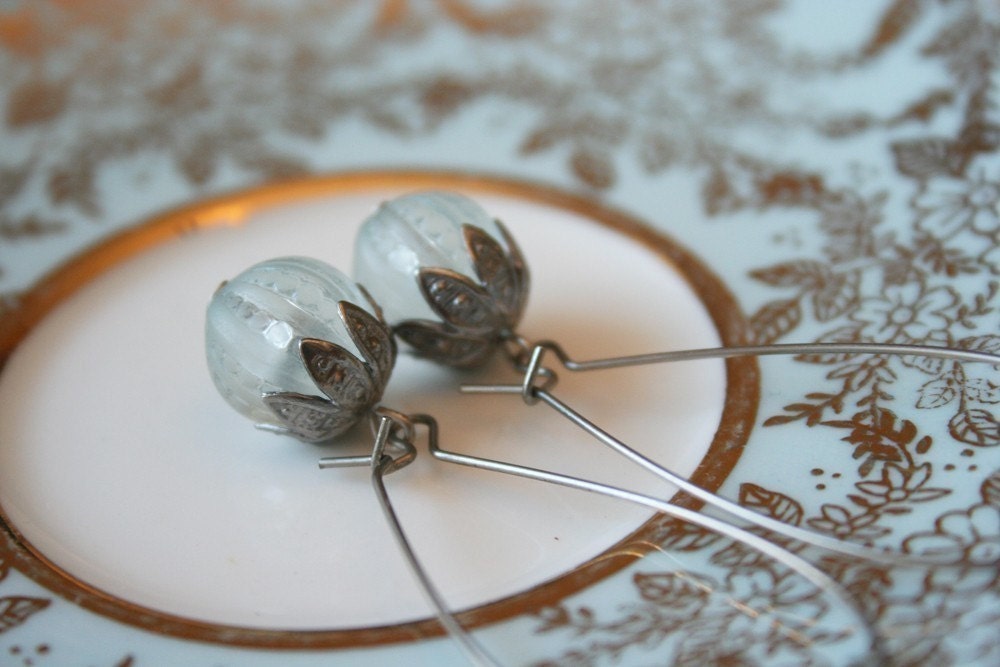
I got two pairs of earrings (yay, me!). As I type, I'm wearing this pair:


The second pair was the very last one of its kind available (lucky me!), so I couldn't find a picture of it on the site, but these one are very similar. Instead of clear at the bottom, mine are a pretty amethyst color:


Methinks The Ardent Sparrow would be a good place to check out for Mother's Day. Just a thought.

Hope to see you at BYU. :)

Wednesday, April 29, 2009

WNW: Those Hook-Looking Thingys

We're working out the final bugs on There, Their, They're: A No-Tears Guide to Grammar from the Word Nerd. If I don't run into any more snags, it should be available to order on Monday. For those who pre-ordered at last week's conference, I'll ship them to you as soon as I get them in hand.

Today's topic is one I was asked about in my conference workshop last weekend:

How do you use single quotation marks?
This is gonna be fun, because I just might get a little wonky and out of control with it . . .

Note: We're talking U.S. punctuation rules here, not UK rules.

Here's the good part of using single quotation marks: you almost never need them.
Don't use them when you're describing a sarcastic line and using air quotes.
Don't use them for thoughts.
Don't use them to set apart regular dialogue.

In all of those cases, you want double quotation marks like this:

"When in doubt, use double quotation marks," Wanda said. "First off, they're correct. But they're also cute."

Single quotation marks are used when you're quoting something but you're already in the middle of double quotes.

I can think of two situations where this fits:
  • A quote within a quote (when your character is speaking and quotes someone else).
  • A reference in a quote (your character is speaking and referring to a work that needs quote marks).
A quote within a quote:
"Mrs. Lambert is so strict," Tony said. "Today in class, she said, 'Turn in your homework on time or you'll be docked points.' I'm so sure."

(Can you tell I have a teenager?)

Did you see how the quote marks worked? Tony gets double quotation marks around his words.

When he quotes Mrs. Lambert, we can't use double quotes again, because that would be confusing. (Sort of, "Wait. We're already in a quote. Are we ending it? Starting a new one? What?")

You can't stack up sets of double quotes and have it make any sense.

To differentiate between what Tony says and what he's quoting Mrs. Lambert as saying, set apart her words with single quote marks:

"TONY'S WORDS GO HERE, 'THEN MRS. LAMBERT'S WORDS GO HERE,' AND THEN TONY'S DIALOGUE CONTINUES."

A Reference in a Quote
Let's say that Mrs. Lambert mentioned a short story that was part of the homework. Short story titles need quotation marks.

Because you alternate between double and single quotes, a title inside a quote would normally get single quote marks:

"Mrs. Lambert assigned a worksheet on 'A Rose for Emily,' which I still need to read," Tony said.

Let's use the original sentence. We used double quotes for Tony's words.

Then we added single quotes for Mrs. Lambert's words.

What do we do to the title of the story (which is inside her quote)?

(Here comes the part where I'm going out of control . . . so fun!)

If we're quoting Tony, who is quoting Mrs. Lambert, who is referring to the short story, we have to continue to alternate between double and single quotes.

Double for Tony, single for Mrs. Lambert, double for the title:

"Mrs. Lambert is so strict," Tony said. "Today in class, she said, 'Turn in your worksheet for "A Rose for Emily" on time, or you'll be docked points.' I'm so sure."

(Isn't that fun?)

Other Punctuation with Quote Marks
Commas and periods go inside quotation marks, even if you're using single quotes.

If we're closing with a single AND a double quote, we end up with a comma and then three marks dangling at the end:

"Turn in your worksheet on 'A Rose for Emily,'" Mrs. Lambert said.

That looks funky, but it's right.

Now let's get really confusing on you. Question marks and colons go outside the quote marks.

So if the dialogue we're using has a question inside and the title is at the end of that, you can't put the question mark inside the quote marks. That would make the title a question. (Which can happen, like Who Framed Roger Rabbit? as a full title, although it's a movie, so it's italicized and doesn't get quote marks, but that's another post.)

In this case, squeeze the quotation mark between the single quote mark and the double quotes, like so:

"Did you turn in your worksheet on 'A Rose for Emily'?" Mrs. Lambert asked.

Ooooooh! Idea!

Let's go crazy and make that a quote from Tony quoting Mrs. Lambert!

At the end of the sentence, we'd have to:
  • close the quotes on the short story title
  • add the question mark to punctuate Mrs. Lambert's question
  • close her quote
  • and finally close Tony's quote

It looks like this:
"Mrs. Lambert said, 'Did you turn in your worksheet on "A Rose for Emily"?'" Tony said.

I'm giggling with glee over here. I love this stuff.

Tuesday, April 28, 2009

2nd Annual Whitney Awards Gala

Right after the LDStorymakers Writers Conference ended, we had to hurry to get gussied up for the Whitney Gala in less than an hour. (Thanks yet again to Alison Palmer, who let me, Josi, and Heather crash her hotel room so we could dress!)

I got my hair cut two days before the conference (brilliant move on the timing, no?), and the stylist had a hey-day doing something to it that I didn't ask for, so I had to experiment with it for that night. It didn't really work, but hey, the night was fun anyway.

Here I am with my husband:


In case you're wondering, yes, that's the same blouse you saw in the bottom half of this post. (I'd worn it once, two years ago. Figured I might as well get some more use out of it!)

Here I am presenting the award for Best Historical Novel (won by H. B. Moore) with my beloved former editor, Angela Eschler:


Apparently, the best part of our presentation was the one unscripted part. Most of the presenters had silly puns and funny skits. Angela and I prepared a pretty straight-forward presentation. Since it was so different than everyone else's, I began with, "We aren't funny." That got an unexpected laugh.

Here's the entire 2008 Whitney Awards committee as well as the LDStorymakers Executive Committee (just realized I'm the only person on both committees). We were on stage honoring the service of Rob Wells, who has ended his tenure as Whitney president. It was a cool moment.


And finally, here is Rob saying thank you for the gift and tribute.


Two years in a row now, I've driven home from the Whitney Gala with tears in my eyes because I get to be part of something so great and history-making. It's truly been an honor.

Looking ahead: Since the Whitneys are reader-driven, be sure to nominate your favorite 2009 releases by LDS writers. Do so at the Whitney Awards website. Also visit the site to see this year's winners.

Monday, April 27, 2009

I'm Baaaa-aaack . . .

At least, I'm back on some level.

I don't know how active I'll be bloggy-wise in the next few days. There's still the whole re-entry process to finish after mom has being away from the family for two and a half days, but I needed to post about the weekend.

Lots of fun today (saving the best for last):

First, the GIVEAWAY WINNERS:
When Hearts Conjoin, by Erin Herrin with my good friend Lu Ann Staheli, goes to Karlene Browning.

And Michele Paige Holmes's upcoming release, All the Stars in Heaven, goes to Tink.

Congratulations to both!

Be sure to e-mail me your mailing addresses so the authors can ship the prizes. (Tink, yours should arrive in July after the book is released.)


Pictures!
The 6th Annual LDStorymakers Conference rocked. Absolutely and totally. In addition to hanging out with LDStorymakers who are some of my best friends on the planet, I got to meet tons of bloggers I've known only virtually (and each was just as awesome in person!). I don't dare list them, because I just know I'll forget someone, but you all know who you are. It was great meeting and talking with you!

I had a great time in the workshop I taught, but then, I always have fun talking about grammar, usage, and punctuation. :)

Last year my camera languished in my bag the entire time. This year, my camera hung out in my hotel room the first day (I'm brilliant like that), and on the second day, I actually remembered to pull it out three times. Be impressed, people. I lifted one picture from Anne Bradshaw, so I have four here. (I look all pale and washed out in them all. Odd.) My husband took more pictures at the Whitney Gala (what a great awards ceremony!), and I'll post some of those later.


Me and dear Luisa from Novembrance. She's one of my oldest bloggy friends, and I've had the good fortune to meet her in person twice now. (Crud--how did I not get a picture with Kim?!)


This is me with Josi in the hall as I prepare to knock on agent and editor doors to keep the pitch sessions running on time.


With Melanie J. She was a ball to talk to and a great writer as well. I can say that because she was at my Boot Camp table and I got to read her work. It had me snorting with laughter several times. (Wish you could see her heels in this picture. They were awesome.)


Here I am in the bookstore with Janette Rallison and Elodia Strain. Apparently, I'm short. Even when wearing heels.


Articles about How Cool It all Was:
A reporter from Mormon Times hung out at the first day of Boot Camp and then ran this story about it. I was quoted, but it sure sounds weird out of context . . .

And then this one one came out after that about the Whitney Awards. The Whitneys were downright awesome. I got all weepy when Kerry Blair received her Lifetime Achievement Award . . . and then had to present an award right after that, so I had to pull myself together.

It was an exciting night. I got to meet some authors I've admired for the first time (Angela Hallstrom and Sarah M. Eden), although I couldn't find another one (Tanya Parker Mills . . . I wanted to meet her so bad!). I loved every minute of serving on the Whitney committee this year. It really was an honor.


Now for the Best Part: A Video!
While listening to Nickleback's song, "I Wanna Be a Rock Star," Heather Moore thought to herself, I don't want to be a rock star. I want to be a best seller.

Thus an idea was born. With some input from Crystal Leichty, Heather rewrote the lyrics. The two ladies then approached Stephanie Fowers, who's known for her wacky sense of humor and ability to make fun music videos.

Next thing we knew, Stephanie had recorded herself singing the song and several of the LDStorymakers had been roped into being filmed for the video. Including yours truly, pretty much making a fool of herself.

The video was shown at the conference on Saturday during lunch. Now it's available for the world to enjoy:

Monday, April 20, 2009

We Interrupt This Bloggy Break . . .

for a brief announcement!

I've picked a title for the book. I have a cover designed by my good friend Crystal Leichty, graphic designer extraordinaire, and I've written, proofed, and uploaded the puppy to the publishing company.

If all goes well, I should have actual copies to put in the bookstore at the LDStorymakers Conference this weekend. That also means it'll be available for order online in just a few days.

Can I hear a woot, woot!

I sort of have two title winners.

Lara from Overstuffed was the first to suggest using "Word Nerd" in the title. I decided that was a must, since a lot of people know me by that lovely term.

So that's in the subtitle. Lara gets a copy.

The main title was suggested by Mel Henderson. Also known as my cool big sister. She got on a real title-suggestion roll there, shooting dozens into my in-box. She'll get a copy too.

The title is . . . (drum roll, please) . . .

There, Their, They're:

A No-Tears Guide to Grammar from the Word Nerd

And here's the cover:

I'll let my readers know when and how to order it when it's officially available. I plan to do new editions in future years, expanding it as I people shoot me more grammar, usage, and punctuation questions. For now, even though the first edition is by no means exhaustive, it has the most common errors I see and the questions I've been asked the most.

Quick reminder: Don't forget to enter the drawing for the two books on my last post!

Now, back to my bloggy break (I've missed you guys, and I'll miss you even more!). But I've got oodles to get done before the LDStorymakers conference this weekend, and I certainly won't have time to blog during the conference.

That means I'll see you next week!

(Unless you're coming to the conference, in which case, can't wait to see you there!)

Monday, April 13, 2009

A Giveaway, a Thank You, and a Break

Giveaway!
Two friends from my critique group are getting close to new releases, and my readers get a chance to win one of their books!

The first is When Hearts Conjoin, the true story about the conjoined Herrin twins and their separation surgery.


As the ghostwriter, Lu Ann Staheli worked tirelessly with the twins' mother, Erin. Lu Ann did a ton of work to make the final product a wonderful account of the journey the Herrin family has taken so far. (Read an interview about her ghost-writing experience here.)

The book is now available for pre-order, and it'll be officially released in a few weeks. This fall, it'll be featured on Oprah. (You read that right!)

The second book up for grabs is by Whitney Award winner Michele Paige Holmes, who took home the Whitney for Best Romance for her first novel, Counting Stars.


Her next book, All the Stars in Heaven, will be out in June. Jay (from Counting Stars) attends Harvard Law and meets Sarah, a music student with a mysterious life and a strangely over-protective father and cousin. In the very first chapter, an innocent conversation with Sarah winds up giving Jay a black eye at the hands of her bodyguard cousin.

You'd think Jay would leave Sarah alone after that, but what follows is a web of lies and deceit surrounding a drug ring Sarah's father (the chief of police) is in the middle of. Forget trying to date; soon Jay and Sarah in the middle of the web, and their lives are at stake. It's a great suspenseful romance.

To enter the giveaway for both books, simply leave a comment here. For a second entry, mention the giveaway and link back to it on your blog (and then let me know you did that so I can count it).

***

Thanks!
With the exception of most (but not all) weekends, I have posted here every day since March 2. That's six weeks of near-daily posts, a record for me (almost like my own NaNoBloPoMo or something!). I even blew through my 300th post without realizing it.

Much of it was due to my blog book tour with the release of Tower of Strength and linking over to my great hosts each day. Doing the tour was an experiment; I'd never done anything like it with my previous five books. I was nervous, but it turned out really great.

As a result, I'm deeply indebted to all 47 (!) of my hosts for their generosity in letting me be part of their blogs for a day. That number includes a few people who approached me during the tour and asked if they could participate. (Um, yeah!!!) Their creativity and kindness knows no bounds.

I've gotten to know a lot of great bloggers over the last few months, and I had a ball during the tour. So a huge thank you to all of my hosts as well as to everyone who participated by following me around the bloggosphere!

***

Time for a Break!
With a month and a half of straight blogging (plus answering blog tour interviews and all the other fun stuff I've been up to), it's time for a little bloggy break. I need to regroup, spend time with family, and maybe even catch up on some writing that's languished a bit (like trying to finish the grammar book . . . I haven't decided on a title yet).

My break will last one or two weeks--I'm not sure how long yet, especially with the LDStorymakers Conference coming up, which will take a lot of time.

(Speaking of which, WEDNESDAY, April 15th is the LAST day to register for the conference. Don't forget!)


***
Be sure to enter the giveaway while I'm gone.

I'll draw the winners when I get back.

See you soon!

Friday, April 10, 2009

Writing Journey: Part XIV

Part I Part II Part III Part IV Part V
Part VI Part VII Part VIII Part IX
Part X Part XI Part XII Part XIII

When Spires of Stone came out, I was smart enough to take a camera with me more often, so I actually have pictures of things like the LDS Booksellers Association Convention and my giant book cover poster and cool stuff like that.

As I think this series has shown, writing is hard work. It's not a journey for the faint of heart. And even when you cross the "finish line," you're really just beginning a new race with new challenges.

For this post, I thought I'd show some of the fun that has come with my writing journey. Because yes, there are a lot of perks.

Here I am at my LDSBA book signing:


And here's my gigantic book cover poster:


That spring was the 5th Annual LDStorymakers Conference, which Heather (H. B.) Moore and I co-chaired.

Lots of fun, that. Here I am with my co-chair Heather (far left) and the previous year's conference "queens," Josi and Julie:


And of course following the conference was the first-ever Whitney Awards Gala, where I was a finalist for Best Historical novel for Spires of Stone. (I said I'd be okay losing only to Heather. I did, so we're all good.)


Here I am with Heather and Michele, who are both in my critique group:


I got to present the award for Best Romance. I couldn't have been more thrilled to read the name of my dear friend Michele Paige Holmes:


My older sister nominated me for Utah's Best of State medal for fiction (I tell the whole story here). And I won.


My parents were overseas on a church assignment, so they celebrated by treating me to a salon for my hair to be done in an up-do:


This was the first time since our wedding day that my husband wore a tux:


And here I am with my sweet sisters at the Best of State gala:


The year following the release of Spires was definitely more busy, exciting, and rewarding than any other of my writing career. I'd been through enough ups and downs that these moments were ones I cherished and drank in as they came.

Even though at times it would have been nice not to have to scrape and claw my way along the path, I think I appreciated each success more for having fought each step of the way.


Today we have the very last, final tour stops (phew!)*

Compulsive Writer
Creative Chaos

*But I'll still link over to other reviews and fun stuff as they come along.

Thursday, April 09, 2009

Calling People Good with Titles

I lack the skill of inventing good titles.

It's one of several reasons I rarely bother coming up with a working title for my novels (the others include not wanting to go through mentally renaming my "baby" and the fact that marketing always changes it anyway).

BUT . . .

Some of you may recall that I'm working on a grammar, usage, and punctuation book. I'm not Strunk and White. I'm not Chicago. I'm not an expert.

But I am a writer and an editor and an English major who graduated cum laude. I'm affectionately known among friends as the Grammar Nazi. I do know a few things.

I'm writing the book because I've had so many fellow writers ask me questions, and when I offer an answer that's actually understandable, they tell me I should write a reference book on these things because they want it on their own reference shelf.

I'm in the final stages of writing it, and I hope to have it available real soon. Down the road, I'll likely do updates and new editions, adding new topics that readers ask and want included. For now, I've been keeping a running list of common questions on grammar, usage, and punctuation, including some of the topics I've used for Word Nerd Wednesday.

Now I need a title. And I'm coming to my peeps for help!

I'm totally stealing this idea from Luisa at Novembrance, who asked her blog readers to help come up with a title for her forthcoming cookbook. (I wanted to submit an idea for her, but as I said, I'm really, really bad with titles, so I sat back as others offered fantastic, witty suggestions.)

Here's the deal:
Throw out title ideas in the comment trail or e-mail them to me directly. I'm not averse to subtitles to go along with the main title. I might like having a subtitle, actually.

If I pick your title suggestion, you'll get a free copy of the book as a thank you.

So . . . help? Please?


Today's tour stops are two people who didn't used to give LDS Lit much of a shot. Glad they did this time:

The Dance
Crash Test Dummy Diaries

The latter is, in Crash's own words, an "unreview." Her way of telling how it came about isn't quite how I remember it. (She got the PDF file like all the other tour people, for starters.)

But I think I tricked her into buying the book. Bwahahahaaa . . .

Wednesday, April 08, 2009

WNW: Reader Edition

Since the inception of Word Nerd Wednesday, I've gotten lots of suggestions for issues to address. (Keep 'em coming! You can leave ideas in the comments or e-mail them to me.)

I'll discuss a just handful today.


Might Could
Erin brought up this particularly annoying phrase, used as:
I might could go to the movie tonight.

Might could is a dialectal thing, but it's definitely not acceptable in standard English. Depending on the quirk, I find some dialectal things intriguing rather than annoying. This one, however, bugs me, because it makes no sense.

It's like a some funky compound version of, "I might go to the movie tonight" and, "I could go to the movie tonight," or perhaps they're really meaning, "I might be able to go to the movie tonight."

But since when does could mean be able to?


In the mists
A malapropism is when one (incorrect) word is accidentally substituted for the word the speaker means. I love catching these puppies, because they're often really funny. My linguist father has a running list of malapropisms he hears from others, and it's hysterical to read.

Another term for them is "Dogberryisms," named after the character of Dogberry in Shakespeare's Much Ado about Nothing (and we all know how much I love me some Much Ado!). Dogberry's lines are full of malapropisms, some of the funniest parts of the whole play.

(Michael Keaton performs the role brilliantly in the movie. Now I'm almost wishing I'd worked a Dogberry character into Spires.)

Lara brought up a malapropisms seen a lot on blogs: "in the mists" such as, "I was in the mists of making a project."

Of course, what the writer means is in the midst (or in the middle of) making a project.


Supposably
Brooke mentioned another peeve of mine: using supposably for supposedly.

Technically, supposably is a word, but it doesn't mean what its speakers generally use it for. Supposably means something is able to be supposed, not that something allegedly happened or is mistakenly believed to have happened, which is what suppsedly means.


Feeling Poorly
Mina mentioned this one. It always brings a smile to my face, because I remember my beloved professor, Dr. Oaks, acting it out in class.

First off, the correct version isn't I feel poorly, but rather, I don't feel well.

Remember: poorly would mean you don't have a skill for feeling.

Just like you might ice skate poorly or cook poorly, if you feel poorly, you're doing a bad job of it.

Dr. Oaks demonstrated, pretending to feel the desks, the chalkboard, and the wall, but doing so in an inefficient way: with his hands palm side up so the only contact was with the back of his hand.

He was feeling poorly.

If you're sick, you're not feeling well.


Their/There/They're and Your/You're
Heffalump suggested that some common homophones be mentioned, particularly their/there/they're and your/you’re.

Since they sounds alike (duh, since they're are homophones), it's easy to mix them up (or easy to type the wrong one even when you know which is which).

A refresher:

Their is the possessive pronoun for they:
Their car was repossessed.

There refers to location:
Put the newspaper over there on the table.

They're is a contraction of they and are:
Tonight they're going out to eat.

Now for your/you're:

Your is possessive:
I love your new haircut.

You're is a contraction of you and are:
You're in ninth grade now, right?


Voila
Melanie J brought up one that I have a hard time understanding the confusion on, but I've seen it myself, so here we are:

Using wa-la for voila.

(I think I just heard Erin, francophile, gasp and faint.)

Voila is a French word meaning (according to Merriam-Webster), "see there." In English, it's used, "to call attention, express satisfaction or approval, or to suggest an appearance by magic."

But it's not pronounced with a W.


Lose/Loose
Finally, Lucy added a word pair very, very commonly misused. This time, they're not even homophones. I think the error is made because they simply look alike, the difference being whether the word has one or two Os in it:

Lose (with one O) refers to is when something is gone, missing, destroyed, lost:
Almost every day, I lose my keys.

Loose is the opposite of tight:
Tighten the strap; it's too loose.

For fun, let's combine them:
After losing weight, her pants were too loose.

See? Not so hard, right?


Today's Tour Stop:
Life in the Sagebrush
(I think this is third time someone has quoted the section about Samuel's disgusting work smells. I so rock at making readers sick to their stomachs! Gross smells aside, it's a hugely flattering review. Thanks, Brooke!)

Tuesday, April 07, 2009

Rant Update and More Ranting

First off, I have to thank everyone who encouraged me to not white-knuckle the rest of the school year and instead get my son out of that nasty English class now.

I contacted the principal via e-mail that very day (Tuesday). He didn't get back to me until Thursday (I was about to barge into his office and break down his door if he didn't respond soon). I couldn't tell by his reply whether he was willing to work with me. One thing he asked was whether I'd been in contact with the teacher about the problem.

No, I hadn't. And I still have no plans to talk to her, because anything I'd say would be a personal attack. (Not a way to endear my son to her.) This isn't a matter of a teacher singling out a student or parent and teacher collaborating to find a way through a behavior problem. It's a matter of teacher incompetence and attitude. Talking to her would be tantamount to putting a target on my son's chest.

That, and I have no desire to make this work. I want my son out.

I responded to the principal, being firm--not just politely requesting a change. When I hadn't heard back the next day (Friday), I called him. He said he'd already contacted the academic counsellor to see what our transfer options were, but he hadn't heard back from her. He also wanted to talk with the teacher, but she'd taken a personal day on Friday.

Over the weekend, I decided to e-mail the academic counsellor myself. I know full well that there's another 8th grade English class with a good teacher the very same period, so if he transfers there, the rest of his schedule won't be disrupted.

She hasn't responded to the e-mail. I called her this morning, but got her voice mail. I left an urgent message, because this is getting obnoxious (it's been a week since my first contact!) and the term is moving on. I think the wheels are turning, but painfully slowly. I think I'll just show up at her office today, because it's harder to ignore a mother bear in person.

Second rant:
Our neighborhood constantly gets solicitors, whether it's for those teens supposedly making a life for themselves, lawn aeration, satellite TV, or a hundred other things. It's beyond annoying. The only people I'll buy stuff from are kids in my ward trying to raise money so they can participate in the high school football team or whatever. That's it.

Recently my husband bought a nice, pretty "No Soliciting" sign and stuck it to the center of the door. Yay! I thought our solicitor problems were over.

Not so.

Just yesterday, the doorbell rang in the afternoon. I assumed it was a kid's friend asking to play.

"Mom, it's some men asking to see you or Dad."

Greeeeaaat.

Before the sign, I was always polite to solicitors, possibly to a fault: "I'm so sorry, but I'm not interested. Good luck. Have a nice day."

But now I have a sign. They know not to bug me. I have no qualms about abandoning manners, because if they see the sign and insist on ringing the doorbell anyway, they're asking for it.

As soon as I saw their stances and their clipboards, I knew what was coming. I had an urge to reach out and smack them both. They began their little pitch, "Hi, we're with such-and-such landscaping company, and--"

I interrupted, pointing to the sign. "Sorry, no soliciting."

"Oh, we aren't soliciting," the guy on the right hurried to say. "We're just . . ."

"Drumming up business?" I asked.

"Um, yeah. But we're not soliciting."

(Do you know what soliciting means, moron?)

"Sorry, not interested." (I was a bit more clipped than usual, but not rude. Yet.)

At this point, guy #2 said with a rather snotty voice, "Do you have a problem?"

Hooo, boy. NOT the way to endear yourself to a potential customer. Any lingering inclination to be polite flew south.

"Yes, I have a problem," I snapped, not pointing out the sign a second time because apparently, as I said, they were morons. "I've got a really nasty headache. So yeah, I have a problem. Good-bye."

I shut the door. Kinda hard.

Their shocked and irritated voices came though from the other side.

And I didn't care.

Morons.


Today's Tour Stops:

Crazy Lady on Road 80
(Where Jan gets dressed in period clothes for authenticity.)

Sunshine in My Soul
(One word: Giveaway)

Monday, April 06, 2009

Temple Trivia: Logan


Of all my temple books, House on the Hill tells more about its temple than any other. The Logan Temple is almost another character, it's such a big part of the story. Even though there are more stories in that book, plenty more aren't in it. Here are two of my favorites.

Carpeting the Temple
The original plan was to purchase factory-made carpet. 1,516 yards were purchased, but that wasn't nearly enough. Worse, the order had pretty much depleted the supply available. What to do?

Superintendent Charles O. Card asked the committee for permission to use handmade carpets. As soon as it was granted, stake Relief Societies were called on to band together to make the carpets.

The women donated rags, which were torn into strips at rag-tearing sessions. The strips were then sewn together by color and rolled into balls. The balls were taken to a weaving machine, which created long strips of cloth. They then sewed the strips together carefully so the carpet wouldn't twist or bulge.

As they were sewn together, the carpets were stretched across a room, tied to doorknobs on either side, to help keep them square. Some wards had to work together on pieces for the larger rooms to make sure the pattern remained consistent.

In spite of how hard they worked, the women weren't able to complete quite all of the carpet on time. The last of it was delivered to the temple on Tuesday, May 20, three days after the dedication. The carpet was installed all that night, with the last bit being laid at 8:00 AM, barely in time for ordinance work to begin that day.

In all, the Relief Society sisters made 2,144 yards of carpet, about two-thirds of the total 3,660 yards in the temple. The homemade carpet remained until 1925, when it was replaced by store-made carpet, with the exception of one bit, which hung on in one of the towers until 1959. When it was removed, that last section was cut into pieces, which were given to officiators and others. Presumably, one piece is still in the temple office.

The Hay Baler
One of the saddest stories in the construction is something I wanted to tell in the book, but I couldn't find a natural way to fit it into the plot. Since I refuse to throw in irrelevant history just for history's sake, I reluctantly left it out. So I'm going to tell it here instead.

Since the construction era was well before things like gas-powered cranes and other motorized vehicles, much of the power came from animals like horses and mules who hauled stone, pulled ropes on pulleys to raise stone blocks, and the like. (I do tell about Old Jim the donkey in the book. Fun story there.)

As a result of the animal labor, they had a temple stable where the work animals were fed and housed. For many families, their donations for the temple consisted of hay for the animals. To keep the hay in good condition and to be able to distribute it easier, they needed a baler.

Nolan P. Olsen describes it as being, "15 feet high, consisting of a large wooden enclosure, with a hole through which the hay was pitched. A large flat rock was rigged up so it could be hoisted up high by horse power, and when it was tripped it would fall into the enclosure and mash the hay flat."

The 300-500 pound bale would be tied up with ropes or wire and then stacked for later use.

One day the rope got stuck, and they couldn't trip the rock to make it fall. The workers couldn't get the rope to loosen or the stone to budge. At that point, a young man of 13 years, John Hincks, put his head inside the baler to peer up in hopes of seeing what the problem was.

Of course, that's the moment the rock tripped on its own. It came down and crushed his head, killing him.

The death of John Hincks was the first connected to the construction of the Logan Temple, but while it wasn't anywhere near the last, to me, it's one of the most tragic because he was so young.

As his grave marker said, he was "Like a flower in bud just bursting into view."


Today's tour stops:
Is It Just Me? (Featuring the Lunar Temple and a new face for me!)
Heather Justesen

Friday, April 03, 2009

Writing Journey: Part XIII

Part I Part II Part III Part IV
Part V Part VI Part VII Part VIII
Part IX Part X Part XI Part XII


Something a lot of readers don't know is that a copy editor can input errors and changes into a manuscript that the author never approved. This is why I'm freakishly controlling about my edits and proofs. I know that if a grammatical error or a typo slips through, most readers will blame me. After all, it's my name of the cover.

The majority of copy editors are very good at what they do. Since each of my books has gone through anywhere from one to three copy/line edits, I've had several copy editors, and only a few complaints. (Like the copy editors who inserted four misspelled words and added a lay/lie error . . . that was fun. I was glad I caught it at the last minute.)

I've really had only one really bad copy editor, and that was one of three I had for Spires of Stone.

An editor's job is to make the writer look good. They polish and smooth out the text and make the writer shine.

On the other hand, a bad editor will try to rewrite the whole thing so it sounds like them.

(This isn't just a whiny writer talking; I edit professionally and know what it takes to make a writer look good but still sound like themselves.)

That second scenario is what happened in one copy edit for Spires. I believe that this editor was really a frustrated writer, because they kept changing my voice, pulling out any personality that was me. Many sentences were rewritten so they were different . . . but no better. Entire sections were diluted from showing to telling. Humor was stripped out. Cliches (yes, cliches!) were added.
I had steam coming out of my ears.

In a sense, I'm glad this didn't happen until my fifth book. Earlier, I would have been hesitant to request that they change it back to the way I originally had it. This time, I had no qualms. With my blazing red pen, I scrawled STET (the editorial mark meaning "put it back the way it was") page after page.

Getting Spires to press had been more time-consuming and stressful than any of my other books to date. When it was done, I wanted to celebrate. But I couldn't quite do it at first, because I'd had moments of thinking I was done several times, so I waited, holding my breath for a few days before collapsing.

I've had people ask about what was changed in all those rewrites. In all honesty, I don't remember much about how the final book varied from earlier versions. I do know that my editor thought a prologue with some action would help introduce the male characters better and start the book of with a bang more, so that was added.

I remember that there was a lot of developing of Claude's character and his issues.

Oh, and the scene where the Relief Society sisters show up in support of Hannah was added (although originally put into the wrong spot, thanks to a late-night session where I had about two brain cells functioning).

Beyond that, I've seriously blocked most of it out.

Here's the cover they picked:


The artwork is pretty (always a fan of Al Rounds). But if I'm being perfectly honest, it's my least favorite of the temple covers. Part of that might be my own fault; I asked for two girls to be on the cover instead of one. Bethany and Hannah are both huge parts of the story; I didn't want readers to have to guess which was on the cover. But having two instead of one changed the basic look; they had to cram more in the same space.

One other downside is that the girl facing front looks so serious that I think she made a lot of people think that the book was more somber and tragic than it is, and that might have steered some readers away from it. (It's a retelling of a Shakespeare comedy; it has a lot of light moments!)

We all know the adage, "Don't judge a book by its cover," but the fact is, we all do it anyway.


I'm getting all weepy lately. Today's tour stop did it to me again:
Cranberry Corner

Thursday, April 02, 2009

Where Book Ideas Come from

Recently, I've had several people ask where I get the ideas for my books. Some of my unpublished manuscripts are so bad they'll always be unpublished, but here's a book-by-book look at my published books.

I'll start with the most recent and go backward:


With most of my historical novels, I haven't had a clue about what the story will be until I learn about the temple and the area. Since I'm very big on the history being an organic part of the story, I need to know about the setting before I can come up with a plot or characters to fit it.

With Tower of Strength, I researched the settlement of Manti and the temple there for several weeks, making notes and marking spots in the text of several publications, but I really had no clear idea for a story.

Then one day as I was blow drying my hair, Tabitha showed up in my head. I heard her say, "It's Tab, not Tabby. I'm not a cat!" I grinned, knowing I'd found my heroine.

From that point, I knew enough about the area that I was sure Temple Hill and some of its history needed to figure prominently in the story. But those events were way before the construction of the temple and therefore several years before Tabitha was born. I knew I'd need a character that was a child during those years. (Which is why Fred is several years her senior.)

Early into the drafting, I uncovered Mantia's story and groaned. GREAT. More research. In an area I knew nothing about. So I hit the Internet and studied up on horses and horse training. Such. A. Pain. (But in the end, totally worth it.)


As I mentioned in a recent Writing Journey post, Spires of Stone is essentially a retelling of Shakespeare's Much Ado about Nothing. I've always loved that play and wanted to retell the story. The trick for this one wasn't finding the idea, but finding a way to adapt a classic to the 1800s and work in details about the temple in a natural way.


At the Journey's End was a bit like Tower of Strength in that I was several weeks into the research before I had any clue what the story would be. I had lots of cool ideas about what could happen (and things that had happened) on the Honeymoon Trail that led from Arizona to St. George, but I also knew there was no way to tell all of them.

Thanks to all the horror stories I read about one area of the trail, I knew pretty early on that there would be a disaster in that spot. (Something that apparently takes most readers by surprise.)

One thing I did know going in was that Abe would need a strong reason to leave Utah. Plus, he needed someplace else to go that had Mormons. I'd recently read about a lynching that really happened in Salt Lake City around this time. That tragedy provided the perfect impetus Abe needed.

Once I settled on him going to Arizona, his story wasn't the hard one to come up with. It was the heroine's. Fortunately, Maddie showed up on her own a couple of weeks into the research, and I could breathe a sigh of relief. Now I had both sides of the equation and could move forward.


House on the Hill, my very first temple novel, came about after I read my parents' copy of Nolan P. Olsen's Logan Temple: The First 100 Years. I picked it up after getting married in the Logan Temple myself, and after reading the book, I knew immediately that there was a story there I had to tell. But it wasn't until after I read the book again, made a master chronology, and started looking at the events and dates that I figured out a story to go with it. This book went through a lot of drafts and revisions, especially in the early stages. Writing a historical for the first time was pretty terrifying.

I managed to buy a copy of Olsen's book for myself a few years ago. It's out of print again, so I'm glad I snagged it when I had the chance. Sometimes I get e-mails asking where you can find the book. I've seen it for sale at online used bookstores and even Deseret Book's online auction. They're out there, just hard to find.

As I've mentioned before, Abe came about after I read a paper on Native American children who were indentured by Latter-day Saints. It was such an intriguing idea that I knew right away who he was and where he'd come from. He remains a favorite character for a lot of readers.


As some people have guessed, At the Water's Edge was somewhat inspired by my parents' own love story. But only inspired by. The vast majority of the book is pure fiction. Here's where it dovetails with reality:

My dad served a mission in Finland. He returned several years later on graduate research and met my mother at church. (Check, check, and check for Kenneth.)

Mom became the black sheep of her family when she was baptized, and her father threatened to kick her out of the house if she joined the Church. (Check and check for Annela.)

But that's as far as the story mirrors reality. Mom was seventeen when she was baptized, not an adult in her twenties with a messed-up, live-in boyfriend. All the rest of the story is out of my head. One big difference is that both of Mom's parents were against the Church, not just her father.

I made the mistake of telling one of my sisters that our parents inspired the story right as I handed over a few chapters for her to read. She came back with tears in her eyes saying, "Did Grandma really say that?" I had to burst her bubble. Sorry, no. This is FICTION. Annela's mother isn't Grandma (who was very much against Mom's baptism). Grandma never expressed support like Annela's mother does. (It's a novel. Pretend. Made up!)


Lost without You was sparked by a dream. (Wouldn't it have been nice if that dream yielded millions like Stephanie Meyer's dream?! :-D) At the time, I had two children. In the dream, I knew I was going to die soon, and my two regrets were that I couldn't say good-bye to my husband and that I couldn't tell him to find a good mother to raise my children.

Up to that point, I'd been adamantly opposed to him ever remarrying were I to die. But that dream showed me that if another woman were to truly mother and nurture my children as her own, that I would praise and honor her for doing so.

That was the kernel of the idea.

Next week I might go into some other ideas, such as what prompted Band of Sisters, coming out next spring, and my the dust-gathering murder mystery I really should do something with


Today's Tour Stop:
Author Bee's Blog (Therein I discovered what that smell is.)

Wednesday, April 01, 2009

WNW: Long-A has an E in It! Or: Diphthongs

When my third child had trouble reading, I was so proud.

Not because she struggled, but because of the reason: she was hearing diphthongs.

They confused the heck out of her, because teachers in the U.S. don't usually have a reason to address them. For that matter, a good number of teachers don't even know what a diphthong is.

They merrily go along, telling their students to sound out words: short A, long A, short I, long I. Remember, the silent E makes the short vowel long. All that stuff.

For most students, that method works just fine. After all, most English-speakers hear just one vowel sound in words like, cake, sky, and dozens of others.

But my kid didn't; she heard the diphthong. She recognized that a long-A isn't really an A. That a long-I isn't really an I. For that matter, that a lot of the "long" vowels and vowel pairs were not made up of a single vowel sound. She had the darnedest time trying to sound anything out.

A diphthong is two vowel sounds that glide together. For example, a long-A, such as in cake, is really made up of a short-E, followed by a long-E.

cake = K-eh-ee-k

We say the word so fast that we usually hear a simple long-A rather than two separate vowels. But we're still saying both vowels, because there is no simple long-A.

The same concept follows for the long-I, which can be broken down into a short-O (like AH) and a long-E (EE).

sky = sk-ah-ee

I learned all about diphthongs while going to public school in Finland. While Finnish is known for being a complicated language, the one thing it has going for it is that it's ridiculously easy to read once you know what sound each letter makes, because every word is spelled phonetically.

There would be no point in having a spelling bee in grade school over there, because no one would win or lose. If you know how to say a word, you know how to spell it.

And Finnish has diphthongs galore.

The Finnish word kaikki ("all") is pronounced with what Americans would think of as a long-I sound in the middle (k-eye-kk-ee), but it's spelled with an A and an I because technically it's: k-ah-ee-kk-ee. Both versions sound the same, of course.

Can you figure out what diphthong is made by the O and I in the middle of poika ("boy")? (Hint: the I makes a long-E sound.)

It's a long-O (just the plain O, without the typical long-U English speakers add to the end) and a long-E.

It's, O-EE, or what we'd think of as OY. the same sound at the end of the English words boy, toy, and joy.

If you can't hear diphthongs, don't feel bad; for an English-speaker, distinguishing them often takes learning another language that relies on diphthongs.

That is, unless you're my poor daughter when she was in first grade, pulling her hair out because, "Mom, there's a short-E in bake, but it has a silent E at the end! I don't get it!"


P.S. Now in fourth grade, she has no trouble reading at all and is halfway through Harry Potter #4.


Today's tour stop:
World According to Little Fish, where my writing is described using knitting terminology (something right up my alley!)

Tuesday, March 31, 2009

Not on My Watch

Warning: Rant ahead.

Let me say upfront that teachers have my utmost respect and admiration. They have one of the hardest jobs in the world, and are way underpaid for it. Most go into education for the love of the students, hoping to mold the young minds of the future.

I had some fantastic and influential teachers in my day, and I owe them much. (I just found one of my best high school teachers, now retired, on Facebook. I wanted to send her a big long letter about how awesome she was.)

Today, I count my lucky starts I didn't get a doozee of a teacher like the one I'm going to rant about.

Here's the problem: My son hates his English class. Nay, he abhors it.

With a passion.

Almost every time I pick him up from the junior high, he has a horror story to tell. Worse, he gets totally confused with what the teacher is trying to teach, and he hates the assignments.

He dreads going.

To English class.

MY son?!

Put aside for a moment the fact that reading and writing are my life. Look at who he is and explain to me how this makes any sense:
  • Last year he was in the Creative Writing class.

  • This year he's in the Science Fiction and Fantasy Writing class.

  • He's been an active member of the Fantasy Writers Club for two years.

  • This year, he's the club "emperor" and teaches a writing lesson there every week.

  • He loves the play-writing unit he's in the middle of in his Advanced Drama class.

  • Many, many nights I check on him before going to bed and find him up, reading a good book he just can't put down.
And he hates his English class? What the?!

At the beginning of the year when he complained about the teacher, I nodded and sympathized but insisted he needed to stick it out. You won't always have teachers you love, you know. It'll be okay.

But now he's had her for seven months, and I'm changing my tune. As far as I'm concerned, this woman has no business being in education and giving the entire field a bad name.

Mama Bear is coming out.

This is way beyond, "I really don't like my teacher."

My son hates English.

It must take a superpower for a teacher to take a kid who lives for reading and writing and make him hate the subject.

She can make a fun topic like mythology feel like lead (jealous gods and battles . . . really?!). She reads to the class aloud, but she's so monotone it's hard to listen to or follow, let alone enjoy. He has a hard time knowing if he'd like a book without her negative influence on it. When she explains a grammar concept, it's convoluted. And she's a grouch, to boot.

I can't count how many times he's expressed confusion with a grammar rule she spent the entire period lecturing on (like that is the best way to keep kids interested). I explain it in a simple way (in about thirty seconds), and he has a light bulb go off over his head. "Oh! That makes sense. I get it."

It's great I can explain concepts in a way he understands (in that sense, good it's not his math teacher), but isn't that her job?! I end up gritting my teeth all the time, because Mrs. What's-her-name should be doing this herself, and in a way that won't make him hate the subject.

The other day, his English horror story of the day showcased her incompetence to the point that it had me laughing with tears in my eyes. The topic of the day: show-not-tell. This is something my son knows well. He's heard me lecture on it, he's read about it, and he's taught it at Fantasy Writer's Club.

His teacher had an exercise where she put up a "telling" sentence on the board and supposedly demonstrated how to make it "show" instead.

The kicker: her final sentence didn't show.

My son was exasperated. "That isn't show-not-tell! That's still telling!"

And he was right.

He has reached the point of thinking that taking English is stupid and useless. (He knows more about writing than she does, for Pete's sake!) I worry because he can't see the value of learning grammar. This from a kid who is a WRITER. HELLO?!!!

His teacher has nearly ruined him in several areas of English, and it's all I can do to white-knuckle it through the last part of the school year.

Next year, assuming she hasn't retired (we can all hope), if he's assigned to her class again, I will insist he gets transferred. She will not be allowed to influence him again.

Not on my watch.


Today's tour stops:
I Blog about Nothing
Views from Hobbit Hole

Monday, March 30, 2009

Temple Trivia: St. George


The settlement of St. George was so significant to building the temple there, that that's what I'm focusing on today, rather than on specific temple stories. (I can go into those another time.)

After I learned about the settlement of southern Utah, I'm amazed anyone stuck around. Many didn't.

The original reason for getting a settlement down there was so the Latter-day Saints could be more self-sufficient. The Civil War had broken out, which led to a decrease in the cotton supply out West.

Combine that with the fact that Brigham Young didn't like to rely on outsiders for anything, and he decided that the Saints needed a way to get their own cotton.

(I found it ironic that even when the Cotton Mission was up and running, they always, always relied on dyes from back East to color the fabric.)

They'd already had success growing flax in what is now Utah Country, but they needed a warmer climate for cotton.

After scouts came back to Salt Lake and described the area, a lot of people were understandably wary. Volunteers were requested to settle the "Cotton Mission," but only one man raised his hand. The next week, Church leaders just called people from the pulpit, folks who had the skills they needed (everything from farmers to blacksmiths to coopers and even a mineralogist and a fiddler).

I'd heard about those kinds of mission calls and always marveled that the men just accepted their calls and did their duty. Not this time. About a third declined. They knew what a harsh environment they were being asked to live in. No, thanks!

Of those who did go, some turned around and went back as soon as they saw the area, and still more left after giving it a go for a time. The heat and other issues just made eking out a living there hard.

One early trial was an outbreak of malaria. (In the desert. I know; I don't get it either.)

A continuing problem was the Virgin River. The settlers had to dam it to reroute the water so they could actually water their crops. They spent much of the winter of 1861-62 making a dam and ditches. In the spring, floods washed out the dam and filled the ditches with mud. This delayed building their homes.

The dam washing out (and then rebuilding it) became a common theme: it broke again and again over the years, making it hard to grow food and build shelter, let alone to grow the cotton they were there to produce.

The settlers eventually began construction on a tabernacle, and then, on the counsel of Brigham Young, construction on a temple. I go into some of the challenges in building the temple in At the Journey's End, so I won't here. Just know that the people had their work cut out for them. I would have sat down and cried.

By the time the Cotton Mission was disbanded, there was quite a large settlement, and living there wasn't quite as big a sacrifice.

One interesting item is that a handful of people who were originally called to the Cotton Mission made a point of growing a token amount of cotton in their gardens every year even after the mission was closed.

Their reasoning: They'd been called to grow cotton and hadn't ever been released from that duty.

The early settlers had little in the way of material goods, and they sacrificed greatly to build both a tabernacle and a temple.

At first glance, building a temple there doesn't make much sense. The bulk of Church membership certainly wasn't in the area. The Salt Lake Temple was under construction (although it wouldn't be done for some time). Before long, the Logan and Manti Temples were being built and would serve more members of the Church.

In the end, President John Taylor, who became prophet shortly after the dedication of the St. George Temple, explained why it was built there: "Because there was a people living here [in St. George] who were more worthy than any others. Who were more worthy of the blessings of the temple"

Essentially, only the best of the best not only agreed to go down there, but they stayed and endured and sacrificed greatly because of their faith and dedication to God. That devotion was repaid with the blessings of eternity.

I'd say it was worth the price.

Today's tour stops:
An Ordinary Mom (in which I'm long-winded with thoughtful questions I've never been asked before)
If You Give a Mom a Moment (where she quotes lines from the book and tells why they resonated)

Saturday, March 28, 2009

A Video & A Graphic Novel

First, a reminder about my TWO book signings happening TODAY. See the sidebar for times and places.

My techno-genius teenage son figured out how to compress the file of his animation so Blogger could handle it. (Missed the still-shot? It's on this post here.)

For those who wanted to see the goblet turn into a sword:


Another gem: this week's Tuesday tour stop was too great to pass up. Rob Wells has a brilliant sense of humor, and what he created for his tour stop was so original that Mormon Times even picked it up and linked to it.

Click the picture to enlarge and laugh at a mini graphic novel called Bethany's Story, created entirely with my book covers. I tried to get it to post here so you could click on it to enlarge, but my techno-idiocy is shining through again.

To see the graphic novel (and laugh), click HERE.


Today's tour stop is one that touched my heart. Keith Fisher, who I met years ago at a writing conference, is one of the dearest men alive. He talks about reading Tower of Strength to his dying father in the hospital. I'm still misty over it:

Keith Fisher at LDS Writers Blogck

Friday, March 27, 2009

Writing Journey: Part XII

Part I Part II Part III Part IV
Part V Part VI Part VII Part VIII
Part IX Part X Part XI

I generally get three reader evaluations back from my publisher on every accepted manuscript. There's a patten with reader evals, one I can't explain, because as far as I know, the three readers are never the same people.

For some odd reason, every time, one eval hasn't been helpful. It's either too vague, or the commentary is way off in left field, or something else. But the other two tend to be good, pointing out both strengths and weaknesses and giving a direction to go on revisions.

With Spires, the evals were a bit different. As usual, one didn't really help. And the other two . . . conflicted on almost every single point.

One eval said to add more of this, while the other said to take out what I already had of the same thing.

One described something as a strength, while the other called the exact same thing a weakness.

And so on. I read through them over and over, knowing I had to turn in a revision within a few weeks, and having no clue where to go.

I asked my trusty critique group. They helped on several issues, but even they were split on several other things. They're usually my perfect place for advice, but in this case, they were already jaded by seeing the original manuscript; they couldn't give a real objective answer.

I decided I'd better ask yet another person, someone who hadn't yet seen the book at all. I begged and pleaded for my good friend Josi Kilpack to read it and tear it apart. If I'm the Grammar Nazi, Josi is the Big Picture Nazi. She'll catch a plot hole the size of a pin prick, won't let you get away with motivation issues, and can simply zero-in on what the problem is.

I told her the different directions I could go with the revisions and then sent her the file. So Josi read it. And then sent back a very long e-mail. As expected, she nailed several key points, finally giving me a place to go.

I spent weeks of long days reworking the book, adding here, taking away there, expanding this, clarifying that. Due to a variety of issues, my editor hadn't been able to read it yet, so I was on my own. Doing revisions without the guidance of my beloved editor was freakishly painful.

Not having a clear road map was so stressful that a day or two before the rewrite was due, when my visiting teacher came by, I about broke down in front of her. She could tell my sanity was hanging by a thread. She brought my family dinner that night so I could make my deadline. (Bless her!)

I finished the rewrite, turned it back in, and tried not to curl up in a ball and rock back and forth.

Angela finally read it and gave me her content edit. As always, it was on target and perfect. Unfortunately, it also conflicted with much of what I had just rewritten.

I needed to rewrite AGAIN, this time under a tighter time crunch, so I pulled long nights and went without showers.

At this point, I wanted to cause someone serious bodily harm, because if my editor been able to read the thing from the get-go, I wouldn't have gone through those first weeks of heinous revisions only to have more ahead the undid much of that first work. I could have gone through a week or so of mild ones based on her suggestions.

By the time I sent her the second rewrite, I had no idea if the story was even coherent anymore.
And I was so exhausted I almost didn't care anymore; I was just relieved to have made the deadline and still be standing.

Then I got a line edit back from some nameless contract editor.

Hoo-boy. I cared again. With a vengeance.


Today's tour stop:
Little Grumpy Angel
(Where the title starts with, "I Don't Believe David Archuleta is the Lord's American Idol . . .")

Today I've also been interviewed:
Scribbit, where I answered lots of questions about writing.
Kathi's Writing Nook

Thursday, March 26, 2009

Rejection Stinks

Not long ago, Rebecca asked how to get through rejection. Shortly after that, a cousin sent an e-mail saying she'd just gotten her first rejection and asking for advice on what to do next. Since I've gotten the same question from two directions, I thought I'd answer it here.

Here's basically what I told my cousin:

Congratulations! Now that you've been rejected, you're an official writer! Keep that first letter and start a rejection file. Then FILL IT UP.

One major thing working against new writers right now is the economy. Publishers have come back to reject manuscripts they've previously accepted because they're cutting back on how many they're publishing at all. Other books are getting release dates shoved back. So it's not always a matter of quality. Sometimes it's about plain old numbers.

With the typical timeline, Tower of Strength (which was just released this month) would have come out last September, and my next book, which I turned in October 08, won't be out until Spring 2010. That's about twice the lag time I'm used to.

But after all the horror stories I've heard, I'm just counting my lucky stars that I'm even getting another book out at all. The bottom line: breaking in as a first-time writer is harder now than ever before.

That, and if you didn't ever get rejected at all, I'd have to hate you. (It's a rite of passage for writers. Everyone needs that experience!) This isn't to say you're doomed and shouldn't submit. Just know that you need to up your game. Prove that you're the best person for the job. Rise above the competition. Polish, polish, polish.

I've got a pretty good-sized rejection file going back to 1994. It's part and parcel of the whole writing gig.

My best advice on getting through rejection:

1) Drown your sorrows in your food of choice. Then:

2) Analyze the feedback you received (if any) and see if it has merit. Is there a kernel in there you can use to improve, or are they totally up in the night? (I've had both experiences. Sometimes the commentary is just plain dumb, and other times, I can think, even if it hurts, "Yeah. I guess I can see that.")

3) Consider submitting the same piece to another publisher, possibly after a rewrite, and most definitely after you cool down.

4) Regardless about what you decide on #2 and #3, immediately move on to another project. Don't stop writing, or you'll get yourself into a self-doubt rut. Keep the wheels turning.

5) One huge shot in the arm is hanging out with other writers. Find a local writing group (early on, I found a lot of support in my local League of Utah Writers chapter). Consider attending the 6th annual LDStorymakers Writers Conference April 24-25, which will be in Provo this year. It's a great conference (and I'm not just saying that because I'm on the committee). Being with other writers can energize you like nothing else can.

Hang in there! Rejection stinks. There's no other way to put it.


For any other writers out there, feel free to throw in your own rejection advice in the comments!

Today's tour stop:

aMAYzing Wonder Woman

Wednesday, March 25, 2009

WNW: How Come?

Quick announcement: This Saturday I'll be at two book signings in Utah County. Check the sidebar for details.

On to Word Nerd Wednesday:

Friend, closet word nerd (don't deny it), and Whitney President Rob Wells asked why in the world we sometimes say, "How come?" when we're really asking, "Why?"

On the surface, "how come" really makes no sense, does it?

I had no idea whatsoever, so I did a little digging.

I discovered some consensus that "how come" is a shortened version of, "How did it come to be?"

Which, you know, actually makes some sense.

Similarly, Shakespeare used "How comes it" several times (such as in Comedy of Errors and Hamlet).

Supporting Shakespeare's way of thinking is one source I found that claims German and Dutch have a similar phrase hearkening to, "how did it come to be." (I don't know either language, so I'll have to take his word for it.)

However, The Word Detective says that the actual phrase, "how come" didn't come around until the mid-1800s in the U. S. My Oxford English Dictionary agrees, saying it turned up in print around 1848.

The Word Detective goes on to explain that "how come" uses "come" in the sense of something happening, such as, "Come next July, we're going to Disneyland."

Then you add "how" as an adverb, which asks, "in which way," and you get "how come."

Basically, "How come" means, "in which way did that happen/is it going to happen?"

The same article notes that:

Unlike “why,” “how come” strongly suggests that the questioner has already developed an opinion on the situation and has decided that something is not proper or fair.

Examples abound for anyone who has at least two offspring. ("How come SHE gets a cookie?!")

As with many words and phrases, there's ongoing debate on whether "how come" is correct in standard English. I've seen it enough in print that I think it's pretty much accepted in most circles, with some academics being the last to say it's not correct.

Surprisingly, however, I don't have a strong opinion either way.

(Me? Not have an opinion? Quick! Call Ripley's!)

Today's tour stops:

Rarely Home Mom
Queen of the Clan

BOOKLOVER DEALS FOR PRIME DAY!

Amazon's famous Prime Day events are huge for so many reasons, and for bookworms, it's even better: books aren't high-ticket ite...